


Have you ever typed a sentence and suddenly wondered, “Wait, is it wether, weather, or whether?” You’re definitely not alone. These three words look almost identical, yet they have completely different meanings. Wether’ or ‘Weather’ or ‘Whether can be confusing, especially when you’re writing quickly. One word talks about conditions outside, another introduces choices, and the third has a connection to sheep. Yep, sheep! That little difference can completely change your sentence.
In this guide, we’ll make the confusion much easier to handle. You’ll learn what wether means, when to use weather or whether, and how weather vs whether works in everyday sentences. We’ll also look at whether or weather examples so you can spot the right word faster. No complicated grammar lesson here. Just clear explanations, simple examples, and practical tips you can actually remember.
By the end, you’ll know exactly when to use whether or wether and won’t need to guess every time you see these words. Whether you’re writing an email, sending a text, or finishing an article, the right spelling matters. So, let’s break down these confusing words and make the difference easy to remember.
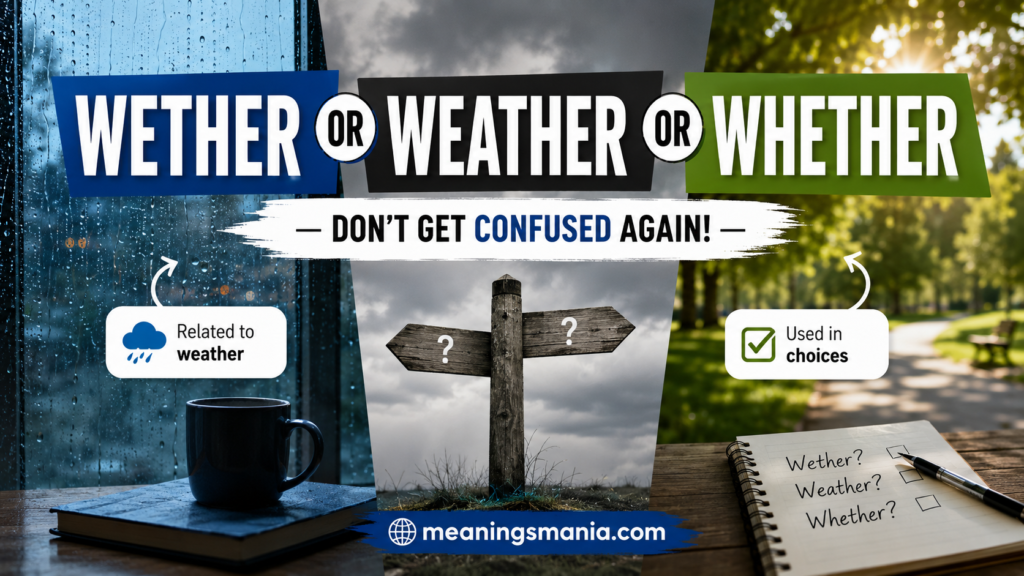
Wether, Weather, and Whether: The Quick Difference
Here’s the easiest way to separate them:
| Word | Meaning | Common Use | Example |
| Wether | A castrated male sheep | Farming and livestock | The wether stayed with the flock. |
| Weather | Conditions in the atmosphere | Rain, wind, temperature, storms | The weather is sunny today. |
| Whether | A choice, possibility, or uncertainty | Decisions and alternatives | I don’t know whether to go. |
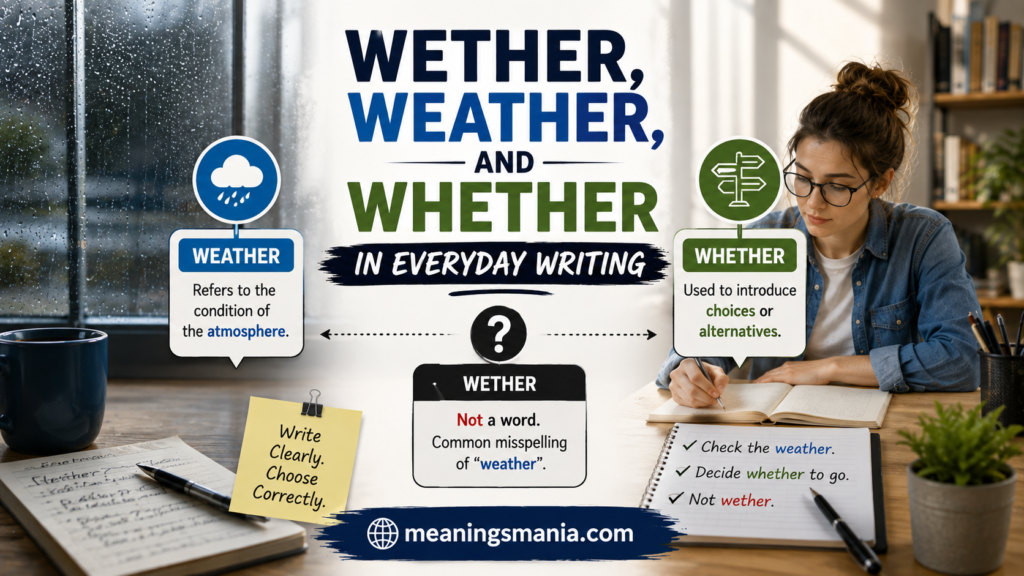
The trick is to focus on meaning rather than spelling. If you’re talking about rain or temperature, choose weather. If you’re discussing a decision, whether is probably the word you need. If you’re talking about a particular type of sheep, use wether.
A simple way to remember all three
Ask yourself one question: What am I talking about?
- Outside conditions → weather
- A choice or possibility → whether
- A male sheep → wether
That quick check works because each word belongs to a completely different context.
Weather Meaning: What Does “Weather” Mean?
Weather describes the atmospheric conditions at a particular place and time. It can include temperature, wind, rain, snow, clouds, humidity, sunshine, and storms.
For example, if you say, “The weather changed suddenly,” you’re talking about what’s happening outdoors. Weather can shift within minutes, hours, or days. That’s why people often check a forecast before traveling, exercising, or planning an event.
Weather as a noun
Most everyday uses of weather treat it as a noun. It names the conditions around us.
For example:
- The weather is beautiful today.
- We had terrible weather during our trip.
- Cold weather can make driving difficult.
- The weather forecast says rain is coming.
A useful mental shortcut is to picture yourself looking out a window. If you’re describing what you see in the sky or feel in the air, weather is likely correct.
Weather as a verb
Interestingly, weather can also function as a verb. In this form, it means to survive, endure, or get through something difficult.
For example:
- The company weathered a difficult financial year.
- The old building weathered several major storms.
- She weathered the criticism and kept working.
Here, the word has nothing to do with sunshine or rainfall. It describes someone’s ability to withstand a challenge.
Common types of weather
Weather can take many forms. Common examples include:
- Sunny weather
- Rainy weather
- Snowy weather
- Windy weather
- Cloudy weather
- Humid weather
- Stormy weather
- Hot or cold weather
These descriptions are useful in everyday conversations because they explain current atmospheric conditions.
Common expressions with “weather”
English uses weather in several familiar phrases.
Under the weather means feeling unwell.
I’m a little under the weather today.
A weather forecast is a prediction about upcoming atmospheric conditions.
Check the weather forecast before you leave.
A fair-weather friend is someone who stays close when everything is easy but disappears during difficult times.
A fair-weather friend won’t always support you when things get rough.
Whether Meaning: What Does “Whether” Mean?
Whether is used when you’re talking about uncertainty, alternatives, or a choice. It often appears when someone doesn’t know which possibility is true or what decision should be made.
For example:
I don’t know whether he’ll come.
The sentence presents uncertainty. You’re unsure if he will arrive.
You can also use whether when choosing between two actions:
She can’t decide whether to stay or leave.
Here, the word connects two possible choices.
When should you use “whether”?
Use whether when your sentence involves ideas such as:
- A decision
- Uncertainty
- Two possible outcomes
- Alternative choices
- Something that isn’t yet known
For example:
We need to decide whether the plan will work.
The sentence isn’t describing the weather. It’s discussing uncertainty about a result.
Whether when talking about choices
One common use involves making a decision.
Consider these examples:
- I don’t know whether to call him.
- She’s deciding whether to accept the offer.
- They haven’t chosen whether to travel by car or train.
In each sentence, someone faces a choice. That’s a strong signal that whether belongs there.
Whether for uncertainty or possibilities
You can also use Wether or Weather or Whether when you’re unsure about something.
For example:
We aren’t sure whether the store is open.
Or:
Nobody knows whether the package arrived.
The word connects the statement with an unknown possibility.
Whether with two or more alternatives
Whether often appears alongside or when a sentence presents alternatives.
Examples include:
- Whether you stay or leave, I’ll understand.
- We must decide whether to drive or take the train.
- I don’t know whether Monday or Tuesday works better.
The whether…or pattern makes the alternatives especially clear.
Using whether after prepositions
In more formal or careful English, whether commonly follows a preposition.
For example:
It depends on whether they agree.
Other examples include:
- We talked about whether the idea was practical.
- The decision rests on whether funding is available.
- It isn’t clear from the report whether the claim is accurate.
This is one reason whether can be preferable to if in formal writing.
Whether vs If: How Are They Different?
The difference between Wether or Weather or Whether can be tricky because the two words sometimes overlap.
For example:
I don’t know if she’ll come.
You can also say:
I don’t know whether she’ll come.
Both sentences are natural. However, they aren’t interchangeable in every grammatical situation.

When “if” can work
In everyday conversation, if often works when you’re simply expressing uncertainty.
For example:
I don’t know if he’s home.
This sounds perfectly normal in casual English.
You can also say:
I wonder if they received my message.
In many conversational situations, whether would also work.
When “whether” is the better choice
Whether becomes especially useful when you’re presenting alternatives or using certain sentence structures.
For example:
I can’t decide whether to stay.
You wouldn’t normally say:
I can’t decide if to stay.
The first sentence is the natural construction.
Whether before an infinitive
When whether comes before a verb with to, it’s the standard choice.
Examples:
- I don’t know whether to wait.
- She couldn’t decide whether to accept.
- We’re discussing whether to continue.
This pattern is worth remembering because it’s a common grammar point.
Whether with alternative possibilities
When alternatives are explicitly connected, Wether or Weather or Whether often fits naturally.
For example:
We need to decide whether to repair it or replace it.
Another example:
Whether we win or lose, we’ll learn something.
These sentences make the available possibilities clear.
Whether after a preposition
After a preposition, whether is generally preferred in standard formal English.
For example:
It depends on whether the weather improves.
Notice something interesting there: whether and weather can appear in the same sentence.
That makes the meaning easier to see:
- whether = the possibility being considered
- weather = atmospheric conditions
Whether vs if comparison
| Situation | Whether | If |
| General uncertainty | Yes | Often |
| Before “to” + verb | Yes | Usually no |
| With “or” alternatives | Yes | Usually less suitable |
| After a preposition | Preferred | Often avoided in formal writing |
| Casual conversation | Yes | Very common |
The safest approach is simple: when you’re presenting alternatives or using a structure where if sounds awkward, choose whether.
What Does “Wether” Actually Mean?
Wether or Weather or Whether is a real English word, although you probably won’t encounter it very often.
It refers to a castrated male sheep. The term mainly appears in farming, livestock management, agriculture, and older or specialized writing.
For example:
The farmer moved the wether into another pen.
If you’ve never worked around sheep, there’s a good chance you’ve rarely seen this word.
The original meaning of “wether”
A wether is specifically a male sheep that has been castrated. The word has a long history in English and remains part of agricultural vocabulary.
You might see it in discussions about:
- Sheep farming
- Livestock
- Animal care
- Agricultural records
- Meat production
It isn’t a common word in everyday conversation, which explains why it can look strange.
Why “wether” is often mistaken for a spelling error
There are three obvious reasons.
First, it sounds very similar to weather. Second, it looks almost identical to Wether or Weather or Whether. Third, most people rarely encounter it.
So if someone writes:
The wether is in the pasture.
You might initially think they made a spelling mistake. They didn’t. The sentence is talking about a male sheep.
Wether vs Weather vs Whether: Real Examples
Examples make the wether weather whether difference much easier to understand.
Compare these sentences:
- Weather: The weather turned cold overnight.
- Whether: I don’t know whether she’ll attend.
- Wether: The wether stayed near the barn.
Each sentence uses a different word because each sentence describes a different idea.
How context reveals the correct word
Look at the surrounding words instead of relying on pronunciation.
We checked the Wether or Weather or Whether before hiking.
The sentence mentions outdoor conditions.
We wondered whether the trail was open.
The sentence expresses uncertainty.
The farmer moved the wether into a separate pen.
The sentence discusses livestock.
Context usually gives you the answer quickly.
Easy Memory Tricks for Wether, Weather, and Whether
You don’t need a complicated grammar formula. A simple mental association can do most of the work.

Weather = conditions outside
Think about the sky.
Rain, sunshine, snow, wind, and temperature all point toward weather.
Try this:
Weather → outside conditions
Whether = a choice or possibility
Think about a decision.
If you’re wondering which possibility is true or which option to choose, think whether.
For example:
I can’t decide whether to order pizza.
That’s a choice, so whether fits.
Wether = a male sheep
This one is easiest to connect with livestock.
Wether → sheep
If the sentence involves a flock, pasture, farmer, or barn, consider Wether or Weather or Whether is the intended word.
The quick three-second test
When you’re stuck, ask:
Is it about the sky, a choice, or a sheep?
- Sky → weather
- Choice → whether
- Sheep → wether
It takes only a moment, but it can prevent a surprisingly common spelling mistake.
Common Mistakes With Wether, Weather, and Whether
These words create problems because pronunciation doesn’t give you much help. You need to identify the meaning first.
Using “weather” when you mean “whether”
This is probably the most common mistake.
Incorrect:
I don’t know weather she agreed.
Correct:
I don’t know whether she agreed.
The first version accidentally refers to atmospheric conditions. The second expresses uncertainty.
Assuming “wether” isn’t a real English word
It’s easy to think wether is simply a typo.
However, it has a specific meaning. If you’re reading about sheep or agriculture, the spelling may be completely correct.
Letting autocorrect choose the word
Spellcheck isn’t always smart enough to understand your intended meaning.
For example, weather is spelled correctly in:
I wonder weather they’ll come.
The problem isn’t spelling. It’s word choice.
That’s why context matters. A grammar tool can recognize valid words, but it may not always understand what you meant.
Why Wether, Weather, and Whether Sound So Similar
The pronunciation is a major part of the problem.
These words are commonly treated as homophones or near-homophones in many varieties of English. In other words, they can sound the same or extremely similar when spoken.
That creates a frustrating situation: you may hear the correct word but have no clue which spelling the speaker used.
The solution is to connect the sound with meaning.
If someone is discussing rain, they mean weather. If they’re discussing a decision, they probably mean whether. If they’re talking about sheep, wether may be correct.
Wether, Weather, and Whether in Everyday Writing
Knowing definitions is helpful, but seeing these words in realistic situations makes them easier to remember.
Examples in emails and messages
In an email, you might write:
Please let me know whether you can attend.
That’s a professional way to ask about a choice or possibility.
For casual texting, you could write:
Do you know whether they’re coming?
The same grammar works outside formal writing.
Examples in casual conversations
You might say:
The weather is perfect today.
Or:
I can’t decide whether to go out.
These examples show how different the meanings are, even though the words sound alike.
Examples in professional and business writing
Business writing frequently uses whether when discussing decisions.
For example:
The team will determine whether the proposal meets the requirements.
Meanwhile, weather may appear in travel, construction, shipping, agriculture, and outdoor industries.
Examples involving farming and animals
Wether belongs most naturally in agricultural contexts.
For example:
The farmer separated the wether from the younger sheep.
Here, wether isn’t interchangeable with either of the other words.
How One Spelling Change Can Alter a Sentence
Sometimes one incorrect letter creates an entirely different meaning.
Consider:
We don’t know whether the event will happen.
This means the event’s status is uncertain.
Now replace the word:
We don’t know weather the event will happen.
The second sentence contains the wrong word because weather refers to atmospheric conditions.
Here’s another example:
The weather delayed the flight.
That’s about rain, wind, storms, or other conditions.
If you wrote whether, the meaning would no longer work.
The lesson is simple: spelling isn’t just about appearance. The correct word needs to match the idea you’re expressing.
Test Yourself: Wether vs Weather vs Whether Quiz
Ready for a quick test? Fill in each blank before checking the answers.
Fill in the blanks
- I can’t decide ______ to accept the invitation.
- The ______ became colder after sunset.
- The farmer moved the ______ into another enclosure.
- We aren’t sure ______ the store is open.
- Bad ______ caused several travel delays.
- She wondered ______ she should call first.
- The ______ remained with the flock.
Answers explained
- whether — This sentence involves a decision.
- weather — It describes outdoor conditions.
- wether — The sentence refers to a male sheep.
- whether — The sentence expresses uncertainty.
- weather — Weather can cause travel problems.
- whether — The speaker is considering an option.
- wether — The sentence refers to livestock.
If you got them all right, you’ve already mastered the basic distinction.
A Quick Cheat Sheet for Fast Recall
When you need the answer quickly, use this simple guide:
| If you mean… | Use… | Remember |
| Rain, wind, temperature, or climate conditions | Weather | Outside |
| A choice, doubt, or possibility | Whether | Decision |
| A castrated male sheep | Wether | Livestock |
The key isn’t memorizing complicated grammar. It’s recognizing the context.
When Should You Use Wether, Weather, or Whether in a Sentence?
Start by identifying the subject of your sentence.
If you’re describing atmospheric conditions, use weather. If you’re introducing uncertainty or alternatives, use whether. If you’re talking about a specific type of male sheep, use Wether or Weather or Whether.
For example:
The weather looks terrible.
I don’t know whether we should leave.
The wether is standing beside the fence.
Once you connect each word with its meaning, the correct spelling becomes much easier to choose.
A simple rule for choosing the right spelling
Remember this three-word shortcut:
Weather = outside.
Whether = choice.
Wether = sheep.
If you can identify which category your sentence belongs to, you probably already know the answer.
Wether vs Weather vs Whether Examples You Can Learn From
Let’s put the three words together in a few practical examples.
- Weather: The weather was warm enough for a picnic.
- Whether: We’re deciding whether to have the picnic tomorrow.
- Wether: The wether remained near the grazing area.
You can also combine two words in one sentence:
We haven’t decided whether to travel because the weather looks unpredictable.
That sentence is useful because both words are correct, but they perform completely different jobs.
Short sentences that show each word clearly
Here are a few quick examples to remember:
Weather
- The weather is changing.
- Today’s weather is mild.
- The storm ruined the weather conditions for travel.
Whether
- I don’t know whether he’ll come.
- Tell me whether you’re ready.
- She can’t decide whether to stay.
Wether
- The wether joined the flock.
- The farmer inspected the wether.
- That wether is grazing near the fence.
How to Remember the Difference Between Weather and Whether Forever
The biggest mistake is trying to remember the spellings without remembering their meanings.
Instead, attach each word to an image in your mind.
Picture dark clouds when you see weather. Imagine someone choosing between two options when you see whether. Picture a sheep in a pasture when you see Wether or Weather or Whether.
Those mental connections are much stronger than memorizing letters alone.

A practical trick for avoiding spelling mistakes
Before submitting an email, article, assignment, or message, pause when you see one of these words.
Ask yourself:
Am I describing conditions, expressing a choice, or talking about a sheep?
That tiny pause can catch the mistake before spellcheck does.
FAQs
Is “wether” a real English word?
Yes, Wether or Weather or Whether is a real English word meaning a castrated male sheep, mainly used in farming and livestock contexts.
What is the difference between weather and whether?
Weather describes atmospheric conditions, while Wether or Weather or Whether introduces uncertainty, choices, alternatives, or possibilities in English sentences.
Can whether and if always be used interchangeably?
No, Wether or Weather or Whether is preferred before infinitives, with explicit alternatives, and after prepositions in careful formal English.
Why does wether sound like weather and whether?
These words sound extremely similar because English pronunciation often makes them homophones, despite their completely different meanings.
How can I remember whether versus weather?
Remember Wether or Weather or Whether for outside conditions and whether for choices, uncertainty, or deciding between possible outcomes.
What does wether mean in farming?
In farming, Wether or Weather or Whether refers specifically to a castrated male sheep and commonly appears in livestock-related discussions.
Why does spellcheck miss weather versus whether mistakes?
Spellcheck may miss them because Wether or Weather or Whether are all legitimate words with different meanings and uses.
Conclusion
Now you know the real difference between Wether’ or ‘Weather’ or ‘Whether. These words may look alike, but their meanings are far apart. Weather describes conditions outside, while whether shows a choice or uncertainty. Wether refers to a castrated male sheep.
When you’re unsure about weather or whether, focus on the meaning first. Ask what the sentence actually describes. The weather vs whether choice becomes easier when you connect each word with its purpose. If you’re talking about a decision, whether or weather, choose whether. If you’re discussing rain, temperature, or storms, choose weather.
Finally, remember whether or wether by checking the context. The wether meaning is tied to sheep, and its wether definition is simple. Still wondering how to spell wether? Just remember its unusual meaning. With these quick tricks, you’ll make fewer mistakes and write with confidence clearly.
