


Have you ever typed “Carmel or Caramel” and suddenly wondered which spelling is right? It’s an easy mix-up because the words look and sound surprisingly close. However, they usually refer to completely different things. If you’re talking about a sweet made by heating sugar, Carmel or Caramel is the word you need. Carmel, on the other hand, is commonly used as a name or place name.
The confusion becomes even more understandable when you hear people pronounce caramel in different ways. Some speakers use three syllables, while others use a shorter pronunciation that can sound very close to “Carmel.” That’s why caramel vs carmel can feel confusing, even when you know the basic rule.
In this guide, you’ll learn the difference without complicated grammar terms. We’ll look at spelling, meaning, pronunciation, American English usage, common mistakes, and everyday examples. By the end, you’ll know exactly when to write Carmel and when to choose caramel.
Carmel or Caramel: Which Word Are You Looking For?
The right choice depends on what you’re trying to describe. Caramel is the food-related word, while Carmel or Caramel is generally a proper name.
Think about the context first:
- Caramel → a sweet substance, flavor, candy, sauce, or dessert ingredient.
- Carmel → a place name, personal name, or other proper noun.
- Caramel is normally lowercase unless it begins a sentence.
- Carmel is capitalized when it functions as a proper name.
For example, you might write, “I added caramel sauce to my coffee.” But you could also say, “We spent the weekend in Carmel.”
That simple context check can solve most Carmel or Caramel questions immediately.
Quick Answer: Carmel or Caramel?
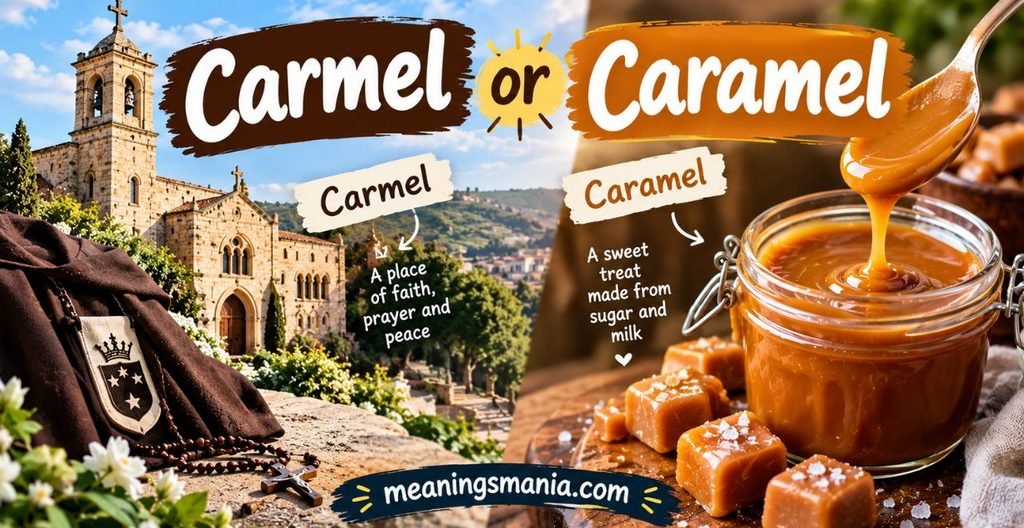
If you mean the sweet food made by heating sugar, the correct spelling is caramel.
If you’re referring to a location or person named Carmel, use Carmel.
Here’s the quickest way to remember it:
| If you mean… | Use… |
| Sweet sauce | caramel |
| Candy or dessert flavor | caramel |
| Sugar-based confection | caramel |
| A city or town named Carmel | Carmel |
| A person named Carmel | Carmel |
| A geographic or religious place name | Carmel |
So, “caramel ice cream” is correct when discussing the flavor. Writing “Carmel ice cream” would normally suggest a name rather than the sweet ingredient.
What Does Caramel Mean?
Caramel is a sweet food substance produced when sugar is heated and changes chemically. It develops a characteristic brown color, rich flavor, and smooth or chewy texture depending on how it’s prepared.
You’ll see the word in many food-related situations. For example, caramel can appear in:
- Ice cream
- Candy
- Cakes
- Cookies
- Coffee drinks
- Dessert toppings
- Sweet sauces
- Puddings
You may also hear Carmel or Caramel used to describe a flavor or color. For instance, someone might describe a drink as having a caramel flavor, or a fabric as having a caramel-colored shade.
The important point is that caramel meaning is connected to a sweet food, flavor, ingredient, or related description—not the name Carmel.
What Does Carmel Mean?
Carmel is generally a proper noun. That means it can identify something specific rather than describing a general object.
You might encounter Carmel as:
- A city or town name
- A person’s name
- A geographic name
- A religious or biblical reference
For example, Carmel-by-the-Sea is a well-known California community. Mount Carmel is another important geographic name with biblical and historical associations.
Because Carmel can be a proper noun, capitalization matters. If you’re writing about a specific place called Carmel, use the capital C.
So, asking “is carmel a word?” has a simple answer: yes. It is a legitimate name and appears in established place names and personal names. It simply isn’t the standard spelling for the sweet food.
Carmel vs Caramel: What’s the Difference?
The main carmel vs caramel difference comes down to meaning and context.
Caramel refers to the sweet substance or flavor. Carmel generally identifies a particular person, place, or named thing. Although their pronunciation can overlap in some varieties of English, their written forms aren’t interchangeable.
Caramel
Use caramel when you’re discussing food, flavor, color, or a product made with caramel.
Examples include:
- “This coffee has caramel syrup.”
- “She bought caramel candies.”
- “The dessert has a caramel topping.”
- “I love caramel-flavored popcorn.”
The spelling contains an extra a after the initial “car.”
Carmel
Use Carmel when the word functions as a proper name.
For example:
- “They moved to Carmel.”
- “Carmel is a popular place name.”
- “She named her daughter Carmel.”
- “Mount Carmel appears in biblical references.”
In these examples, Carmel isn’t describing a sugary ingredient. It identifies something specific.
Carmel vs Caramel: Easy Comparison Table
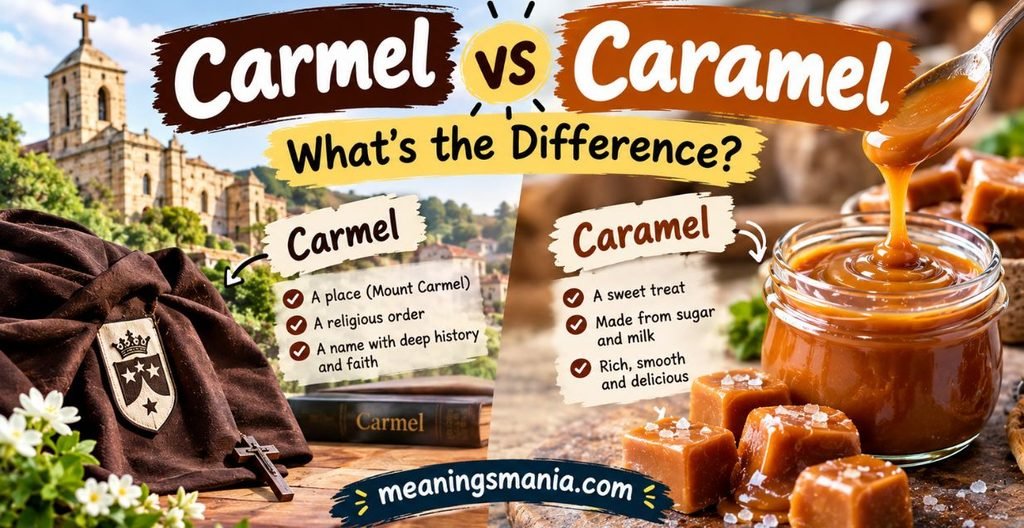
A side-by-side comparison makes the distinction much easier to remember.
| Feature | Caramel | Carmel |
| Basic meaning | Sweet substance or flavor | Name or proper noun |
| Common category | Food-related word | Place or personal name |
| Typical capitalization | Lowercase | Capitalized |
| Common examples | Caramel sauce, caramel candy | Carmel, California |
| Used for desserts? | Yes | No, unless part of a specific name |
| Can describe flavor? | Yes | Generally no |
| Extra “a” | Yes | No |
A useful shortcut is to ask yourself one question: Am I talking about food or a name? That usually gives you the answer immediately.
Why Do People Confuse Carmel and Caramel?
The spelling difference is small, but pronunciation makes things trickier. Depending on the speaker and regional variety, caramel may be pronounced with two or three syllables.
When someone uses a shorter pronunciation, it can sound very similar to Carmel or Caramel. That similarity often carries over into informal writing, especially online.
Different Pronunciations
There isn’t just one pronunciation pattern for caramel across all English speakers. Some people clearly pronounce the middle vowel, while others use a shorter form.
That’s why you might hear the food word pronounced in a way that sounds close to “Carmel.” The spoken similarity doesn’t mean the spellings are interchangeable.
If you’re writing rather than speaking, focus on the meaning. If it’s a sugary food, write caramel.
Similar Spelling Patterns
The words differ by only one letter, which makes typing errors easy.
For example, someone might quickly type:
“I want a carmel latte.”
The intended meaning is obvious, but the standard spelling for the flavor is caramel.
This is especially common in casual messages, social posts, menus, and search queries. A similar sound can make an incorrect spelling feel natural.
When Should You Use Carmel or Caramel?
The easiest way to choose correctly is to identify the thing you’re naming.
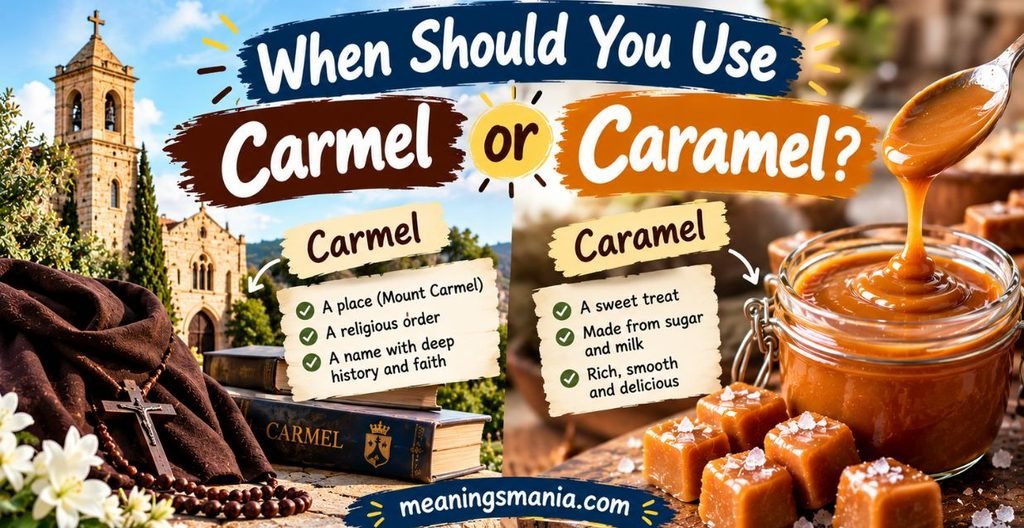
If you’re describing something sweet, caramel is almost certainly the word you want. If you’re identifying a specific place, person, or other named entity, Carmel may be correct.
Use “Caramel” When Referring to Food
Choose caramel for food and flavor-related contexts.
For example:
- “Can I get a caramel latte?”
- “The caramel sauce tastes amazing.”
- “She ordered caramel ice cream.”
- “These caramel candies are homemade.”
- “The cake has a caramel filling.”
The same spelling also works when caramel describes a flavor or related color.
Use “Carmel” When Referring to a Place or Name
Choose Carmel when you’re referring to a specific name.
For example:
- “We’re visiting Carmel this summer.”
- “She lives near Carmel.”
- “Mount Carmel has historical significance.”
- “Carmel is her first name.”
Because these uses identify something specific, the capital letter is important.
Common Carmel and Caramel Mistakes to Avoid
Most mistakes happen because people rely on sound instead of meaning. Once you separate the two concepts, these errors become much easier to spot.
Mistake 1: Using “Carmel” for the Sweet Food
A common error is leaving out the second “a” in food-related writing.
Incorrect:
Correct:
“I ordered a caramel latte.”
The same rule applies to caramel candy, caramel sauce, caramel apples, and similar foods.
Mistake 2: Confusing a Place Name With the Food
The reverse mistake can happen, too. Someone may see the familiar food word and use caramel when discussing a location.
If you’re writing about a place called Carmel, preserve its proper name:
“We stayed in Carmel during our California trip.”
Don’t change the spelling simply because caramel is more familiar.
Mistake 3: Assuming Both Spellings Mean the Same Thing
They don’t simply represent two acceptable spellings of one word.
Caramel and Carmel can sound similar in speech, but their meanings and grammatical roles differ. Treating them as interchangeable can make a sentence unclear or incorrect.
Carmel vs Caramel in Everyday Sentences
Real examples make word differences much easier to remember. Notice how the surrounding context tells you which spelling belongs.
Example 1: Ordering a Caramel Coffee
“Could I get a caramel latte with oat milk?”
Here, caramel describes the flavor of the drink.
Example 2: Talking About Carmel, California
“We visited Carmel during our trip along the California coast.”
Here, Carmel is part of a geographic name, so the capital letter is necessary.
Example 3: Writing a Social Media Caption
“This caramel dessert deserves its own appreciation post!”
Because the caption discusses food, caramel is correct.
Example 4: Using the Words in School Writing
“The recipe calls for caramel sauce.”
This is also a food-related use, so the spelling includes the extra a.
For schoolwork, professional writing, or published content, it’s especially important to choose the standard spelling rather than writing based on how the word sounds.
Carmel or Caramel: A Simple Lesson for Beginners
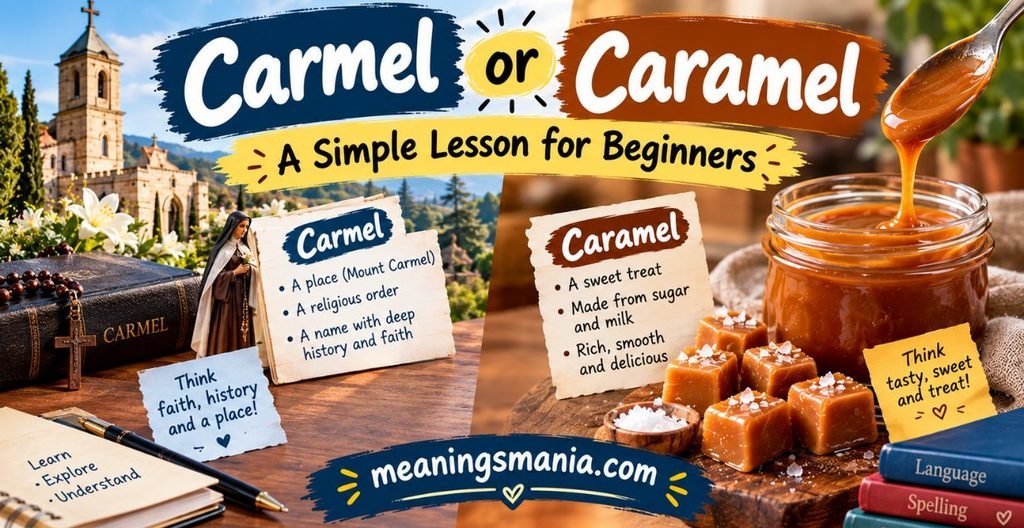
You don’t need to memorize a complicated grammar rule here. Just connect each spelling with its main meaning.
Caramel belongs with food and flavor. Carmel usually belongs with names.
Once you’ve made that mental connection, the spelling becomes much easier.
Vocabulary to Remember
A few basic language terms can help:
- Common noun: A general word for a person, place, thing, or idea.
- Proper noun: A specific name that normally begins with a capital letter.
- Pronunciation: The way a word is spoken.
- Context: The surrounding information that helps explain meaning.
- Flavor: The particular taste associated with food or drinks.
In this comparison, caramel commonly works as a common noun, while Carmel often functions as a proper noun.
Practice Questions
Try these quick examples:
- “I bought ___ popcorn.” → caramel
- “We traveled to ___.” → Carmel, if that’s the location being named.
- “She poured ___ sauce over the cake.” → caramel
- “___ is a place name.” → Carmel
- “He ordered a ___ macchiato.” → caramel
The trick isn’t memorizing every sentence. It’s recognizing whether you’re discussing a sweet food or a specific name.
Easy Memory Trick
Here’s a simple way to remember the spelling:
Caramel = food. Carmel = name.
When you’re thinking about candy, coffee, sauce, ice cream, or dessert, look for caramel.
When you’re thinking about a city, geographic location, or person’s name, check whether Carmel is the proper name.
That small mental shortcut can save you from repeatedly second-guessing the spelling.
Carmel vs Caramel Pronunciation: How Are They Said?
Pronunciation is one reason this pair causes so much confusion. English speakers don’t always pronounce caramel exactly the same way.
Some speakers use a pronunciation with three syllables. Others use a shorter pronunciation. Depending on the accent, the shorter version can sound remarkably close to Carmel.
However, pronunciation doesn’t change the standard spelling when you’re writing. If you’re talking about the sweet ingredient, the written form remains caramel.
Why “Caramel” Has More Than One Common Pronunciation
English has many words whose pronunciation varies by region. Caramel is one of them.
You may hear speakers pronounce the word differently while still meaning exactly the same sweet food. This is a pronunciation difference, not a difference in meaning.
So if someone says caramel in a way that sounds like Carmel, don’t assume they’ve changed the spelling. Listen to the context.
Is Carmel a Correct Spelling of Caramel?
No—not when you’re using the word to mean the sweet food.
The standard food-related spelling is caramel. Carmel is correct when it represents a proper name or established place name.
This distinction explains why you might see both spellings in everyday life. They aren’t competing spellings for the same food. They’re different words that happen to look and sound similar.
When “Carmel” Is Correct and When It Is Not
Use Carmel when the word is part of a specific name.
Use caramel when you’re referring to the sweet substance, flavor, or related food product.
Compare these:
- “I love caramel cheesecake.” ✅
- “I visited Carmel last year.” ✅
- “She bought caramel sauce.” ✅
- “We stayed in Carmel.” ✅
The surrounding context tells you which form belongs.
Caramel vs Carmel in American English: Examples and Usage Tips
In American English, you’ll encounter both words frequently, but in very different situations. Caramel appears constantly in food, beverages, recipes, and dessert descriptions. Carmel appears mainly in proper names and geographic references.
This distinction matters when you’re writing online, preparing schoolwork, creating menus, or publishing content. A single missing letter can change the intended word.
How to Choose the Right Word Without Second-Guessing Yourself
Before writing either word, pause and ask:
“Am I talking about something sweet, or am I naming something?”
If it’s sweet, choose caramel. If it’s a specific name, check for Carmel.
For example, “caramel coffee” describes a flavor, while “Carmel, California” identifies a place. Once you connect the spelling with the context, the Carmel or Caramel question becomes much easier.

Frequently Asked Questions
What is the main difference between Carmel and caramel?
Caramel describes a sweet food or flavor, while Carmel generally refers to a person, place, or proper name.
Is “Carmel” ever correct when talking about food?
Usually no; when you mean the sweet ingredient or flavor, the correct spelling is caramel, not Carmel.
Why does caramel sometimes sound like Carmel?
Some English speakers use a shorter pronunciation of caramel, making it sound similar to Carmel in casual conversation.
Is Carmel a real word or just a misspelling?
Carmel is a legitimate proper name used for people, places, geographic features, and religious references.
Should Carmel always have a capital letter?
When Carmel functions as a proper noun, such as a place or personal name, it should be capitalized.
How can I remember the spelling of caramel?
Think of caramel whenever you’re discussing sugar, desserts, candy, sauces, coffee flavors, or other sweet foods.
Which spelling should I use in American English?
Use caramel for the sweet food or flavor and Carmel for a specific name or place in American English.
Final Takeaway: Carmel or Caramel?
The Carmel or Caramel question is much easier once you focus on meaning instead of sound.
Caramel is the spelling you want for the sweet food, flavor, sauce, candy, or dessert ingredient. Carmel is generally used for a proper name, such as a person, place, or geographic reference.
The pronunciation can make these words sound surprisingly similar, especially in casual American English. Still, their written meanings remain distinct. When you’re unsure, look at the context: food means caramel; a specific name means Carmel. That simple rule will help you choose the right spelling with confidence.
