


What does eta meaning actually tell you? If you’ve seen “ETA?” in a text, you’re probably being asked when you’ll arrive. It’s a simple abbreviation, but its meaning can change slightly depending on the conversation. Understanding it makes texting much easier and clearer.
You may also come across unfamiliar terms while searching online. For example, you might wonder about rls meaning, what is a simile, or look for similes examples. These phrases show how quickly language changes across texts, social media, and everyday conversations. ETA meaning is one of those useful shortcuts you’ll see often.
In this guide, we’ll explain the eta meaning in plain English. You’ll learn what ETA stands for, how people use it, and what it means in different situations. We’ll also briefly explain hyb meaning in text, so you won’t feel lost when another unfamiliar abbreviation pops up during a chat.
Quick Answer to the ETA Meaning in Text
ETA usually means “Estimated Time of Arrival.” It describes when a person, vehicle, package, or other item is expected to arrive.
For example:
“What’s your ETA?”
This simply means:
“About when will you arrive?”
The key word is estimated. An ETA is generally an approximation, not a guaranteed or exact time.
What Does ETA Mean in Text?
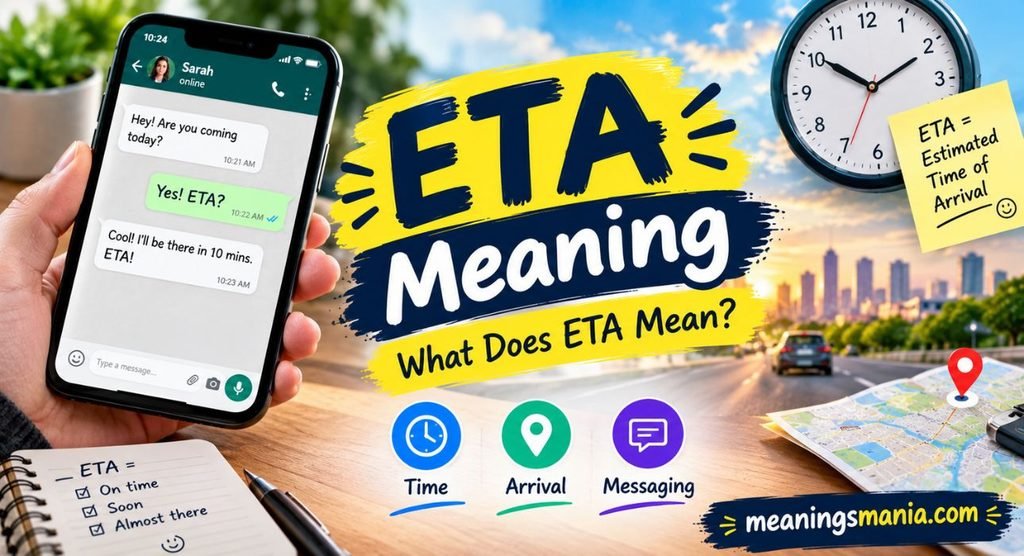
The most common ETA meaning in text is Estimated Time of Arrival. People use the abbreviation when they want a quick update about someone’s expected arrival.
You might receive a message like:
“What’s your ETA?”
You could reply:
“About 15 minutes.”
Or:
“I should be there around 7:30.”
ETA meaning can also describe the expected arrival of things. For instance, a customer might ask about a package’s ETA or a friend might ask about a rideshare driver’s arrival.
Examples of ETA in Text Messages
Here are a few natural examples:
- “What’s your ETA?” — When do you expect to arrive?
- “My ETA is 20 minutes.” — I expect to arrive in about 20 minutes.
- “ETA around 6 PM.” — The expected arrival is around 6 PM.
- “Do you have an ETA for the delivery?” — When is the delivery expected?
- “Any ETA on the update?” — When is the update expected?
Notice that the exact meaning depends on what’s being discussed.
ETA Full Form and Definition
The ETA full form is Estimated Time of Arrival.
Each word gives you part of the meaning:
- Estimated means roughly calculated or expected.
- Time refers to a particular point or period.
- Arrival means reaching a destination.
Put together, ETA means the expected time when someone or something will arrive.
For example, if a navigation app says your ETA is 6:45 PM, it means the system expects you to reach your destination around that time. Traffic or other delays can change that estimate.
ETA Meaning in Different Contexts
ETA meaning isn’t limited to one type of conversation. You can encounter it in everyday texts, workplace communication, delivery updates, and online discussions.
The basic idea stays the same: someone wants to know when something is expected.
1. ETA in Texting
In casual texting, ETA usually relates to someone’s arrival.
For example:
“Hey, what’s your ETA?”
A natural answer might be:
“About 10 minutes. Traffic’s moving slowly.”
The abbreviation saves time and keeps the message easy to understand.
2. ETA on Social Media
ETA can appear on social media when users ask about the expected timing of something.
For example:
“Any ETA for the next episode?”
Here, ETA doesn’t mean a person is physically arriving. The person wants to know when the episode is expected to become available.
Similarly, someone might ask:
“Do we have an ETA for the event announcement?”
The context makes the intended meaning clear.
3. ETA for Deliveries
Businesses, drivers, customers, and delivery services commonly use ETA when discussing packages, meals, or other orders.
For example:
“The driver’s ETA is 5:40 PM.”
That means the driver is expected to arrive around 5:40 PM.
Delivery ETAs can change because of traffic, weather, order volume, or other unexpected delays. So it’s best to treat an ETA as an estimate rather than a promise.
4. ETA at Work
At work, ETA meaning can refer to the expected completion time for a task or project.
For example:
“What’s the ETA for the report?”
The manager isn’t necessarily asking when an employee will physically arrive. They’re asking when the report should be finished.
A response could be:
“I should have it ready by Thursday afternoon.”
In professional communication, context matters because ETA can describe either arrival or completion.
Is ETA Rude, Offensive, or Neutral?
ETA is generally neutral. The abbreviation itself isn’t rude or offensive.
However, the way you phrase the message can affect how it sounds.
Compare these:
- “ETA?” — Very brief and casual.
- “What’s your ETA?” — Direct and neutral.
- “Hey, do you know your ETA?” — Friendly and casual.
- “Could you share your estimated arrival time?” — More formal.
- “Give me an ETA.” — Direct and potentially demanding.
So, if a message feels impatient, the problem usually comes from the wording or situation rather than ETA itself.
Where Is ETA Commonly Used?
You can encounter ETA meaning in many types of communication, including:
- Text messages
- Group chats
- Workplace messages
- Emails
- Delivery updates
- Travel conversations
- Transportation apps
- Customer service
- Social media
- Online communities
- Gaming chats
It’s especially useful when timing matters and everyone already understands the context.
Real-Life Conversation Examples
Seeing ETA in actual conversations makes the meaning much easier to understand.
ETA in a Friendly Conversation
Alex: “Are you still coming over?”
Sam: “Yep! My ETA is about 20 minutes.”
Here, Sam is giving Alex an approximate arrival time.
ETA in a Casual Conversation
Friend: “What’s your ETA?”
You: “Probably around 8.”
This is a common, informal use of the abbreviation.
ETA in a Work Conversation
Manager: “What’s the ETA for the presentation?”
Employee: “I’ll have the final version ready by 3 PM.”
Here, ETA meaning refers to the expected completion time.
ETA in a Delivery Conversation
Customer: “Do you know the delivery ETA?”
Support: “It should arrive around 6 PM.”
The customer wants an estimated arrival time for the order.
ETA in a Travel Conversation
Driver: “Traffic’s heavy, so my ETA is 9:15.”
The driver is explaining when they expect to reach their destination.
ETA in an Argument or Tense Conversation
Person A: “You said you’d be here at 7.”
Person B: “I know. My ETA changed because of traffic.”
ETA remains a neutral abbreviation here. The disagreement comes from the circumstances and tone surrounding it.
Emotional and Psychological Meaning of ETA
ETA doesn’t normally carry a hidden emotional meaning. It’s mainly a practical abbreviation used to communicate timing.
Still, the way someone asks for an ETA can suggest impatience, friendliness, urgency, or concern.
For example, “ETA?” may feel abrupt because it’s so short. Meanwhile, “Hey, do you have an ETA?” sounds softer and more conversational.
Punctuation, timing, and your relationship with the other person can all influence how the message feels. The abbreviation itself doesn’t automatically express an emotion.

Origin and Background of ETA
ETA meaning comes from the phrase Estimated Time of Arrival. The abbreviation has long been useful in transportation and scheduling because people often need to communicate expected arrival times quickly.
It became especially practical in areas such as transportation, shipping, aviation, and logistics. Over time, people began using it outside those settings.
Today, you don’t need to work in transportation to understand or use ETA. It’s common in everyday texts, workplace chats, delivery updates, and online conversations.
Does ETA Always Mean Estimated Time of Arrival?
No abbreviation can be interpreted correctly without considering context. However, Estimated Time of Arrival is the standard meaning of ETA in ordinary texting.
If someone writes:
“What’s your ETA?”
they almost certainly want to know when you expect to arrive.
In another context, an abbreviation could have a different specialized meaning. When you’re unsure, look at the surrounding conversation before deciding what the person intended.
ETA Meaning Slang: Is ETA Really Slang?
People often search for ETA meaning slang, but ETA is more accurately described as an abbreviation or initialism.
It can certainly appear in casual conversations, but that doesn’t automatically make it slang. ETA is also widely used in professional communication.
For example:
“What’s the ETA on the report?”
A coworker might use this in a workplace chat. The wording is informal, but ETA itself isn’t traditional slang.
That’s different from expressions created mainly for casual or informal speech.
ETA vs. Similar Terms
Several abbreviations deal with time, schedules, or deadlines. They’re easy to mix up, especially when you’re new to workplace or online shorthand.
| Term | Meaning | What It Usually Describes |
| ETA | Estimated Time of Arrival | Expected arrival |
| ETD | Estimated Time of Departure | Expected departure |
| ASAP | As Soon As Possible | A request for quick action |
| EOD | End of Day | A daily deadline |
| TBD | To Be Determined | Something not decided yet |
Knowing these distinctions helps prevent misunderstandings.
ETA vs. ETD
ETA and ETD are closely related, but they describe opposite parts of a journey.
- ETA = Estimated Time of Arrival
- ETD = Estimated Time of Departure
For example:
“The flight’s ETD is 6 PM, and its ETA is 9 PM.”
The first time describes when the flight is expected to leave. The second describes when it should arrive.
When Should You Use ETA?
ETA meaning works well when the person reading your message is likely to understand the abbreviation.
You can use it when:
- Asking when someone will arrive
- Giving an approximate arrival time
- Discussing deliveries
- Talking about transportation
- Discussing travel plans
- Asking when a task may be completed
- Communicating quickly with coworkers
It’s especially convenient when everyone involved already understands the subject.
When Should You Avoid ETA?
You may want to avoid unexplained abbreviations when writing for a broad or unfamiliar audience.
For example, a formal document might be clearer if you write “Estimated Time of Arrival” instead of ETA the first time.
Once you’ve established the full phrase, using the abbreviation afterward can make the writing shorter and easier to scan.
Polite Alternatives to “What’s Your ETA?”
Sometimes you want to ask for an arrival time without sounding too brief.
Try one of these:
- “About what time will you arrive?”
- “When do you expect to get here?”
- “Do you have an estimated arrival time?”
- “Could you let me know when you’ll arrive?”
- “Roughly when should I expect you?”
- “Do you have an idea of when you’ll be here?”
These alternatives can work better in professional conversations or when you’re speaking with someone unfamiliar with abbreviations.
Why Do People Use ETA in Text Messages?
People use ETA meaning because it’s quick, familiar, and convenient.
Instead of writing:
“What time do you expect to arrive?”
you can simply write:
“What’s your ETA?”
That’s particularly helpful when someone is driving, traveling, working, or handling several things at once.
ETA also works well in group chats because it communicates the basic question without adding unnecessary words.

How ETA Affects Everyday Communication
ETA can make conversations more efficient. A short message can quickly establish when someone or something is expected.
However, estimates aren’t guarantees. If circumstances change, the original ETA may no longer be accurate.
For clearer communication, you can give a little extra information:
“My ETA is about 20 minutes, but traffic is getting worse.”
That response gives the other person both a time estimate and useful context.
Is ETA Safe to Use on Social Media?
Yes. ETA is generally harmless and appropriate for social media.
It’s a common timing abbreviation and doesn’t inherently contain offensive or inappropriate language.
For example:
“Any ETA on the new update?”
or:
“What’s the ETA for tonight’s event?”
The reader can usually determine the intended meaning from the surrounding post or conversation.
Common Misunderstandings About ETA
Even though ETA is simple, people sometimes interpret it incorrectly.
Misunderstanding 1: ETA Means an Exact Time
ETA doesn’t guarantee an exact arrival time.
The word estimated signals that the time is approximate. Traffic, weather, delays, or other circumstances can change the expected arrival.
Misunderstanding 2: ETA Only Refers to People
ETA can describe more than a person’s arrival.
It can apply to:
- Cars
- Flights
- Trains
- Packages
- Food deliveries
- Drivers
- Tasks
- Projects
The context tells you what’s expected to arrive or be completed.
Misunderstanding 3: ETA Is Always Slang
ETA isn’t necessarily slang.
It’s better classified as an abbreviation or initialism. You’ll find it in casual texting as well as professional communication.
Variations and Types of ETA Usage
ETA can appear in several forms depending on what you’re trying to say.
As a question:
“ETA?”
As a direct question:
“What’s your ETA?”
As an estimate:
“My ETA is 15 minutes.”
As a time update:
“ETA 6:30 PM.”
For a project or update:
“Any ETA on the new version?”
The wording changes, but the central idea remains an expected time.
How to Respond When Someone Uses ETA
If someone asks “What’s your ETA?”, you don’t need a complicated answer.
You can give an approximate time:
- “About 10 minutes.”
- “Around 6 PM.”
- “Probably half an hour.”
- “I should be there by 8.”
- “Roughly 20 minutes.”
If you’re unsure, be honest:
“I’m not sure yet, but I’ll update you when I know.”
That’s often better than giving a time you’re unlikely to meet.
Regional and Cultural Usage
ETA is widely recognized in English-language communication, including casual and professional settings.
However, communication habits can vary. Some people may use the abbreviation constantly, while others may prefer the full phrase, especially in formal writing.
In international conversations, context can be especially helpful. If you’re unsure whether someone understands ETA, simply use “estimated arrival time” instead.
What Does ETA Mean in a Text From a Friend?
When a friend texts “What’s your ETA?”, they’re usually asking when you’ll arrive.
For example:
Friend: “Are you close?”
You: “Yeah, my ETA is about 15 minutes.”
The message isn’t necessarily formal. In a friendly conversation, ETA is simply a convenient shortcut for asking about arrival time.
How to Understand ETA When Someone Asks for Your Arrival Time
Think of ETA as asking for an approximate arrival time, not a guaranteed appointment time.
If you’re running late, it’s helpful to update the person:
“Traffic’s bad. My ETA changed to around 7:30.”
That gives them a more realistic expectation.
Can ETA Mean Something Different in Online Chats?
Yes, context can change what ETA refers to. However, in ordinary online conversations, Estimated Time of Arrival remains the most common interpretation.
For example, someone might ask about an ETA for a new feature, event, video, or update. In that situation, they’re asking when something is expected to become available.
ETA Meaning in Comments, Group Chats, and Social Media Posts
Online, ETA often appears as a quick question:
“Any ETA on the next update?”
“What’s the ETA for the livestream?”
“ETA for the delivery?”
The subject changes, but the underlying idea is the same: the person wants an expected time.
How to Use ETA Correctly in a Text Message
Use ETA when the context makes its meaning obvious. You can use it to ask for an expected arrival time or provide one yourself.
For example:
“What’s your ETA?”
or:
“My ETA is around 6:45.”
If the situation is more formal, consider writing the full phrase instead. Clear communication matters more than using an abbreviation.

Examples of Natural Ways to Ask for Someone’s ETA
Here are several options based on tone:
Casual:
“What’s your ETA?”
Friendly:
“Hey, do you know roughly when you’ll be here?”
Professional:
“Could you share your estimated arrival time?”
Very direct:
“ETA?”
Choose the version that fits your relationship and the situation.
FAQ’s
What does ETA mean in text?
ETA usually means Estimated Time of Arrival, or the approximate time someone or something is expected to arrive.
What does ETA stand for?
ETA stands for Estimated Time of Arrival, a common abbreviation used for expected arrival times.
What is the ETA meaning in texting?
In texting, ETA usually asks when someone expects to arrive, such as when a friend says, “What’s your ETA?”
Is ETA a slang word?
ETA meaning is better described as an abbreviation or initialism, although people frequently use it in casual texting and online conversations.
Is ETA rude?
No, ETA isn’t inherently rude. A very short message like “ETA?” can sound impatient depending on tone and circumstances.
Can ETA refer to a project?
Yes. In workplace communication, ETA can describe when a project, report, update, or task is expected to be completed.
What does “my ETA is 20 minutes” mean?
It means the speaker expects to arrive in approximately 20 minutes, although delays could change that estimate.
Conclusion
Understanding internet slang and language terms becomes much easier when you focus on context. The eta meaning can differ depending on where you see it, while rls meaning may also change by conversation. Learning these terms helps you understand messages without second-guessing what someone intended.
Language also becomes more interesting when you learn simple literary ideas. If you’ve wondered what is a simile, the answer is straightforward: it compares two things using words such as “like” or “as.” Reading similes examples can make this concept easier to recognize and use naturally in your own writing.
Overall, knowing terms like hyb meaning in text, eta meaning, and rls meaning can improve everyday communication. These ETA meaning may seem confusing at first, but context usually provides the missing clue. Keep learning, stay curious, and don’t hesitate to check unfamiliar words when they appear.
