
Tomorrow is one of those simple words that can cause surprising spelling trouble. If you’ve searched for Tomorrow vs Tommorow, you’re probably wondering which version is correct. The answer is simple: tomorrow is the standard spelling. The extra “m” in Tomorrow vs Tommorow makes it a common mistake. It can happen when you type quickly or remember the word incorrectly. Don’t worry, though. This guide will make the difference easy to remember.
Spelling mistakes often happen with words that sound familiar. The same thing can happen with humerous, lended, or spell tieing. Some forms look right at first glance but aren’t standard English. Others need a different spelling depending on the context. Learning these small differences can make your writing cleaner and more confident.
In this guide, we’ll focus on Tomorrow vs Tommorow and explain why one spelling works. You’ll also see simple examples that show how to use tomorrow naturally. Plus, we’ll cover totalling or totaling and other tricky spellings. By the end, you’ll have an easy way to remember the correct form without second-guessing yourself.
Quick Answer: Tomorrow or Tommorow?
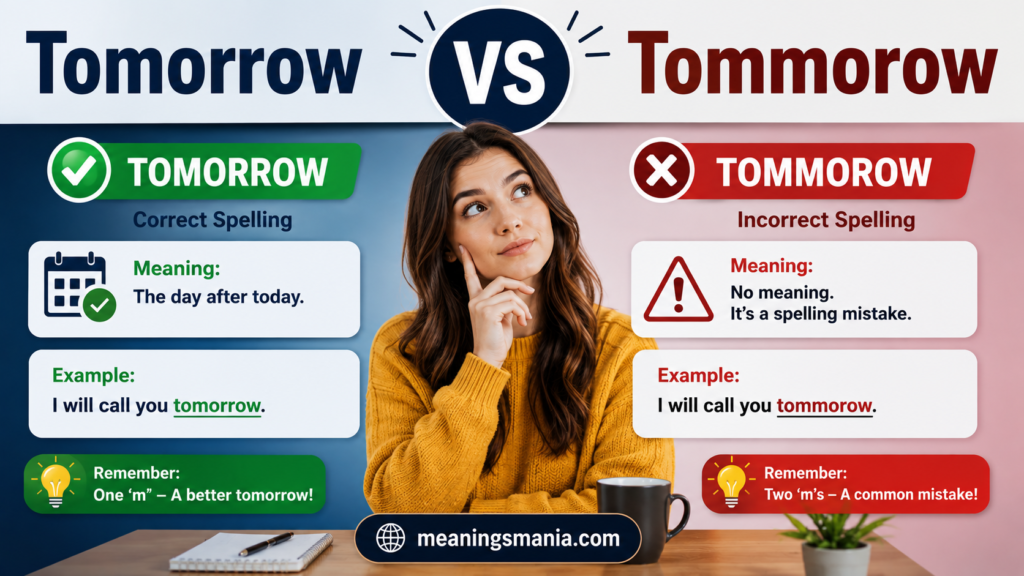
Tomorrow is the correct spelling. Tommorow is incorrect in standard English.
The word tomorrow refers mainly to the day that comes after today. It can also describe a future time more generally.
For example:
- Correct: I’ll call you tomorrow.
- Incorrect: I’ll call you tommorow.
- Correct: Tomorrow is my first day at work.
- Incorrect: Tommorow is my first day at work.
The key spelling rule is simple: tomorrow has one M and two R’s.
Which Is Correct, Tomorrow or Tommorow?
The correct form is tomorrow, spelled:
T-O-M-O-R-R-O-W
The version Tomorrow vs Tommorow contains an extra M, so it doesn’t follow standard English spelling.
This is a spelling issue, not a difference in meaning. If someone writes tommorow, most readers will understand what they mean. However, the mistake can make formal or professional writing look less polished.
Tomorrow vs. Tommorow at a Glance
| Spelling | Status | Meaning |
| tomorrow | Correct | The day after today |
| tommorow | Incorrect | Misspelling of tomorrow |
| tomorow | Incorrect | Missing an R |
| tommorrow | Incorrect | Extra M and R |
So, whenever you’re unsure, choose tomorrow.
Is Tomorrow Spelled With Double R?
Yes. Tomorrow has two R’s, and that’s one of its most important spelling features.
The letters appear next to each other in the middle:
t-o-m-o-r-r-o-w
Notice that the word doesn’t have double M. That’s where many people get confused.
A useful memory rule is:
One M, two R’s: tomorrow.
Once you remember that pattern, the spelling becomes much easier.
Why Is Tomorrow So Hard to Spell?
The word can feel tricky because its pronunciation doesn’t clearly highlight every letter. When people say it quickly, some sounds blend together.
That can lead to several common spelling errors, including:
- tommorow
- tomorow
- tommorrow
- tomarrow
- tomorro
Another reason is simple muscle memory. If you’ve typed a misspelled version many times, your fingers may automatically repeat it.
However, recognizing the letter pattern helps. Think about one M + two R’s + final W rather than trying to spell the entire word from memory.
Is “To Morrow” a Correct Spelling?
To morrow isn’t the normal spelling in modern English. Today, we write tomorrow as one word.
The older form developed from an expression involving to and morrow, with morrow referring to the following day. Over time, the expression became established as the single word we use now.
You may occasionally see older forms in historical writing or literary material. In ordinary modern communication, though, stick with tomorrow.
How Do Americans Spell Tomorrow?
American English spells the word tomorrow.
There isn’t a separate American spelling such as tommorow or tomorow. British English also uses tomorrow, so this isn’t an American-versus-British spelling difference.
That means you can confidently use tomorrow in:
- American English
- British English
- School writing
- Business communication
- Text messages
- Social media
- Everyday conversation
The standard spelling stays the same.
Why Do We Say “Tomorrow” Instead of “Morrow”?
Tomorrow became the everyday form because it developed from the older expression to morrow.
The word morrow itself is an old term connected with the following day. Today, it’s much less common and can sound literary or old-fashioned.
For example, you might encounter:
We shall meet on the morrow.
That style sounds historical or poetic. In normal conversation, you’d simply say:
We’ll meet tomorrow.
So, while morrow still has historical value, tomorrow is the natural modern choice.
Is It Ever Correct to Spell It “Tommorrow”?
No. Tommorrow isn’t a standard spelling of the word.
It combines spelling mistakes by adding letters that don’t belong. The correct version remains tomorrow.
If you notice tommorrow in a message, the intended word is almost certainly tomorrow. It isn’t a different English word with another meaning.
What Is the Old-Fashioned Word for Tomorrow?
Morrow is the old-fashioned or literary word associated with tomorrow or the following day.
You might see it in novels, poems, historical writing, or dramatic speech. It isn’t normally used in casual modern conversations.
For example:
They planned to leave on the morrow.
In everyday English, you’d probably write:
They planned to leave tomorrow.
Understanding morrow can also help explain why tomorrow has its particular spelling.
When Did “Morrow” Become Associated With Morning?
Historically, morrow could refer to the following day and was also connected with the morning or beginning of that day.
Language changes over time, though. Modern English gradually settled on morning for the early part of the day, while morrow became much less common.
Today, these words aren’t interchangeable in normal conversation. Morning describes a part of the day, while Tomorrow vs Tommorow identifies the day after today.
For example:
- Tomorrow morning means the morning of the next day.
- Tomorrow means the entire following day or a future time.
When Did “Tomorrow” Become a Word?
Tomorrow has roots in older forms of English and developed from the expression connected with to morrow.
As English changed, words and phrases often became shorter or joined together. That’s how expressions that once appeared separately could eventually become established as single words.
The exact historical forms changed across different periods of English. Today, however, tomorrow is firmly established as the standard modern spelling.
How Do You Remember How to Spell Tomorrow?
The easiest spelling trick focuses on the letters that cause the most confusion.
Remember:
Tomorrow = 1 M + 2 R’s
You can also break the word into smaller pieces:
to + mor + row
The second method gives you a visual pattern to recall when you’re typing quickly.
For example, before writing an important email, mentally check:
T-O-M-O-R-R-O-W
That quick pause can prevent an unnecessary spelling error.
How Can You Remember Difficult Spellings Easily?
You don’t need to memorize every difficult word separately. Instead, use simple techniques that make the spelling easier to recognize.
Try these methods:
- Spot the unusual letters: Tomorrow has one M but two R’s.
- Break it into parts: Think of to + mor + row.
- Write it repeatedly: A few correct repetitions can reinforce the pattern.
- Use it naturally: Write a sentence such as, “I’ll finish it tomorrow.”
- Compare forms: Tomorrow is correct; tommorow is not.
- Proofread slowly: Check tricky words after you’ve finished typing.
Using the word in real sentences often works better than memorizing a spelling list.

Tomorrow vs Tommorow at a Glance
Here’s a quick comparison for anyone who wants the answer immediately:
| Feature | Tomorrow | Tommorow |
| Standard English | Yes | No |
| Meaning | Day after today or future time | None; spelling error |
| Number of M’s | One | Two |
| Number of R’s | Two | Two |
| Final letter | W | W |
| Suitable for formal writing | Yes | No |
The important difference is the extra M in tommorow. Remove it, and you have the correct spelling.
Why Tomorrow Is Correct
Tomorrow is the standard English word for the day following today.
For example:
- I’ll start the assignment tomorrow.
- We have a meeting tomorrow.
- Tomorrow should be warmer.
- She’s traveling tomorrow morning.
The word can also represent the future in a broader sense.
For example:
Good decisions today can create better opportunities tomorrow.
Here, tomorrow doesn’t necessarily point to one specific date. Instead, it refers to the future.
Why Tommorow Is Wrong
Tommorow is simply a misspelling of tomorrow. It isn’t an alternate spelling, dialect form, or separate vocabulary word.
People commonly make this mistake because they expect the middle of the word to contain a double M. However, the correct spelling has only one.
Compare:
- ❌ Tommorow
- ✅ Tomorrow
If you’re writing a resume, school assignment, application, or professional email, correcting this small error is worthwhile.
How to Remember the Correct Spelling
Here’s a practical way to lock the spelling into your memory.
Start with the correct word:
tomorrow
Now identify the tricky letters:
- One M
- Two R’s
- One final W
You can say the rule quietly to yourself: one M, two R’s.
Another helpful approach is to connect it with morrow, an older word related to the following day. That gives the spelling a recognizable structure rather than making it feel like a random collection of letters.
Why People Misspell Tomorrow
There isn’t just one reason people write tommorow. Several factors can contribute to the mistake.
First, fast typing can cause nearby letters to be repeated. Second, pronunciation can make the middle of the word less obvious. Finally, people sometimes remember the visual shape incorrectly.
Common errors include:
- tommorow — extra M
- tommorrow — extra M
- tomorow — one R missing
- tomarrow — incorrect vowel
- tomorro — final W missing
The best solution isn’t simply correcting each mistake after it happens. Learn the correct letter pattern so you recognize the error before submitting your writing.
Tomorrow as an Adverb
Tomorrow often works as an adverb because it tells you when an action will happen.
Consider these examples:
- I’ll send the document tomorrow.
- We can talk tomorrow.
- She starts her new job tomorrow.
- They plan to leave tomorrow afternoon.
In each sentence, tomorrow answers the question when?
When will I send the document? Tomorrow.
This is one of the most common ways people use the word in everyday English.
Tomorrow as a Noun
Tomorrow can also function as a noun, especially when it refers to the next day or the future as an idea.
For example:
- Tomorrow is another busy day.
- Nobody knows what tomorrow will bring.
- We should prepare for tomorrow.
- Tomorrow could be a fresh start.
The distinction depends on the sentence. Don’t worry if the grammar feels complicated at first. Focus on what role the word plays in context.
When to Use a Date Instead of Tomorrow
Tomorrow works well when the timing is obvious to everyone involved. However, an exact date is safer when precision matters.
For casual conversation:
I’ll send the photos tomorrow.
For a formal schedule:
Please submit the form by August 15, 2026.
An exact date avoids confusion when messages may be read later. This matters for contracts, appointments, deadlines, travel plans, and business communication.
A simple rule works well:
Use tomorrow for everyday context. Use a date when timing needs to be unmistakable.
Correct Examples of Tomorrow in Everyday Writing
You can use Tomorrow vs Tommorow naturally in almost any type of everyday communication.
Text message:
Are you free tomorrow evening?
Email:
I’ll send the revised document tomorrow morning.
School assignment:
Our class will present the project tomorrow.
Work chat:
Let’s discuss the remaining tasks tomorrow.
Social media:
Big plans for tomorrow!
Personal reminder:
Remember to call the dentist tomorrow.
The spelling doesn’t change based on where you use it.

Incorrect vs Correct Sentence Fixes
Seeing mistakes side by side can make the correct form easier to recognize.
| Incorrect | Correct |
| I’ll call you tommorow. | I’ll call you tomorrow. |
| Are you free tomorow? | Are you free tomorrow? |
| Tommorrow is my interview. | Tomorrow is my interview. |
| We’ll finish it tomarrow. | We’ll finish it tomorrow. |
| The package arrives tommorow. | The package arrives tomorrow. |
Notice that the sentence structure doesn’t change. Only the spelling needs fixing.
Common Phrases With Tomorrow
You’ll see Tomorrow vs Tommorow in many familiar expressions. Learning these phrases can make the spelling easier because you encounter the word repeatedly.
Common examples include:
- tomorrow morning
- tomorrow afternoon
- tomorrow evening
- tomorrow night
- by tomorrow
- starting tomorrow
- until tomorrow
- see you tomorrow
- the day after tomorrow
- like there’s no tomorrow
- tomorrow is another day
For example:
I’ll see you tomorrow morning.
We need to finish this by tomorrow.
She spent the evening preparing for tomorrow.
These phrases are useful in both casual and formal writing.
Synonyms and Alternatives for Tomorrow
Sometimes you can replace tomorrow with another expression, depending on what you mean.
For the next day, alternatives include:
- the next day
- the following day
- the day after today
For a broader future meaning, you might use:
- the future
- the days ahead
- the years ahead
- what lies ahead
However, these aren’t always exact replacements.
For example, “I’ll see you tomorrow” specifically points to the next day. “I’ll see you in the future” has a much broader meaning.
Also remember that tommorow isn’t a synonym. It’s simply a misspelling.
Tomorrow vs Tommorow in Text Messages and Social Media
Spelling mistakes are especially common in quick messages because people often type without proofreading.
You might see:
“I’ll send it tommorow.”
The meaning is still obvious. Most readers will understand that the person means tomorrow.
However, casual communication doesn’t make the standard spelling change. If you’re posting publicly, sending a professional message, or writing something important, tomorrow is the better choice.
Common Texting Mistakes With Tomorrow
Quick typing can produce several versions:
- “tommorow”
- “tomorow”
- “tommorrow”
- “tomarrow”
Autocorrect may fix some errors, but you shouldn’t depend on it completely. A quick visual check is often enough.
Should You Correct “Tommorow” in Casual Messages?
It depends on the situation. If you’re casually texting a friend, a typo usually doesn’t matter.
However, correcting the spelling is worthwhile when the message is public, academic, professional, or important. Clear writing helps your message look polished and prevents repeated spelling habits from becoming automatic.
Tomorrow vs Tommorow in American and British English
Both American and British English use Tomorrow vs Tommorow as the standard spelling.
There isn’t a major regional spelling difference here. You don’t need to switch forms based on whether you’re writing for a US or UK audience.
For example:
American English: I’ll see you tomorrow.
British English: I’ll see you tomorrow.
The spelling stays exactly the same.
Does British English Spell Tomorrow Differently?
No. British English also uses tomorrow.
Some English words have different American and British spellings, such as color and colour. Tomorrow isn’t one of them.
Is “Tomorrow” the Same in Every English-Speaking Country?
Standard English uses tomorrow across major English-speaking varieties.
People may pronounce the word differently depending on their accent, but the standard written form remains the same. That’s another reason pronunciation shouldn’t determine the spelling.
Easy Spelling Trick for Remembering Tomorrow
If you regularly forget how to spell tomorrow, focus on just three details:
One M + two R’s + final W
That’s much easier to remember than trying to visualize the entire word.

Break “Tomorrow” Into Simple Parts
Try looking at it as:
to + mor + row
You can also write it slowly:
T-O | M-O-R-R | O-W
The goal isn’t to memorize a complicated formula. It’s simply to notice where the double letter belongs.
Use a Short Memory Sentence
Create a sentence that reinforces the spelling:
Tomorrow has one M and two R’s.
Repeat that sentence whenever you catch yourself writing tommorow. After enough repetition, the correct pattern becomes much more familiar.
FAQ’s
Is tommorow ever a correct spelling?
No. Tommorow is a misspelling, while tomorrow is the standard spelling used in modern English.
How many M’s are in tomorrow?
Tomorrow contains one M. Its middle has two consecutive R’s, which often causes confusion during spelling.
How many R’s are in tomorrow?
The correct spelling Tomorrow vs Tommorow contains two R’s. Remembering this detail helps prevent several common spelling errors.
Is tomorrow a noun or an adverb?
Tomorrow can function as both a noun and an adverb, depending on how it appears within the sentence.
Does American English spell tomorrow differently?
No. American and British English both use Tomorrow vs Tommorow as the standard written form for the next day.
What is the easiest way to remember tomorrow?
Remember one M, two R’s, and a final W. This simple pattern makes tomorrow easier to spell correctly.
Can I use tomorrow in formal writing?
Yes. Tomorrow is perfectly appropriate for formal writing, although exact dates work better when deadlines require complete clarity.
Conclusion
The Tomorrow vs Tommorow question is easier once you know the correct pattern. Tomorrow is the standard spelling, while tommorow is a common mistake. Remember one M, two R’s, and a final W. That simple trick can save you from second-guessing the word. It also works in texts, school assignments, emails, and professional writing.
Spelling can be confusing when words look or sound similar. Forms such as humerous, lended, and spell tieing may also make you stop and check. Likewise, questions about totalling or totaling can depend on the English variety you’re using. The important thing is to check the standard form and understand how it works in context. Small details can make your writing much clearer.
So, whenever you’re unsure, choose Tomorrow vs Tommorow rather than tommorow. Write it correctly a few times, and the pattern will become familiar. Good spelling isn’t about memorizing every word overnight. It’s about noticing tricky patterns and practicing them naturally. With that approach, you’ll feel more confident every time you write.
