
Have you ever wondered whether eyeing or eying is the correct spelling? You’re not alone. Both versions look reasonable, and the unusual spelling of eye makes the choice a little confusing. The good news is that both forms are accepted in English, so you don’t need to worry about seeing either one in print.
The main difference comes down to spelling preference, not meaning. Eyeing is the familiar choice for most American English writing, while eying is a recognized alternative. Both come from the verb eye, which means to look at someone or something with interest, curiosity, or suspicion. For example, you might be eyeing a new phone or eying a promotion at work.
In this guide, you’ll learn the correct spelling of eyeing, understand the meaning of eying, and see how both forms work in everyday sentences. We’ll also cover American and British English preferences, common spelling mistakes, and useful synonyms. By the end, you’ll know which form to choose and how to use it confidently.
Quick Answer: Eyeing or Eying?
Both eyeing and eying are correct spellings. However, eyeing is the better default for most American English writing because readers commonly recognize it and can easily connect it to the base word eye.
The two spellings have the same meaning, pronunciation, and grammatical function. You can use either one when describing someone looking at something carefully or considering an opportunity.
For example:
- Maria was eyeing the last piece of chocolate cake.
- Maria was eying the last piece of chocolate cake.
Both sentences describe the same action. If you’re writing a school assignment, website article, or professional email, choose eyeing unless your preferred style guide recommends otherwise.
Why Do People Confuse Eyeing and Eying?
The confusion starts with the word eye. English spelling rules often remove a silent final E before adding the suffix -ing. For instance, write becomes writing, and make becomes making. Following this pattern, you might expect eye to become eying.
However, English doesn’t follow one simple rule in every situation. The spelling eyeing retains the final E, while eying uses the shorter form. Both spellings are recognized, even though one may look more familiar to you.
Pronunciation doesn’t help much either. Both words are generally pronounced the same way, so you won’t hear a difference when someone says them aloud.
The easiest solution is to remember that both forms are accepted. When you’re unsure, use eyeing as your everyday default.

Eyeing vs Eying: Key Differences at a Glance
The difference between eyeing and eying is straightforward once you compare their spelling and usage. Neither form has a separate meaning or grammatical role.
| Feature | Eyeing | Eying |
| Correct spelling | Yes | Yes |
| Meaning | Looking at or considering carefully | Looking at or considering carefully |
| Part of speech | Verb form; can function as a gerund | Verb form; can function as a gerund |
| Pronunciation | Same | Same |
| American English usage | Familiar default | Accepted alternative |
| Suitable for formal writing | Yes | Yes, depending on style preferences |
Here are the main points to remember:
- Eyeing: A familiar spelling and a practical choice for everyday and professional writing.
- Eying: A recognized alternative that carries the same meaning.
- Both forms: Work in the same grammatical contexts and communicate the same idea.
You don’t need to memorize separate definitions. Focus on choosing a spelling that suits your audience and keeping it consistent throughout your writing.
Are Eyeing and Eying the Same Word?
Yes. Eyeing and eying are alternative spellings of the present participle of the verb eye. They describe the same action, so the spelling alone doesn’t change the meaning.
The verb eye means to look at someone or something with particular attention. Depending on the situation, that attention might express interest, curiosity, suspicion, or desire.
Consider these examples:
- Liam was eyeing a new bicycle at the store.
- Liam was eying a new bicycle at the store.
In both sentences, Liam is looking at the bicycle with interest. Similarly, a business owner might be eyeing a new location, or a manager might be eyeing an employee for promotion.
The surrounding sentence tells you why someone is looking at something. Neither spelling automatically suggests a particular emotion or intention.
Eyeing vs Eying: American and British English Preferences
For American English, eyeing is a sensible default because it’s familiar and widely understood. However, eying is also recognized as a spelling variant, so you shouldn’t automatically label it an error.
The distinction between American and British English isn’t a strict rule that assigns one spelling to each region. Dictionary entries can vary in which form they emphasize, and individual publications may follow their own preferences.
If you’re writing for a US audience, consider these guidelines:
- Use eyeing for general American English content.
- Follow your publication’s preferred dictionary or style guide.
- Keep the spelling consistent throughout the same article.
- Don’t change an accepted spelling merely because it looks unfamiliar.
For British English, check the dictionary or editorial style preferred by your publisher. The important point is to follow a consistent standard rather than assume that geography determines the only acceptable spelling.
Which Spelling Should You Use in American English?
If you’re unsure which form to choose, use eyeing. It’s a familiar spelling that clearly preserves the connection to the verb eye. It also works well in articles, academic assignments, business documents, and everyday messages.
For example, these sentences use eyeing naturally:
- The company is eyeing a possible expansion next year.
- She was eyeing the blue jacket in the shop window.
- Investors are eyeing opportunities in the technology sector.
You can use eying in the same sentences without changing their meaning. Nevertheless, choosing one form makes your writing look more consistent and polished.
For SEO articles, consistency is especially useful. Readers should focus on your explanation rather than wonder whether two spellings represent different words.
When Does One Spelling Look Wrong?
Sometimes, eying looks like a typo because readers expect to see the word eye written in full. Other readers may expect the final E to disappear before the suffix -ing. Both reactions are understandable.
However, appearance alone doesn’t determine whether a spelling is correct. Since both forms are recognized, you should consider established dictionary usage and the style you’re following.
For most American English content, eyeing remains the straightforward option. It looks familiar, maintains the base word’s spelling, and avoids unnecessary questions from readers who don’t recognize the alternative.
That doesn’t mean eying needs correction every time you encounter it. If the spelling is intentional and fits the chosen style, it can remain in the text.
Common Mistakes With Eyeing and Eying
Even when writers know both spellings are accepted, they can still make avoidable mistakes. Most problems involve assuming the forms have different meanings or applying spelling rules too rigidly.
Mistake 1: Assuming Eying Is Always Incorrect
Some writers automatically mark eying as a spelling error because it looks unusual. However, it’s a recognized alternative spelling.
Quick fix: Check a reliable dictionary before correcting it. For general American English writing, you can still choose eyeing as your preferred form.
Mistake 2: Giving the Two Spellings Different Meanings
You might assume that eyeing means looking with interest while eying suggests suspicion. Neither spelling carries that distinction.
Quick fix: Let the context explain the person’s intention. Both forms can describe interest, curiosity, desire, or suspicion.
Mistake 3: Assuming a Strict Regional Difference
It’s tempting to believe that one spelling belongs exclusively to American English and the other to British English. However, the distinction isn’t that simple.
Quick fix: Follow your chosen dictionary or publication guidelines instead of relying on an assumed regional rule.
Mistake 4: Switching Spellings Without a Reason
Using eyeing in one paragraph and eying in another isn’t necessarily a grammar error. Still, unnecessary changes can make an article feel inconsistent.
Quick fix: Choose one spelling before editing and use it throughout the document.
Mistake 5: Confusing the Verb With the Noun
The word eye can be a noun or a verb. As a noun, it names the organ of sight. As a verb, it describes looking at something carefully.
For example, Her eye hurts uses the noun, while She is eyeing the dress uses the verb form.
Quick fix: Identify the word’s role in the sentence before deciding which form belongs there.
Everyday Examples of Eyeing and Eying
Everyday sentences make the spelling difference easier to understand. Both forms fit naturally into conversations about shopping, work, food, travel, and personal interests.
Eyeing in Everyday Situations
Here are eight examples using the familiar spelling:
- Emma was eyeing the last cookie on the plate.
- The shopper kept eyeing the expensive headphones.
- He is eyeing a larger apartment near his office.
- The dog sat quietly, eyeing the food on the counter.
- Our neighbors are eyeing a house across the street.
- The manager is eyeing several candidates for the position.
- She stood by the window, eyeing the dark clouds.
- Investors are eyeing new opportunities in the market.
In each sentence, eyeing describes looking at something with attention or considering a possible choice. The exact intention depends on the surrounding details.
Eying in Everyday Situations
You can use eying in those same situations:
- Emma was eying the last cookie on the plate.
- The shopper kept eying the expensive headphones.
- He is eying a larger apartment near his office.
- The dog sat quietly, eying the food on the counter.
- Our neighbors are eying a house across the street.
- The manager is eying several candidates for the position.
- She stood by the window, eying the dark clouds.
- Investors are eying new opportunities in the market.
Notice that the meaning stays unchanged. The only difference is the spelling of the present participle.
For general American English writing, using eyeing throughout is an easy way to maintain a consistent style.
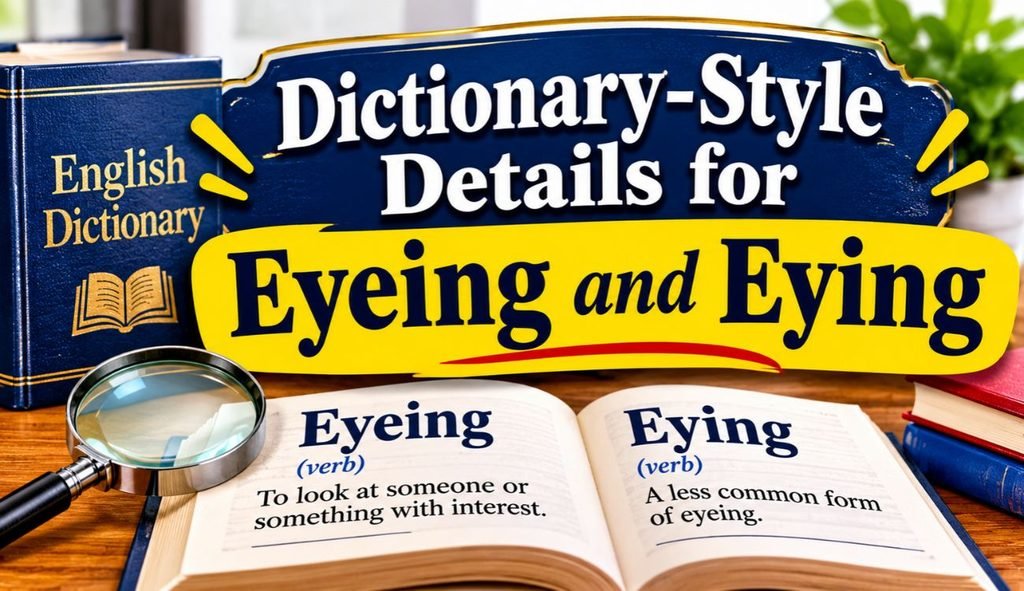
Dictionary-Style Details for Eyeing and Eying
Understanding the word’s grammatical role helps you use both spellings correctly. Since they represent the same verb form, their definitions and sentence patterns are essentially identical.
Verb Forms and Grammatical Usage
The verb eye means to look at someone or something carefully, often with interest, suspicion, or desire.
Its common forms include:
- Base form: eye
- Third-person singular: eyes
- Past tense: eyed
- Past participle: eyed
- Present participle: eyeing or eying
For example, She eyed the unfamiliar package carefully uses the past tense. In contrast, She is eyeing the package uses the present participle.
Both eyeing and eying can appear after forms of be, as in They are eyeing a new opportunity. The shorter spelling doesn’t create a different verb or change the sentence’s grammar.
Noun Forms and Related Words
The noun eye refers to the organ used for sight. The verb eye describes the act of looking at something carefully.
Although eyeing usually appears as a verb form, it can also function as a gerund. A gerund is an -ing form that acts like a noun within a sentence.
For example:
Eyeing every available option takes time.
Here, eyeing every available option functions as the subject of the sentence. The alternative spelling eying can serve the same grammatical purpose.
Remember that eyeing isn’t a separate noun with a meaning unrelated to the verb eye.
Synonyms for Eyeing
The best synonym depends on what the sentence describes. Someone might be eyeing a product with interest, watching a person carefully, or inspecting an object before buying it.
Useful alternatives include:
- Looking at: A general way to describe directing your eyes toward something.
- Watching: Paying attention to someone or something over time.
- Observing: Looking carefully to notice details or behavior.
- Studying: Examining something closely to understand it.
- Inspecting: Checking an object carefully for details or problems.
- Considering: Thinking about a possible choice or opportunity.
- Sizing up: Informally assessing a person or situation.
- Looking longingly at: Showing a strong desire for something.
These words aren’t interchangeable in every situation. For instance, inspecting suggests a closer examination, while considering emphasizes thinking about a decision.
Example Sentences Using Eyeing and Eying
The following pairs show how both spellings work in different contexts:
- The shopper was eyeing a new smartphone.
- The shopper was eying a new smartphone.
- The coach is eyeing a promising young player.
- The coach is eying a promising young player.
- She kept eyeing the clock during the meeting.
- She kept eying the clock during the meeting.
The first pair suggests interest in a product. The second describes a coach considering a player, while the third suggests that someone repeatedly checked the time.
In each pair, the spelling changes but the meaning remains the same.
Word History and Spelling Origins
Both spellings come from the verb eye, which is closely related to the familiar noun for the organ of sight. The variation appears when writers add the suffix -ing.
English commonly drops a silent final E before adding this suffix. For example, hope becomes hoping. However, eyeing retains the final E, while eying follows the shorter pattern.
Both forms appear in established dictionary usage. There’s no need to assign them separate meanings or treat them as unrelated words.
The practical lesson is simple: spelling patterns can help you understand English, but accepted usage sometimes allows more than one form.
Common Phrases Containing Eyeing
Both spellings work in common expressions involving attention, interest, or possible choices.
- Eyeing the last slice: Looking at the final piece of food with interest.
- Eying the last slice: The same action and meaning.
- Eyeing a job opportunity: Considering a possible position.
- Eying a job opportunity: The same meaning.
- Eyeing the competition: Watching competitors carefully.
- Eying the competition: The same meaning.
- Eyeing a new home: Considering a house you might buy.
- Eying a new home: The same meaning.
These phrases show why context matters more than the spelling variation. Both forms can describe the same action, whether the subject is a person, product, job, or opportunity.
Eyeing vs Eying in Formal and Informal Writing
Both spellings can work in formal and informal contexts. However, eyeing is generally the safer choice for American English writing because it’s familiar to a broad audience.
In professional emails, reports, school assignments, and website articles, using eyeing keeps your spelling straightforward. For example, The company is eyeing expansion into new markets sounds natural in a business report.
In casual messages, eying is also understandable and accepted. You don’t need to change it simply because the writing is informal.
If you’re following a specific editorial guide, use its preferred spelling. Otherwise, select eyeing and keep it consistent. Good spelling choices should make your message easier to read, not distract your audience.
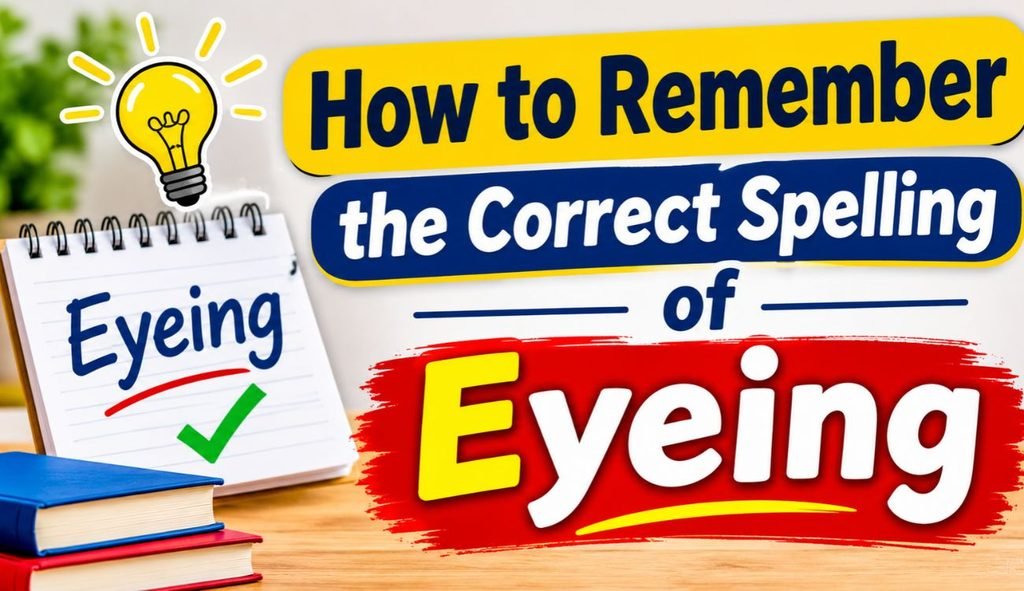
How to Remember the Correct Spelling of Eyeing
A simple memory trick can help you choose between the two forms. Think of eyeing as the spelling that keeps the complete word eye visible.
When you’re writing an article or email, you can use this quick checklist:
- Want the familiar American English spelling? Choose eyeing.
- Found eying in a published text? Don’t assume it’s a typo.
- Unsure which form your editor prefers? Check the relevant style guide.
- Already chose one spelling? Keep using it throughout your document.
You don’t need to memorize two definitions because the meanings are identical. Instead, remember your preferred spelling and apply it consistently.
This small habit makes proofreading easier and helps your writing look more polished.
Frequently Asked Questions About Eyeing vs Eying
Is it eyeing or eying?
Both are accepted spellings of the verb’s present participle. For everyday American English writing, eyeing is the more familiar choice.
What is the difference between eyeing and eying?
There is no difference in meaning, pronunciation, or grammatical function. Both spellings describe looking at something carefully or considering it.
Is eyeing correct in American English?
Yes, eyeing is correct in American English. It’s a familiar spelling for schoolwork, professional documents, website articles, and everyday communication.
Is eying a real word?
Yes, eying is a recognized spelling variant. Although some readers prefer eyeing, the shorter form isn’t automatically a spelling mistake.
Why does eyeing have two spellings?
The variation comes from how English forms words with the suffix -ing. Both eyeing and eying are accepted forms of the verb eye.
Does eyeing mean staring at someone?
Not always. Eyeing means looking with particular attention and can suggest curiosity, interest, suspicion, or desire, depending on the situation.
What is the past tense of eye?
The past tense is eyed. For example, He eyed the unfamiliar package carefully describes an action that happened in the past.
Conclusion
Both eyeing or eying are accepted spellings of the present participle of eye. They share the same meaning, pronunciation, and grammatical function. Neither spelling automatically makes a sentence incorrect.
For most American English writing, eyeing is the practical choice because it’s familiar and preserves the base word’s spelling. However, eying remains an accepted alternative, so there’s no need to correct it automatically.
When writing an article, email, or school assignment, choose one form and use it consistently. Once you understand the difference, deciding between eyeing or eying becomes much easier.
