
Ever seen the phrase “Trump TACO Meaning” and wondered what people are talking about? You’re not alone. TACO has become a term in political conversations, especially when people discuss tariffs, market reactions, and trade decisions. At first glance, it sounds playful. The meaning, however, has a story.
You may spot this phrase in news reports, social media posts, or conversations about Donald Trump’s tariff policies. Understanding the context makes these discussions easier to follow. It also helps you see why investors, journalists, and users mention Trump TACO Meaning when discussing sudden policy changes.
Interestingly, the phrase can appear alongside messages, such as “have a good day reply,” “tbh for friend,” “sweet dreams reply,” “have a nice day reply,” and “have a great day reply.” In this guide, you’ll learn what Trump TACO Meaning, where the phrase came from, and why it matters.
Trump TACO Meaning at a Glance
Here’s a quick breakdown before we look at the phrase in more detail:
| Term | Explanation |
| TACO | Trump Always Chickens Out |
| Type | Informal political and financial acronym |
| Main topic | Tariffs, trade policy, and policy reversals |
| Common users | Investors, journalists, traders, and political commentators |
| TACO trade | A market strategy based on expecting tariff-related pullbacks and later rebounds |
| Tone | Usually humorous, critical, or sarcastic |
| Official term? | No |
| Common settings | Wall Street, financial news, politics, and social media |
In simple terms, Trump TACO refers to a perceived pattern of making a strong policy threat and then softening or delaying it.
However, calling something a “TACO” is an interpretation. It doesn’t automatically prove that a policy reversal happened because of fear or pressure.
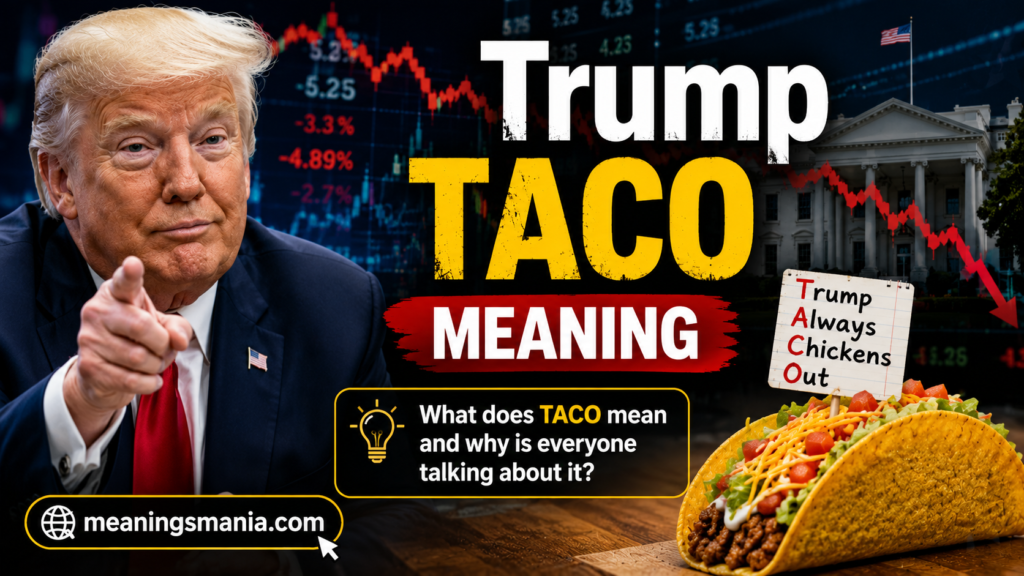
What Does Trump TACO Mean?
Trump TACO means “Trump Always Chickens Out.” It’s an informal phrase used mainly by critics and market commentators when discussing Trump’s tariff and trade decisions.
The expression became especially relevant when investors noticed a recurring market pattern. A major tariff announcement could create uncertainty and push stocks lower. If the policy was later delayed, reduced, or softened, markets could recover.
For example, imagine investors hear that a new tariff will sharply increase import costs. Stocks fall because traders expect weaker profits and more economic uncertainty. A few days later, the tariff is postponed for negotiations. Stocks then rebound.
Someone describing that pattern as a TACO trade is essentially saying, “The market expected another reversal.”
The phrase doesn’t mean every Trump policy was abandoned. It’s a shorthand used to describe a particular perceived pattern in his approach to tariffs and other threats.
The Origin of the Trump TACO Phrase
The modern financial use of TACO traces back to Robert Armstrong, a Financial Times columnist. He introduced the phrase in a May 2, 2025 column while discussing Trump’s tariff policies and their effect on financial markets.
The term quickly moved beyond one financial column. Traders, journalists, political commentators, and social-media users began using it to describe the idea that Trump’s tariff announcements could be followed by negotiations, delays, or reversals.
The basic pattern looked like this:
- Trump announces or threatens a major tariff.
- Investors react to the possible economic impact.
- Stocks or other assets become volatile.
- Negotiations or policy changes follow.
- The threatened measure may be delayed, reduced, or altered.
- Markets may recover if investors view the change positively.
That’s where the TACO trade meaning comes from. It isn’t simply about the word TACO. It describes how some investors interpreted the relationship between tariff announcements and subsequent market moves.
Why Is It Called TACO?
The name comes from the first letters of the phrase:
- T = Trump
- A = Always
- C = Chickens
- O = Out
The expression “chicken out” is informal English. It means backing away from something because of fear, caution, pressure, or a change in circumstances.
So, the acronym deliberately uses humorous and provocative language. It isn’t a neutral description of economic policy.
That’s also why the phrase can sound insulting or politically charged. Supporters of Trump may reject the characterization and describe a tariff delay or change as part of negotiation instead.
The unusual food-related acronym also helped the term spread online. It was memorable, easy to turn into jokes, and simple enough for headlines and social posts.
Trump TACO Meaning in Different Contexts
The meaning stays broadly the same, but people use the phrase differently depending on where they encounter it.
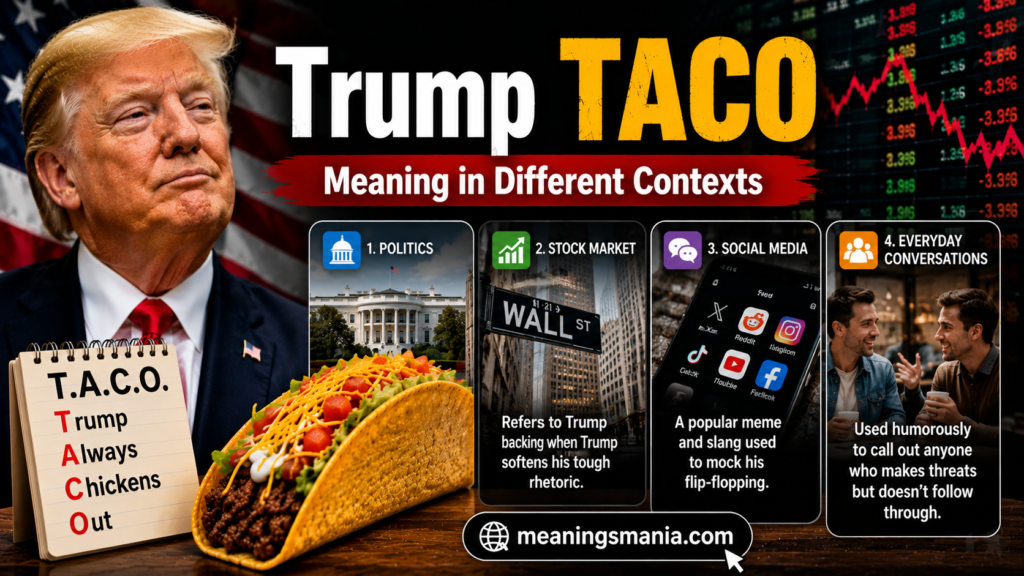
Trump TACO Meaning in the Stock Market
In stock-market discussions, TACO usually refers to the idea that investors can anticipate a reversal after an aggressive tariff announcement.
The concept became associated with a particular trading pattern: markets fall when a major tariff threat appears, then recover if the policy gets delayed or softened. Financial coverage described this as the “TACO trade.”
For example:
“Traders are watching for another TACO trade after the latest tariff announcement.”
Here, the speaker isn’t talking about food. They’re referring to the possibility that tariffs may be softened later and markets may rebound.
Trump TACO Meaning in Politics
In political discussions, TACO is more of a criticism than a financial description.
A political commentator might use it when arguing that Trump makes forceful promises but later changes course. The phrase can therefore carry a clear opinion about his negotiating style.
For example:
“Opponents called the tariff delay another TACO moment.”
That sentence doesn’t establish why the decision changed. It simply shows how critics may characterize it.
Trump TACO Meaning on Social Media
On social platforms, the phrase is often shorter, sharper, and more humorous.
Users may post “TACO trade,” “TACO rally,” or “TACO Tuesday” when discussing a new tariff announcement followed by a policy change. The term also became part of memes and political jokes after it gained attention in 2025.
A post might say:
“Stocks are dropping again. Time to watch for the next TACO move.”
The meaning depends heavily on context, but the reference is usually to tariffs and an expected policy reversal.
Trump TACO in Financial Journalism
Financial journalists may use TACO as a shorthand for investor expectations surrounding Trump’s trade policy.
However, reputable reporting generally explains the term rather than treating it as an established economic theory. That’s important because TACO isn’t a formal financial indicator, model, or government policy term.
You’ll usually see it in opinion pieces, market commentary, headlines, or discussions about investor sentiment.
Why Is the Trump TACO Phrase Controversial?
The controversy comes from the phrase itself. “Chickens out” is a judgmental expression, so TACO doesn’t simply describe what happened. It suggests a reason or interpretation for the change.
One side may see a tariff delay as backing down under pressure. Another may see the same action as deliberate negotiation.
That distinction matters.
A policy can change for many reasons, including:
- New trade negotiations
- Economic concerns
- Market volatility
- Diplomatic pressure
- Business opposition
- Retaliatory tariffs
- Changes in economic data
- Strategic timing
Because of this, calling a decision a Trump TACO can reflect someone’s political viewpoint rather than an objective economic classification.
Trump himself rejected the characterization when asked about the TACO trade in May 2025, arguing that his tariff moves were part of negotiations rather than simply backing down.
Examples of Trump TACO in Sentences
Seeing the phrase in context makes its meaning much easier to understand.
- “Investors are watching closely for another TACO trade.”
- “Critics called the tariff delay a Trump TACO moment.”
- “The market rebounded after the tariff threat was softened.”
- “Financial analysts debated whether the latest move fit the TACO pattern.”
- “Social media users started joking about TACO after the announcement.”
- “The trader expected tariffs to be reduced after negotiations.”
- “The article used TACO to describe Trump’s changing tariff strategy.”
Notice that these examples don’t claim every policy change was a retreat. They show how people commonly use the phrase to express an interpretation.
Related Financial Terms
Understanding a few related terms can make financial coverage much easier to follow.
| Term | Simple Meaning |
| Tariff | A tax placed on imported goods |
| Trade policy | Government rules affecting international trade |
| Market volatility | How sharply and frequently prices move |
| Investor sentiment | How investors generally feel about market conditions |
| Trade negotiations | Discussions between countries about trade arrangements |
| Tariff reversal | A reduction, delay, removal, or change to a tariff |
| Market reaction | How financial markets respond to news or events |
| Import tax | Another common way to describe a tariff |
These terms often appear alongside Trump TACO meaning because tariffs can influence company costs, consumer prices, profits, and investor expectations.
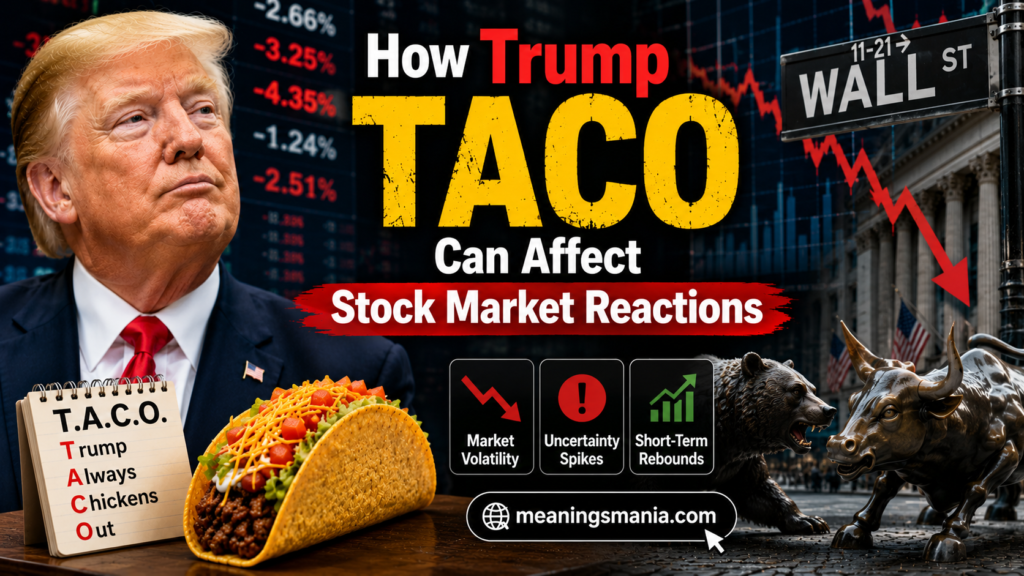
How Trump TACO Can Affect Stock Market Reactions
The TACO idea became popular partly because financial markets can react quickly to tariff news.
When investors expect higher tariffs, they may worry about increased costs for businesses that rely on imported goods. Companies could face lower profit margins, while consumers might eventually pay more.
That uncertainty can pressure stocks.
If the tariff threat later gets delayed or reduced, some of that fear may disappear. Investors may then become more optimistic, which can contribute to a market rebound.
However, this doesn’t mean a TACO pattern guarantees a profitable trade. Markets respond to many factors at once, including interest rates, corporate earnings, inflation, geopolitical events, and economic data.
How Investors Interpret TACO Tariff Reversals
Investors who follow the TACO theory may look for signs that an aggressive tariff proposal won’t remain unchanged.
They might pay attention to:
- Negotiations between countries
- Statements from the White House
- Reactions from financial markets
- Proposed tariff deadlines
- Industry concerns
- Retaliatory measures
- Changes in economic expectations
The idea is straightforward: if traders believe a severe tariff announcement is likely to be softened, they may expect the initial market decline to reverse.
Still, that’s an investment thesis, not a guaranteed formula. A tariff can remain in place, become more severe, or trigger a broader trade conflict.
Is Trump TACO a Real Financial Term?
Trump TACO is a real phrase, but it isn’t an official financial term.
It doesn’t appear alongside standard economic measures such as inflation, GDP, unemployment, or interest rates. There is no official TACO index used by the Federal Reserve or a standard accounting rule called TACO.
Instead, it’s an informal expression that originated in financial commentary and became widely recognized through market and political discussions.
So if you see TACO meaning in finance, think of it as market slang. It describes a perceived behavior and an associated trading idea, rather than a formal financial metric.
Where the TACO Phrase Is Commonly Used
You’ll most often encounter the phrase in places where politics and financial markets overlap.
Common examples include:
- Financial news articles
- Stock-market commentary
- Investor discussions
- Political analysis
- Social-media posts
- Online trading communities
- Discussions about tariffs and trade negotiations
The exact tone depends on the source. A market analyst may use it to explain investor expectations, while a political poster may use it as criticism or satire.
Trump TACO vs. Other Tariff and Trade Terms
TACO shouldn’t be confused with the actual trade policies it describes.
A tariff is a policy tool. A tariff reversal describes a change to that policy. TACO is a nickname people may use when they interpret that change as part of a broader pattern.
Here’s a simple comparison:
| Term | What It Refers To |
| Tariff | A tax or duty on imports |
| Tariff threat | A proposed or threatened tariff |
| Tariff reversal | A tariff being reduced, delayed, removed, or changed |
| TACO | An informal label for Trump’s perceived tendency to back away from aggressive measures |
| TACO trade | A market strategy or expectation based on possible tariff reversals |
This distinction helps prevent a common misunderstanding. TACO isn’t another type of tariff. It’s commentary about how a political figure is perceived to handle policy threats.
How TACO Differs From a Traditional Tariff Reversal
A tariff reversal is a factual description of a policy change. It doesn’t automatically say why the change happened.
TACO adds an interpretation.
For instance, saying:
“The government delayed the tariff.”
describes an event.
Saying:
“That was another TACO move.”
adds the opinion that the delay fits a pattern of backing away.
That’s why context matters whenever you see the phrase. It can tell you as much about the speaker’s viewpoint as it does about the underlying trade policy.
Trump TACO Meaning: Common Misunderstandings
One common misunderstanding is that TACO refers to tacos or Mexican food. In this political context, it doesn’t. The food reference is simply a memorable result of the acronym.
Another mistake is treating TACO as an official economic measurement. It isn’t. The phrase is informal and often appears in commentary rather than technical economic analysis.
It’s also important not to assume that every policy change qualifies as a TACO. The phrase is usually used when someone believes a particular reversal fits the broader pattern.
In other words, Trump TACO meaning depends partly on context and perspective.
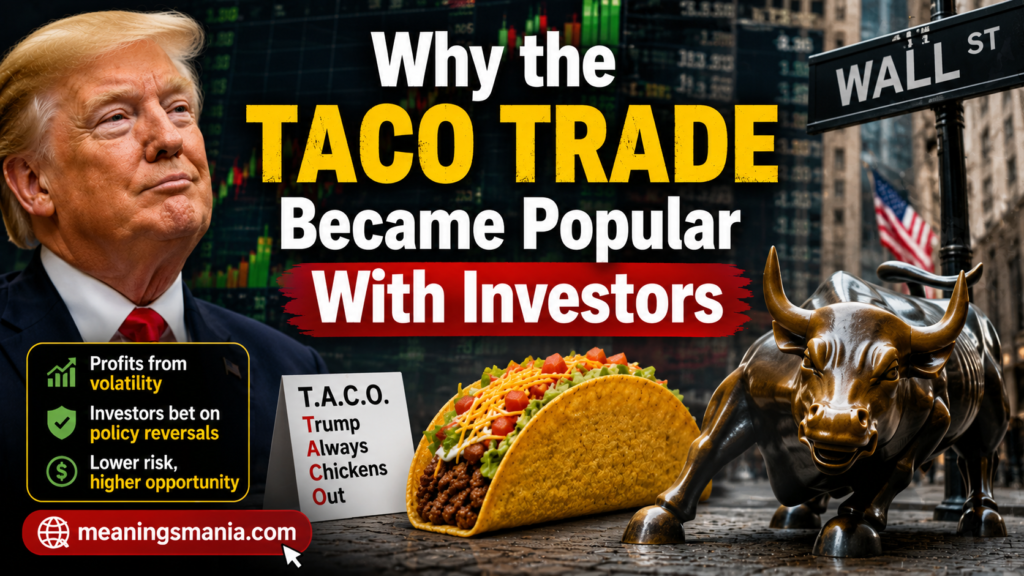
Why the TACO Trade Became Popular With Investors
The phrase caught attention because it offered a simple way to describe a complicated market dynamic.
Investors constantly try to estimate how political decisions will affect companies and markets. When tariff announcements repeatedly produce uncertainty, traders naturally watch for signals that the policy might change.
The TACO concept gave that expectation a catchy name.
That doesn’t make it a reliable prediction tool. Markets rarely move for just one reason. Still, the phrase became useful shorthand for discussing the relationship between Trump’s tariff announcements, investor expectations, and market reactions.
FAQ’s
What does Trump TACO mean?
Trump TACO Meaning “Trump Always Chickens Out,” an informal phrase criticizing perceived reversals or delays in aggressive policy decisions.
Is TACO an official financial term?
No, Trump TACO Meaning is informal market slang used in financial and political commentary rather than an established economic measurement or trading indicator.
Who coined the Trump TACO phrase?
Financial Times columnist Robert Armstrong coined the phrase in May 2025 while discussing Trump’s tariff policies and market reactions.
What does TACO trade mean?
TACO trade refers to an investor strategy based on expecting tariff-related market declines to reverse after policies are delayed or softened.
Does Trump TACO only refer to tariffs?
It mainly refers to tariff and trade-policy reversals, although commentators may apply the phrase more broadly to perceived policy retreats.
Why do investors discuss the TACO effect?
Investors discuss it because tariff announcements can create market volatility, while later policy changes may encourage stocks to recover.
Is Trump TACO positive or negative?
The phrase is generally critical or sarcastic, although investors may use it neutrally when discussing a perceived market pattern.
Conclusion
Understanding Trump TACO Meaning makes financial and political discussions easier to follow. TACO stands for “Trump Always Chickens Out,” an informal phrase linked to perceived changes in tariff and trade policies. It’s not an official financial term. Instead, people use it to describe a pattern they believe they’ve noticed.
The phrase can appear in stock market commentary, political debates, news reports, and social media. Investors may connect it with tariff threats, market volatility, and possible policy reversals. However, calling something a Trump TACO Meaning move reflects an interpretation. It doesn’t automatically explain why a policy changed or predict what happens next.
Whether you’re reading market news or casual posts, context matters. You may also see unrelated phrases like have a good day reply, tbh for friend, sweet dreams reply, have a nice day reply, and have a great day reply online. Knowing the context helps you understand each phrase clearly and avoid confusion.
