
Words that look almost identical can sometimes cause surprisingly big confusion. The vs Thee is a good example. Both contain the same basic letters, and in certain situations, they can even sound alike. However, they don’t perform the same job in a sentence.
The is a definite article used with nouns, while The vs Thee is an old second-person object pronoun. You’ll mostly encounter thee in older English, poetry, religious writing, and historical literature. Once you understand their grammatical roles, the difference becomes much easier to remember.
In this guide, you’ll learn the the vs thee difference, their meanings, pronunciation, history, grammar rules, and everyday usage. You’ll also see simple examples that show exactly when each word belongs.
Understanding “The” and “Thee”: The Basic Difference
At first glance, the and thee can look like two forms of the same word. They aren’t. They come from different grammatical roles and belong to different stages of English usage.
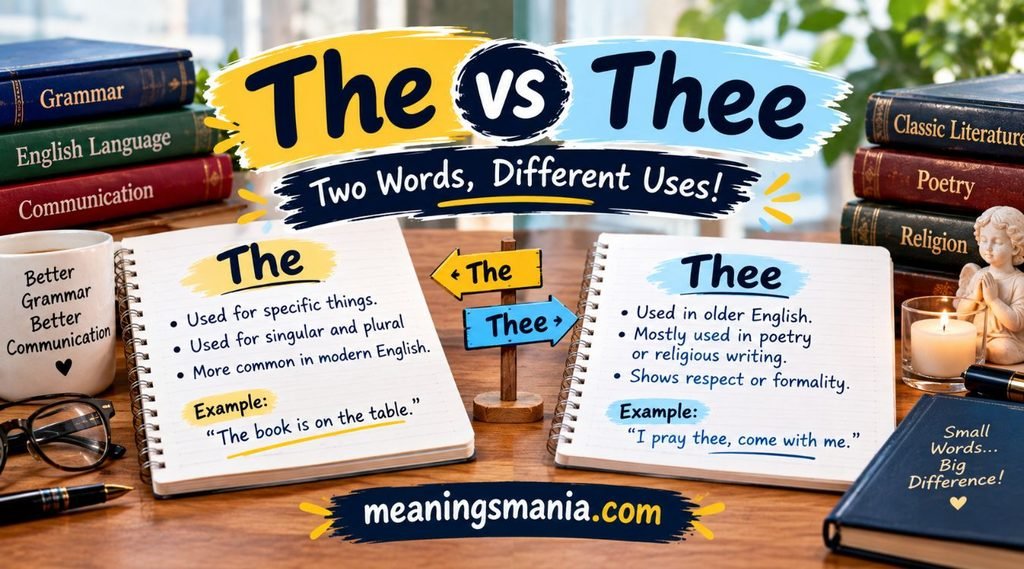
The easiest way to separate them is to look at what follows each word. The normally introduces a noun or noun phrase. Thee, by contrast, refers to a person who receives an action or follows a preposition in older forms of English.
What Is “The”?
The is the definite article in modern English. You use it when you’re talking about a particular person, place, thing, or group that the reader or listener can identify.
For example:
- The dog is sleeping.
- Please close the door.
- The students finished their project.
- We visited the museum yesterday.
In each sentence, the points toward something specific. It can appear before singular nouns, plural nouns, and certain proper nouns.
What Is “Thee”?
Thee is an archaic object pronoun that historically meant “you.” It was used when “you” functioned as the object of a verb or preposition.
For example:
- I thank thee.
- I will follow thee.
- She gave thee a message.
- I speak to thee.
Modern English generally uses you in all these situations. That’s why thee now sounds old-fashioned, poetic, religious, or deliberately dramatic.
Are “The” and “Thee” Homophones?
Not consistently. Thee is normally pronounced with a long “ee” sound, represented as /ðiː/. The has two common pronunciations: /ðə/ before a consonant sound and /ðiː/ before a vowel sound or when emphasized.
So, in a phrase such as “the apple,” the can sound like thee. That creates a pronunciation overlap, but it doesn’t make the two words interchangeable.
The vs Thee: Meaning and Core Difference
The biggest difference between the and thee comes down to grammar. One identifies a noun, while the other refers to a person.
Think of it this way: the helps identify something, whereas thee historically identifies the person receiving an action.
The Meaning and Definition
The word the tells your reader that you’re referring to a specific noun.
Compare these examples:
- I saw a movie.
- I saw the movie.
The first sentence introduces a movie without identifying a particular one. The second suggests that both people know which movie is being discussed.
You can use the with:
- Singular nouns: the car
- Plural nouns: the cars
- Superlatives: the fastest runner
- Ordinals: the second chapter
- Certain geographical names: the Pacific Ocean
Thee Meaning and Definition
The thee meaning in English is essentially “you” when “you” functions as an object. This was part of an older pronoun system that distinguished between subject and object forms.
The historical pattern looked like this:
| Role | Older English Form | Modern Equivalent |
| Subject | Thou | You |
| Object | Thee | You |
| Possessive | Thy/Thine | Your/Yours |
For example, “I love thee” means “I love you.” The word thee doesn’t identify an object or noun. Instead, it refers to the person receiving the action.
The Main Difference Between The and Thee
The easiest comparison is:
| Feature | The | Thee |
| Part of speech | Definite article | Object pronoun |
| Basic function | Identifies a noun | Refers to “you” |
| Modern usage | Extremely common | Rare |
| Register | Everyday English | Archaic or poetic |
| Example | The house | I thank thee |
Because their grammatical functions differ, you can’t replace one with the other.
Historical Origins of “The” and “Thee”
The history of these words explains why they look somewhat related while behaving so differently today. English has changed dramatically over centuries, and both words have roots in older forms of the language.
Where Did “The” Come From?
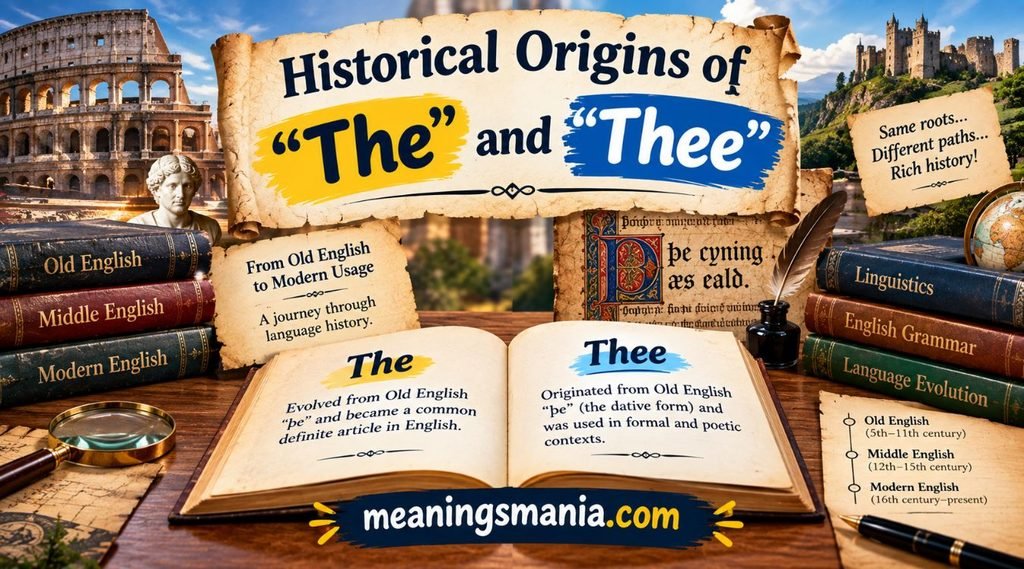
The modern article the developed from several forms used in Old English. Older English had grammatical distinctions that modern English has largely lost.
Forms such as þe, þæt, and se played roles that eventually contributed to today’s article system. Over time, spelling and grammar changed, and these forms gradually developed into the familiar word the.
You don’t need to memorize the historical details to use the word correctly. Still, knowing its background explains why English articles don’t always behave like simple modern vocabulary.
Where Did “Thee” Come From?
Thee developed from the Old English pronoun þē. It was originally part of a larger personal pronoun system.
The distinction was useful because English could show whether a person was performing an action or receiving it.
For example:
- Thou = the person doing something
- Thee = the person receiving something
That distinction eventually faded from ordinary English as you became increasingly common.
How “The” and “Thee” Changed Over Time
English isn’t a fixed language. Words change meaning, pronunciation, spelling, and frequency as speakers adopt new habits.
The history of thee is a particularly clear example of this process.
Why Did People Stop Using “Thee”?
The shift away from thee happened gradually rather than overnight. The word you became increasingly useful because it could serve as both singular and plural and eventually replaced many older pronoun distinctions.
Several factors contributed to the change:
- Changing social conventions
- Increasing use of you
- Simplification of English grammar
- Changes in formal and informal speech
- Standardization of written English
As a result, modern speakers no longer need separate subject and object forms for second-person pronouns.
Where Is “Thee” Still Used Today?
You can still encounter thee, but usually in specific contexts. It appears in historical writing, poetry, religious language, and works designed to imitate older English.
You’ll also see it when an author wants a deliberately dramatic or traditional tone.
For example:
“I shall remember thee.”
That sentence sounds old-fashioned today. In ordinary modern English, you’d simply say, “I will remember you.”
The vs Thee Pronunciation: How Are They Different?
Pronunciation is one reason learners sometimes confuse these words. The spelling can make them appear related, while their spoken forms sometimes overlap.
How to Pronounce “The”
The has two standard pronunciations in everyday English:
- /ðə/ before a consonant sound
- /ðiː/ before a vowel sound
For example:
- the car → /ðə/
- the house → /ðə/
- the apple → /ðiː/
- the orange → /ðiː/
The important point is that pronunciation depends on the sound that follows, not simply the first letter.
How to Pronounce “Thee”
Thee is generally pronounced /ðiː/. It has the same long “ee” vowel found in words such as see and tree.
For example:
- “I thank thee.”
- “I shall follow thee.”
Because thee has a consistent pronunciation, it can occasionally sound exactly like the pronunciation of the used before a vowel sound.
Does “The” Sound Like “Thee”?
Sometimes, yes.
Compare:
- the apple
- thee
The first word in “the apple” can have the same /ðiː/ sound as thee. However, context tells you what the word means.
That’s an important lesson in English: sound alone doesn’t always reveal grammatical function.
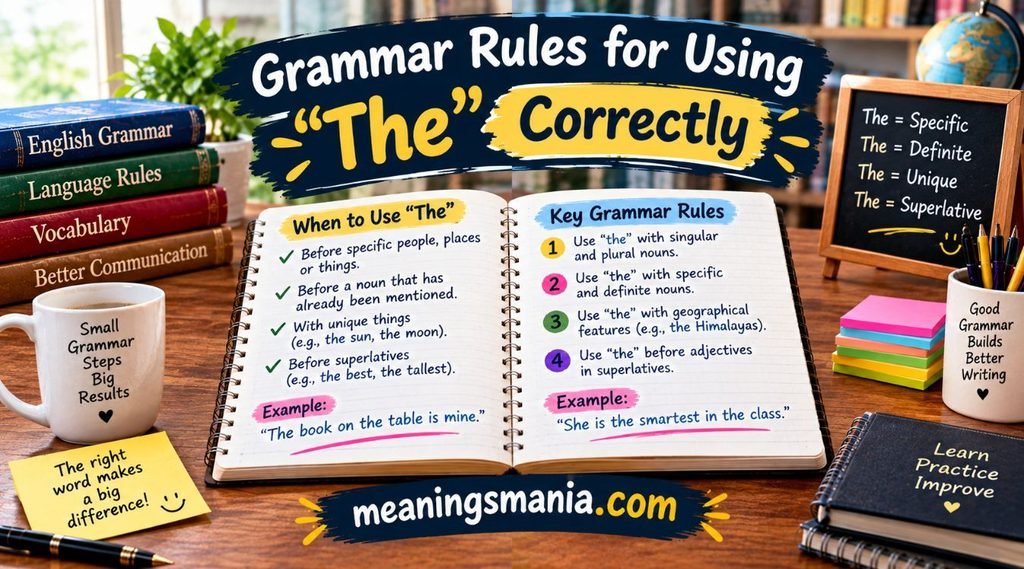
Grammar Rules for Using “The” Correctly
Learning how to use the correctly becomes easier when you focus on specificity. The article usually appears when the listener or reader can identify the noun being discussed.
For example, “I bought a book” introduces something new. Later, “The book was expensive” identifies that same book.
Using “The” as a Definite Article
Use the when you’re referring to something specific or already understood.
Examples include:
- The phone on the desk is mine.
- Please open the window.
- The teacher explained the lesson again.
The listener doesn’t have to know every detail. They simply need enough context to understand which thing you mean.
Using “The” With Singular and Plural Nouns
The article can appear before both singular and plural nouns.
Examples:
- The child is sleeping.
- The children are sleeping.
- The car is outside.
- The cars are outside.
So, the doesn’t automatically mean that the noun is singular.
Using “The” for Unique Things
We often use the for things considered unique within a particular context.
Examples include:
- the sun
- the moon
- the Earth
- the internet
The exact usage can depend on context, but the general idea remains the same: the noun refers to something identifiable.
Using “The” With Superlatives and Ordinal Numbers
English commonly uses the before superlatives and ordinal numbers.
Examples:
- the tallest building
- the fastest runner
- the first page
- the third attempt
- the best answer
These expressions identify one position or one item within a group.
Using “The” With Proper Nouns
Some proper nouns naturally take the, although proper names don’t always require an article.
Examples include:
- the United States
- the United Kingdom
- the Amazon River
- the Pacific Ocean
- the Alps
However, you wouldn’t normally say the Sarah or the London when using those names in their standard forms.
Grammar Rules for Using “Thee” Correctly
Unlike the, thee isn’t an article. It’s a pronoun. More specifically, it’s an older second-person object pronoun.
That means it typically appears where modern English would use you as an object.
Using “Thee” as an Object Pronoun
An object receives the action of a verb.
Consider:
- I remember you.
- I remember thee.
Both sentences have the same basic grammatical structure. The difference is the pronoun style.
Other examples include:
- I saw thee yesterday.
- She called thee by name.
- They welcomed thee warmly.
These sentences sound distinctly old-fashioned in modern English.
Where “Thee” Appears in a Sentence
Historically, thee could appear after verbs and prepositions.
Examples:
- I trust thee.
- I follow thee.
- I speak with thee.
- This gift is for thee.
By comparison, thou functioned as the subject:
- Thou art kind.
- Thou knowest the answer.
This subject-object distinction is central to understanding traditional English pronouns.
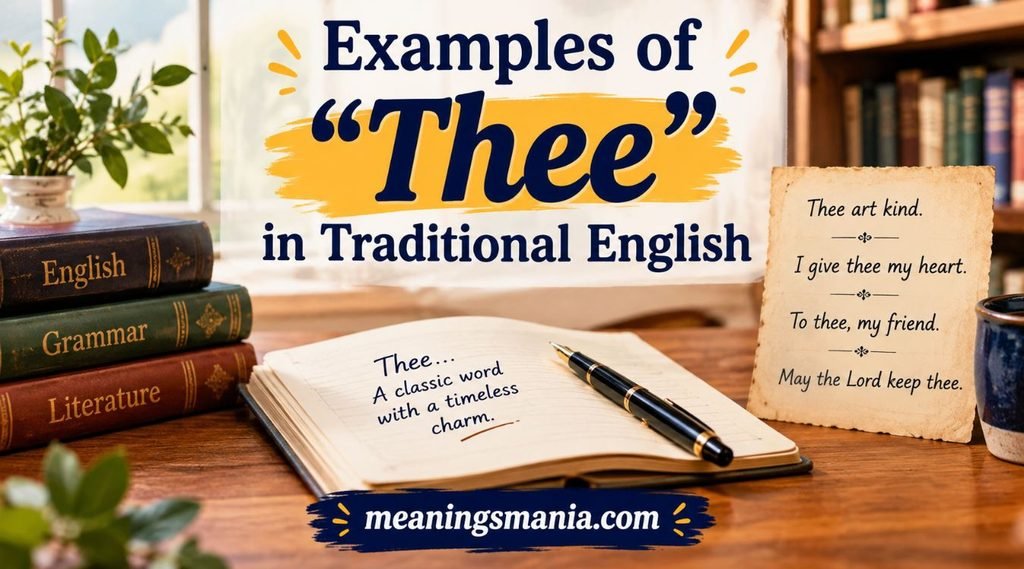
Examples of “Thee” in Traditional English
You’ll often find thee in expressions that have been preserved through literature, religion, and poetry.
For example:
- “I give thee my word.”
- “May peace be with thee.”
- “I shall serve thee.”
- “I remember thee.”
In modern conversation, these would usually become “I give you my word,” “May peace be with you,” and similar forms.
The vs Thee Examples in Sentences
Looking at real sentence patterns makes the the vs thee examples much easier to understand.
Examples of “The” in Everyday Sentences
Here are several natural examples:
- The dog is waiting outside.
- I left the keys on the table.
- The movie starts at eight.
- The students are studying.
- We visited the park yesterday.
- The blue shirt is mine.
In each case, the introduces a specific noun.
Examples of “Thee” in Traditional or Poetic Sentences
Now compare those everyday examples with older-style sentences:
- I shall remember thee.
- I thank thee for your kindness.
- May fortune favor thee.
- I will never forget thee.
- She spoke to thee with honesty.
These sentences aren’t grammatically modern in style, but they’re useful when reading historical or poetic English.
The vs Thee Comparison Table
The following table gives you a quick the vs thee comparison:
| Feature | The | Thee |
| Word type | Definite article | Object pronoun |
| Meaning | Identifies a specific noun | Means “you” as an object |
| English variety | Modern English | Archaic English |
| Common today? | Yes | No |
| Used before nouns? | Yes | No |
| Used after verbs? | Not as a pronoun | Yes |
| Pronunciation | /ðə/ or /ðiː/ | /ðiː/ |
| Example | The book is here. | I thank thee. |
A useful shortcut is simple: if a noun comes after the word, you’re probably dealing with “the.” If the word refers to a person receiving an action in old-style English, it may be “thee.”
Common Mistakes When Using “The” and “Thee”
Because the words look and sometimes sound similar, learners can easily assume they’re interchangeable. They’re not.
Confusing “Thee” With “The”
One common mistake is treating thee as a more formal version of the. It isn’t.
For example:
- ❌ Thee house is beautiful.
- ✅ The house is beautiful.
Here, house is a noun, so the is the correct article.
Another mistake is assuming thee simply means “the” with an extra letter. Its historical meaning is closer to modern you.
Using “Thee” in Modern Everyday English
You generally shouldn’t replace you with thee in normal conversation.
For example:
- Modern: “I appreciate you.”
- Archaic: “I appreciate thee.”
The second sentence isn’t necessarily wrong in a historical or creative context. It simply sounds deliberately old-fashioned.
Understanding the Correct Usage
The best way to remember the distinction is to identify each word’s job.
The:
- Comes before a noun or noun phrase.
- Identifies something specific.
- Is normal in modern English.
Thee:
- Functions as an object pronoun.
- Refers to “you.”
- Belongs mainly to older or stylized English.
When Should You Use “Thee” Today?
For most everyday writing, you don’t need thee. If you’re writing an email, school assignment, blog post, or business message, you will almost always be the natural choice.
However, there are situations where thee can be useful.
Appropriate Situations for Using “Thee”
You might intentionally use thee when:
- Writing historical fiction
- Recreating older dialogue
- Writing poetry
- Quoting traditional language
- Creating a dramatic or ceremonial tone
- Discussing historical English grammar
For example, a fantasy character might say, “I shall defend thee.” The wording immediately creates an older atmosphere.
When You Should Avoid Using “Thee”
Avoid thee when you’re aiming for ordinary modern communication.
That includes:
- Business emails
- Everyday text messages
- Modern academic writing
- Professional reports
- Casual conversations
Using thee in these settings can make your writing sound theatrical rather than polished.
Thee in Shakespeare, the Bible, and Older English
Historical texts are among the main reasons modern readers still encounter thee.
It appears frequently in older works, although its exact use depends on the period and text.
How Shakespeare Used “Thee”
Shakespearean English used a broader pronoun system than modern English. Thou generally served as a subject, while thee served as an object.
For example, a character might say “I love thee,” meaning “I love you.”
The choice between thou and thee wasn’t merely decorative. It reflected grammatical function and could also carry social or emotional meaning depending on the context.
How “Thee” Appears in the Bible
Readers may recognize thee from older English Bible translations, especially the King James Bible.
Expressions such as “unto thee” or “I give thee” reflect the older pronoun system. Modern Bible translations generally use you instead.
This is one reason religious language can preserve words that have disappeared from ordinary speech.
What Traditional Use of “Thee” Tells Us
The continued appearance of thee in famous texts gives modern readers a window into earlier English.
It also shows why understanding grammar history matters. Without that background, an old sentence can seem unnecessarily mysterious.
Once you know that thee means “you” in the object position, many older passages become much easier to understand.
Modern Usage of “The” vs “Thee”
The contrast between these words is especially obvious today. One is among the most frequently used words in English, while the other is rarely used outside special contexts.
How “The” Is Used in Modern English
The is essential to everyday communication. You’ll encounter it constantly in speech and writing.
Examples include:
- the weather
- the news
- the office
- the answer
- the problem
- the internet
Whether you’re chatting with friends or writing professionally, the is a normal part of English grammar.
Where “Thee” Still Appears Today
Thee survives mainly in:
- Poetry
- Religious language
- Historical texts
- Literary writing
- Traditional expressions
- Deliberately archaic dialogue
It may also appear humorously when someone wants to imitate medieval or Shakespearean speech.
For example, “Bring thee some pizza” might be used as a joke. In normal English, you’d simply say, “Bring me some pizza.”
The vs Thee in Modern English: Which One Should You Use?
If you’re writing modern English and you’re unsure between the and thee, the context usually makes the choice easy.
Use the when you need a definite article before a noun. Use thee only when you’re intentionally using an older pronoun meaning “you.”
Why “The” Is Correct in Most Modern Sentences
Modern English relies heavily on you rather than maintaining the old distinction between thou and thee.
For example:
- I saw the car.
- I saw you.
- The car belongs to you.
Replacing the with thee would break the grammar. Replacing you with thee would create an archaic style.
So, when writing for a modern audience, the should be your normal choice whenever the grammar calls for a definite article.
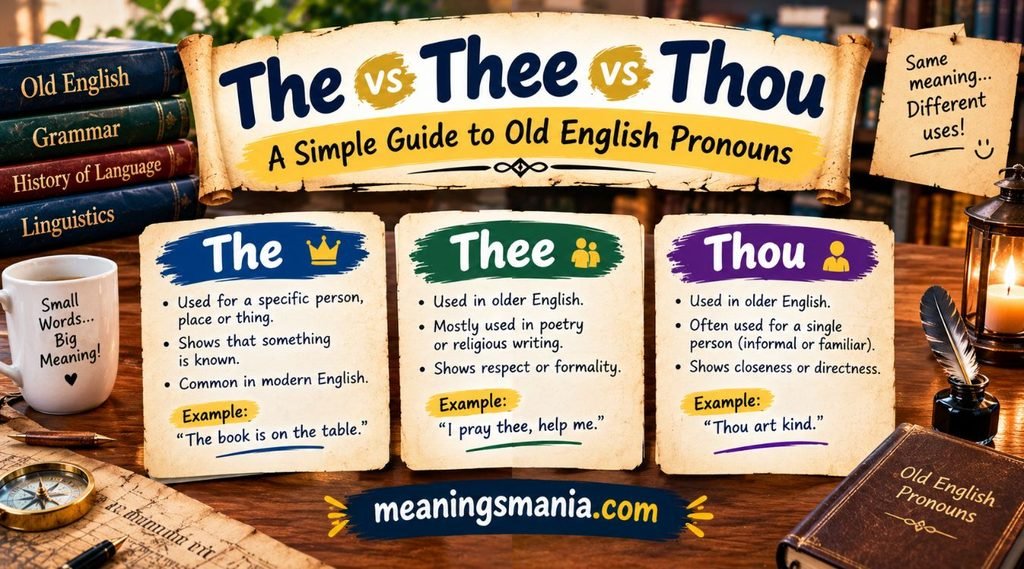
The vs Thee vs Thou: A Simple Guide to Old English Pronouns
Understanding thee becomes much easier when you see it alongside thou, thy, and thine.
These words belonged to a historical pronoun system that had distinctions modern English no longer maintains.
How Thee, Thou, Thy, and Thine Were Used Differently
A simplified guide looks like this:
| Word | Historical Function | Modern Equivalent |
| Thou | Subject | You |
| Thee | Object | You |
| Thy | Possessive before many nouns | Your |
| Thine | Possessive form | Yours |
For example:
- Thou art wise. → You are wise.
- I trust thee. → I trust you.
- Thy book is here. → Your book is here.
- The victory is thine. → The victory is yours.
This system explains why thee shouldn’t be confused with the. They belong to entirely different grammatical categories.
How to Remember the Difference Between The and Thee
You don’t need to memorize complicated historical grammar rules. A simple mental shortcut can help.
An Easy Trick for Choosing the Correct Word
Think of the as a word that points toward a thing.
The + noun
Examples:
- the house
- the teacher
- the book
- the mountains
Think of The vs Thee as an old-fashioned way to say you when someone receives an action.
verb + thee
Examples:
- I thank thee.
- I love thee.
- I follow thee.
If you’re writing a normal modern sentence, there’s a good chance you’ll need the or you, not thee.
Related Grammar Questions and Common Confusions
Learning one confusing pair often leads to other grammar questions. Several English words have similar spellings, sounds, or functions but different meanings.
The vs A vs An
The, a, and an are articles, but they aren’t interchangeable.
- A usually introduces one non-specific noun.
- An does the same before a vowel sound.
- The identifies something specific.
Compare:
- I saw a dog.
- I saw an elephant.
- I saw the dog again.
The first two introduce something. The third identifies something already known.
Thou vs Thee vs Thy vs Thine
These words belonged to an older English pronoun system.
- Thou = subject
- Thee = object
- Thy = possessive
- Thine = possessive
Modern English usually replaces these forms with you, your, and yours.
Who vs Whom
Who and whom can also confuse learners because they have different grammatical roles.
A simple traditional distinction is:
- Who = subject
- Whom = object
For example:
- Who called you?
- Whom did you call?
Modern usage often uses who more broadly, especially in casual conversation.
You vs Thou in Older English
Thou historically served as a singular subject pronoun, while you had different historical functions and eventually became dominant.
That change is part of the larger story behind the disappearance of thee.
Today, you covers the roles that once required several separate pronouns.
Its vs It’s
These two forms sound similar but have different functions.
- Its = possessive
- It’s = it is or it has
For example:
- The dog wagged its tail.
- It’s raining outside.
The apostrophe completely changes the grammatical function.
Then vs Than
Then generally relates to time or sequence, while than appears in comparisons.
Examples:
- We ate, then we left.
- She is taller than me.
Like the and thee, they can cause confusion when learners focus too heavily on sound or appearance instead of meaning.
Expert Tips for Mastering The vs Thee
The best way to master the vs thee is to focus on function rather than appearance.
Keep these points in mind:
- Use the before specific nouns.
- Remember that thee means “you” in older object-pronoun usage.
- Don’t treat thee as a fancy version of the.
- Expect thee in poetry, religious writing, and historical literature.
- Use you instead of thee in normal modern communication.
- Pay attention to pronunciation, but use context to determine meaning.
- Learn thou, thee, thy, and thine as a related historical system.
Once you understand the grammatical roles, this confusing pair becomes much less intimidating.

Conclusion
The The vs Thee difference is much simpler than it first appears. The vs Thee is a modern definite article used to identify specific nouns, while thee is an older object pronoun that means “you.” Although they can sometimes sound alike, their grammatical functions are completely different.
You’ll mainly use The vs Thee in everyday English, whether you’re speaking, texting, studying, or writing professionally. Thee, meanwhile, belongs mostly to historical, religious, poetic, or deliberately old-fashioned language. Understanding that distinction can make classic literature and older texts much easier to read.
When you’re unsure, look at the word’s job in the sentence. If it introduces a specific noun, you probably need The vs Thee. If it refers to someone receiving an action in an older style of English, thee may be appropriate. That simple check will help you avoid most common mistakes.
Frequently Asked Questions
What is the main difference between “the” and “thee”?
The is a definite article before nouns, while thee is an archaic object pronoun meaning you in older English grammar.
Does “thee” mean the same thing as “you”?
Yes, thee historically means you when you function as the object of a verb or preposition in older English.
Are “the” and “thee” pronounced the same?
Sometimes. The can use the same long vowel as thee before vowel sounds, although their grammatical meanings remain completely different.
Is “thee” still used in modern English?
Thee is rarely used in everyday English today, but you’ll still find it in poetry, religious texts, historical writing, and literature.
What is the difference between “thou” and “thee”?
Thou historically functioned as a subject pronoun, while thee functioned as an object pronoun in older English grammar.
Can I use “thee” in formal writing today?
Usually not. Modern formal writing normally uses you, while thee creates an intentionally archaic, poetic, historical, or religious tone.
Why does “thee” appear in Shakespeare and older Bible translations?
Older English distinguished thou and thee, so historical texts use thee where modern English would normally use you instead.
