
English grammar sometimes creates confusion over very small words. People Do vs People Does is a perfect example. Both phrases may look possible at first, but only one follows standard English grammar.
The correct form is “people do.” This happens because people is normally a plural noun. Think of it like they. You would say, “They do their work,” so you would also say, “People do their work.” Once you understand that simple connection, the rule becomes much easier to remember.
Why Is “People Do” Correct Instead of “People Does”?
The phrase “people do” is correct because English verbs need to agree with their subjects. This is called subject-verb agreement. Since people refers to more than one person, it usually takes a plural verb form.
For example, you would say, “People do amazing things when they work together.” However, “People does amazing things” creates a grammar mistake. The easiest way to remember why people do, not people does, is to replace people with they. If “they do” sounds right, “people do” follows the same pattern.

Is the Word “People” Singular or Plural?
In everyday English, people is plural. It refers to two or more individuals, while person usually refers to one individual. That difference directly affects the verb you choose.
For example:
- One person does the job.
- Several people do the job.
So, if you’re wondering, “Is people singular or plural?” the answer is usually plural. There are a few special uses of the word in other contexts, but normal conversation and writing follow the plural pattern.
Do vs. Does: The Simple Grammar Rule Explained
The difference between do and does depends mainly on the subject. Both are forms of the same verb and can work as main verbs, auxiliary verbs, or helping verbs in different sentences.
Here’s the basic rule:
- Use do with I, you, we, they, and plural nouns.
- Use does with he, she, it, and singular third-person nouns.
For example, “My friends do their homework” is correct, while “My brother does his homework” is correct. This simple rule helps you choose the correct verb for people in most situations.
When Should You Use “Do” in a Sentence?
Use do when the subject is plural or when you’re using pronouns such as I, you, we, or they. Since people works as a plural subject, it naturally takes do.
You can see this in everyday sentences: “People do their best under pressure” or “Do people really believe that?” The word can also appear in negative sentences, such as “People do not always agree.”
When Is “Does” the Right Choice?
Use does with a singular third-person subject. This includes he, she, it, or one specific person or thing. The subject represents one individual rather than several.
For example, “She does yoga every morning” and “The teacher does a great job” are both correct. However, once the subject changes from one person to many people, does changes to do.
Understanding Subject-Verb Agreement With “People”
Subject-verb agreement simply means the subject and verb must work together correctly. English changes certain verbs depending on whether the subject is singular or plural.
Because people is generally plural, it follows plural grammar patterns. You would say people are, people have, and people do. Saying people is, people has, or people does usually sounds wrong because the verb doesn’t match the grammatical number of the subject.
This rule is useful beyond the People Do vs People Does question. Once you understand the pattern, your sentence structure becomes more natural and accurate.
How Plural Subjects Affect Verb Choice
Plural subjects often require different verb forms than singular subjects. Compare these examples:
- The student does well.
- The students do well.
- A person has an idea.
- People have different ideas.
The same pattern appears throughout English grammar. When you’re unsure, first ask yourself whether the subject refers to one person or more than one. That quick check can prevent many common grammar mistakes.
Examples of “People Do” Used Correctly in Sentences
Seeing the phrase in real sentences can make the rule stick. People do can describe actions, habits, opinions, or general behavior.
Here are a few natural examples:
- People do change as they gain new experiences.
- People do make mistakes, especially when learning.
- People do care about what others think sometimes.
- People do things differently for personal reasons.
- People do not always share the same opinion.
- Why do people enjoy telling stories?
Notice how do works in affirmative, negative, and interrogative sentences. The grammar stays consistent because people remains a plural subject.

Common Grammar Mistakes When Using “People”
One common mistake happens when writers think of people as one single group. Although a group may seem like one unit, people usually refers to multiple individuals in English grammar.
Here are a few examples:
- Incorrect: People is ready.
- Correct: People are ready.
- Incorrect: People has different opinions.
- Correct: People have different opinions.
- Incorrect: People does understand.
- Correct: People do understand.
These errors are all connected to singular and plural verb forms. If you remember that people = they in most sentences, choosing the right verb becomes much simpler.
Can “People Does” Ever Be Grammatically Correct?
In standard English, “people does” is generally incorrect when people means multiple individuals. For normal writing and conversation, you should use people do instead.
There are unusual situations where people can refer to a nation or ethnic group, and grammar can become more complex. Still, that doesn’t change the basic rule for everyday usage. If you’re writing about ordinary groups of individuals, people do is the safe and correct choice.
So, does people make sense with does after it? In standard sentence structure, not when people is the subject. The plural subject needs the appropriate plural verb form.
People Do vs. Everyone Does: Understanding the Difference
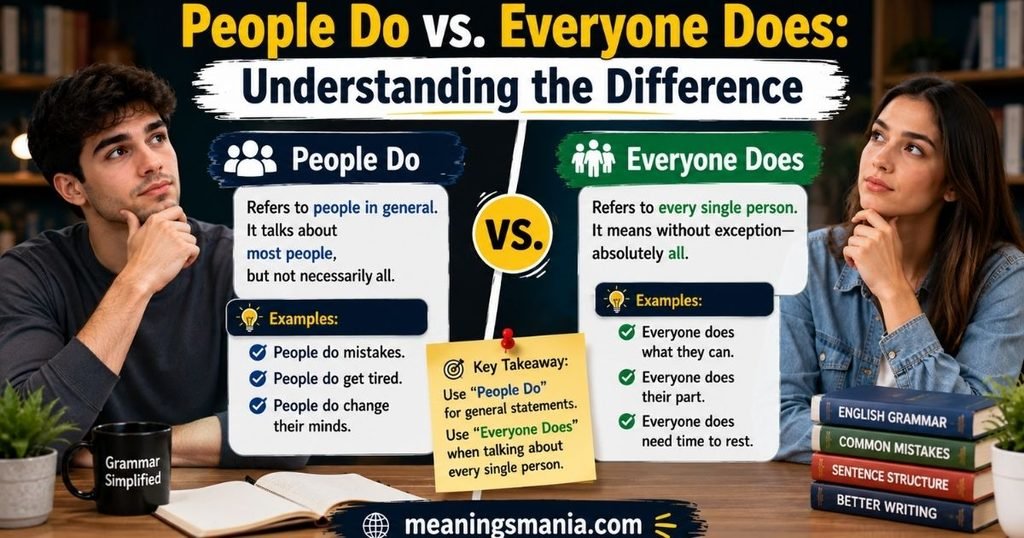
This comparison can feel confusing because both people and everyone can refer to many individuals. However, they follow different grammar rules.
People is grammatically plural, so we say, “People do what they think is best.” Everyone, on the other hand, is grammatically singular. Therefore, we say, “Everyone does what they think is best.”
The difference comes from grammatical meaning, not the number of people involved. Everyone treats each individual separately, while people functions as a plural noun.
Why Do Native English Speakers Say “People Do”?
Native speakers say people do because it follows the normal patterns of English grammar. It’s not a special expression or an exception you need to memorize. The phrase simply follows subject-verb agreement.
Native speakers also naturally connect people with plural pronouns such as they and their. For example, “People do what they want” follows the same grammatical pattern as “They do what they want.” That familiar pattern is why the correct form sounds natural to fluent speakers.
People Do or People Does in Questions and Negative Sentences
The same rule applies when you ask a question or make a negative statement. The sentence format may change, but the relationship between the subject and auxiliary verb remains the same.
For example:
- Do people like surprises?
- People do not always agree.
- Does a person like surprises?
- A person does not always agree.
Questions use an interrogative sentence structure, while negatives use do not or does not. However, the subject still determines which form you need. With people, the answer is do.
How to Remember Whether to Use “Do” or “Does” With People
You don’t need to memorize a long list of grammar rules to solve this problem. One simple mental shortcut works surprisingly well: replace people with they.
Ask yourself which sentence sounds correct: “They do” or “They does”? The answer is obvious. That means the same choice works with people: People do.
This trick is especially useful when you’re writing quickly. It gives you a fast way to check grammatical agreement without overthinking every sentence.

A Quick Trick for Choosing the Correct Verb
Try matching the subject with a familiar pronoun. For example, replace a plural subject with they and a singular subject with he or she.
- People → they → do
- One person → he or she → does
This small habit can help you understand verb conjugation naturally. Over time, the correct form will start to feel automatic.
Common Everyday Examples to Help You Remember
Real-life examples are often easier to remember than technical grammar terms. Think about these simple sentences:
- People do what they can.
- Do people do this often?
- People do not know everything.
- One person does the work alone.
The pattern stays the same across everyday English. Plural subjects use do, while singular third-person subjects use does. Keep that contrast in mind, and you’ll avoid most do and does mistakes.
FAQs
Is “people do” or “people does” correct?
People Do vs People Does is correct because people is a plural noun and requires a plural verb under standard subject-verb agreement rules.
Is people always a plural noun?
People Do vs People Does usually acts as a plural noun, referring to multiple individuals and taking plural verbs such as do, are, and have.
Why does “people does” sound wrong?
People Do vs People Does sounds wrong because does is a third-person singular verb, while people normally functions as a plural subject.
Do people use “do” in questions?
Yes, questions with People Do vs People Does, such as “Do people understand?” because people follows plural subject and verb agreement.
What is the difference between a person does and people do?
A person is singular and takes does, while people is plural and takes do in standard English grammar.
Can I say “people doesn’t” instead of “people don’t”?
No. People is plural, so use don’t or do not rather than doesn’t, which is used with singular subjects.
How can I remember the People Do vs People Does rule?
Replace people with they. Since you say “they do,” the correct People Do vs People Does choice is always people do.
Conclusion
The answer to People Do vs People Does is simple once you know the basic rule: people do is correct. The word people normally refers to more than one person, so it behaves as a plural subject.
Remember the simple contrast: one person does, but many people do. When you’re unsure, replace people with they and check the verb. It’s a quick trick that works in most everyday situations.
With a little practice, the correct use of People Do vs People Does will feel natural. And honestly, that’s the goal of grammar—to help you communicate clearly without having to stop and overthink every sentence.
