
Have you ever typed a word, looked at it twice, and still wondered if it was right? Humorous vs Humerous is one of those small spelling questions that can cause surprisingly big confusion. The two words look similar at first glance, but only one belongs in standard English.
If you’ve written Humorous vs Humerous, don’t worry—you’re definitely not alone. Many people mix up the letters because the word sounds a little different from how it looks. Learning how to spell humorous correctly is easier once you understand the pattern behind the word.
So, how do you spell humorous without second-guessing yourself? This guide breaks everything down in plain English. You’ll learn the correct spelling, meaning, common mistakes, and simple examples. By the end, you’ll know exactly which word to use and feel more confident whenever it appears in your writing.
Quick Answer: Is It Humorous or Humerous?
The correct spelling is humorous.
Humerous is generally a spelling error when you’re trying to describe something funny or amusing. The standard adjective is humorous, formed from the word humor with the suffix -ous.
For example:
- Correct: That was a humorous story.
- Incorrect: That was a humerous story.
- Correct: She made a humorous comment during dinner.
- Incorrect: She made a humerous comment during dinner.
A quick memory trick is to look at the base word: humor → humorous. Keeping the “o” can help you avoid the common humerous spelling mistake.

Why Do People Confuse Humorous and Humerous?
The confusion mostly comes from pronunciation. When people say humorous, the middle sound can be easy to overlook. That makes humerous seem like a reasonable spelling, especially when you’re writing quickly.
There’s another reason, too. English spelling doesn’t always match pronunciation perfectly. You might hear the word in conversation many times before ever seeing it written. When that happens, your brain may naturally choose the spelling that seems to match the sound.
A few things can contribute to the mix-up:
- Sound: The unstressed middle syllable can be easy to miss.
- Typing: Fast writing often produces small vowel errors.
- Visual similarity: Both spellings look almost identical.
- Word formation: Writers may not immediately connect humorous with humor.
If you’ve written “humerous” before, the mistake is understandable. However, humorous is the form to choose in standard modern English.
Humorous vs Humerous: Key Differences at a Glance
The easiest way to separate these terms is to focus on meaning and spelling.
| Term | Correct? | Meaning | Example |
| Humorous | Yes | Funny, amusing, or witty | She told a humorous story. |
| Humerous | No, for this intended meaning | Usually a misspelling of humorous | Avoid this spelling in normal writing. |
| Humor | Yes | The quality or sense of being funny | His humor is subtle. |
So, when you’re describing a person, story, comment, video, situation, or writing as funny, use humorous.
The Simple Spelling Difference You Should Remember
Think of the spelling as humor + ous = humorous.
That little connection makes the word much easier to recall. If you’re wondering, “How do you spell humorous?” start with humor, then add -ous.
For example:
humor → humorous
Not:
humer → humerous
This simple pattern is especially useful when you’re proofreading an email, article, school assignment, or social media post.
What Does Humorous Mean and How Is It Used?
Humorous is an adjective that describes something intended to make people laugh or something that has an amusing quality. It can describe words, behavior, stories, writing, people, situations, and more.
For instance, you might say:
- “The movie has a humorous storyline.”
- “He gave a humorous response.”
- “Her humorous personality makes conversations enjoyable.”
- “The article takes a humorous look at everyday problems.”
The word doesn’t necessarily mean something is laugh-out-loud hilarious. Sometimes Humorous vs Humerous simply means pleasantly funny, witty, playful, or amusing.
It also works in both casual and formal writing. You could use it in a text message, blog post, essay, review, or professional description without sounding unusual.
Examples of Humorous in Everyday Sentences
Seeing the word in context makes its meaning easier to understand. Here are several natural examples:
- The teacher used a humorous example to explain the difficult lesson.
- His humorous comment made everyone relax.
- She wrote a humorous caption for her vacation photo.
- The podcast has a clever and humorous style.
- My brother has a humorous way of telling stories.
- The article uses humorous language without becoming distracting.
Notice how humorous describes something that creates or contains amusement. It doesn’t function as the name of the amusement itself.
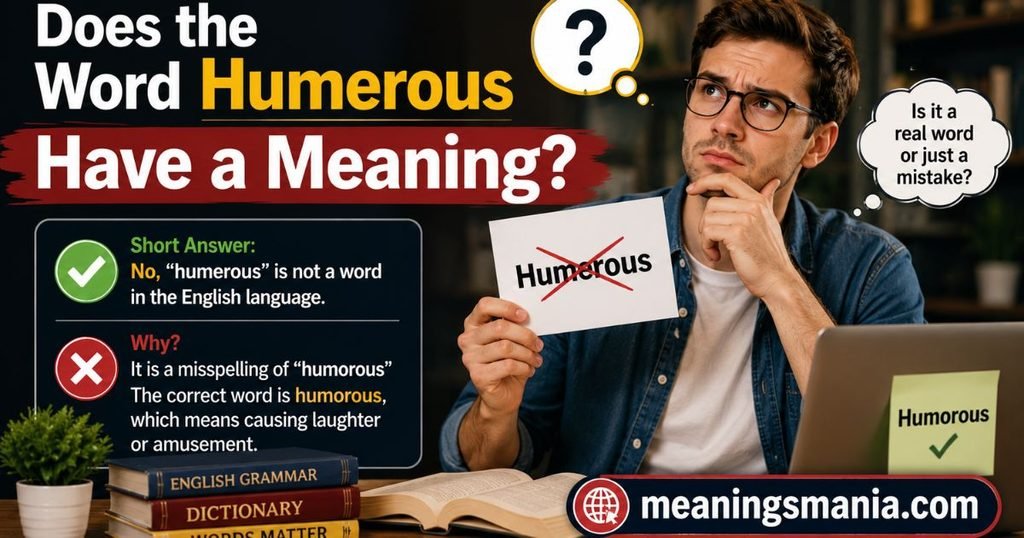
Does the Word Humerous Have a Meaning?
If you’re using humerous as an attempted spelling of “funny” or “amusing,” it isn’t the standard form you want. In ordinary modern English, write humorous instead.
This is why searching for the humerous meaning can be confusing. You may encounter the spelling in mistakes, informal writing, or unusual historical references, but that doesn’t make it the standard choice for modern everyday English.
So if your sentence means that something is funny, the safe choice is straightforward:
Use humorous.
Why Humerous Is Often Considered a Spelling Mistake
The problem with Humorous vs Humerous is mainly the missing “o” from humor.
For example:
❌ The comedian gave a humerous performance.
✅ The comedian gave a humorous performance.
The second version clearly uses the accepted adjective. If you’re writing professionally, using humerous may make readers pause because it looks like an editing mistake.
Tone, Context, and When to Use Humorous
Humorous works in many different settings. You can use it when describing a joke, person, story, remark, article, conversation, or creative style.
In casual conversation, someone might say:
“That was a pretty humorous way to handle it.”
In more formal writing, you could write:
“The author takes a humorous approach to the subject.”
The tone can vary, too. Humorous often sounds a little more polished than simply saying funny, although the two aren’t always interchangeable.
For example, “a funny accident” and “a humorous story about an accident” don’t communicate exactly the same idea. The first may describe the event itself. The second emphasizes how the story is presented.
Which Spelling Should You Use in Formal Writing?
Use humorous in formal writing, academic work, business communication, and professional content.
There’s no advantage to choosing humerous. If you’re unsure, check whether the word relates to humor. In that case, humorous is the spelling you need.
You can safely use it in:
- School assignments
- Business emails
- Blog articles
- Social media captions
- Product descriptions
- Reviews
- Essays
- Professional reports
For example, “The presentation included several humorous examples” sounds natural and grammatically correct.
Common Humorous Spelling Mistakes and Easy Fixes
Most mistakes with this word are small. Fortunately, they’re easy to catch during proofreading.
1. Writing “humerous”
❌ “He wrote a humerous article.”
Replace it with:
✅ “He wrote a humorous article.”
2. Forgetting the connection to humor
If you remember humor, the spelling becomes more intuitive.
Humor + ous = humorous
3. Confusing humorous with humor
These words have related meanings, but they play different grammatical roles.
- Humor is generally a noun.
- Humorous is an adjective.
For example:
“Her humor is clever.”
But:
“Her writing is humorous.”
4. Assuming funny and humorous are identical
They’re close, but context matters. Funny can have several meanings, including strange or unusual. Humorous specifically points toward amusement or comedy.
Everyday Examples of Humorous Used Correctly
Here are some examples that sound natural in everyday communication:
- “Your humorous reply actually made my day.”
- “That was a humorous way to explain the problem.”
- “She shared a humorous story at lunch.”
- “The video has a humorous ending.”
- “His humorous personality comes through in his writing.”
- “I like the author’s humorous style.”
- “The caption adds a humorous touch to the photo.”
You might also see the word in online conversations.
Friend 1: “Why did you send me that picture?”
Friend 2: “It was meant to be humorous!”
Here, humorous describes the intention behind the picture. The sender wanted it to be amusing rather than serious.

Dictionary-Style Details: Humorous Meaning, Pronunciation, and Word Type
Humorous is an adjective. It describes something that is funny, amusing, witty, or related to a lighthearted sense of humor.
Pronunciation: Commonly pronounced roughly like HYOO-muh-rus in American English.
Word type: Adjective
Base word: Humor
Related forms:
- Humor — noun
- Humorous — adjective
- Humorously — adverb
- Humorousness — noun, referring to the quality of being humorous
For example:
“The writer humorously described the awkward situation.”
Here, humorously modifies the way the writer described something, while Humorous vs Humerous would describe the thing itself.
Humorous Synonyms and Related Words
Depending on the sentence, several words can express a similar idea.
- Funny
- Amusing
- Witty
- Comic
- Entertaining
- Playful
- Lighthearted
- Comical
However, these words aren’t perfect replacements every time. Witty, for example, often suggests cleverness, while entertaining can describe something enjoyable without necessarily being funny.
How to Remember the Correct Spelling of Humorous
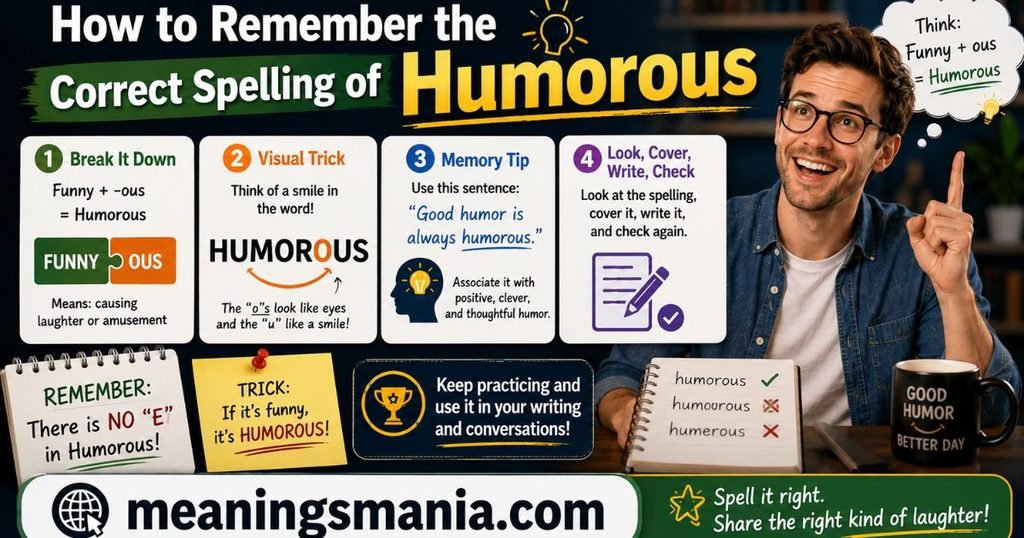
Here’s an easy trick: don’t separate humorous from humor.
Picture the word this way:
HUMOR + OUS = HUMOROUS
The extra “o” belongs there because the adjective keeps the connection to humor.
You can also create a quick mental sentence:
“A humorous person has a good sense of humor.”
That sentence links both words together. Once the connection sticks, humerous starts looking obviously wrong.
Is Humerous Ever an Acceptable Alternative Spelling?
For ordinary modern English, don’t use humerous when you mean funny or amusing. Humorous is the standard spelling readers expect.
You may occasionally encounter unusual or historical spellings when researching older texts or specialized language. However, that doesn’t make humerous a suitable alternative for everyday writing.
If you’re writing an email, article, assignment, caption, or message today, choose humorous.
Humorous Synonyms and Related Words You Can Use Instead
The best synonym depends on exactly what you want to say.
Funny is the most common everyday alternative. It sounds natural and casual.
Amusing suggests something that provides enjoyment or mild laughter.
Witty emphasizes clever remarks, observations, or wordplay.
Comical often describes something that resembles comedy or looks funny.
Entertaining is broader. Something can be entertaining without being humorous.
For example:
- “She gave a humorous answer.”
- “She gave a witty answer.”
- “She gave a funny answer.”
All three can work, but each creates a slightly different impression.
Why Is Humorous Spelled Without an “E” After the M?
The standard spelling is based on humor, not “humer.” Adding -ous gives you humorous.
That’s why the spelling contains:
h-u-m-o-r-o-u-s
Rather than:
h-u-m-e-r-o-u-s
Remembering the base word is more reliable than trying to memorize every letter individually.
How Do You Spell Humorous Correctly in American English?
In American English, spell it humorous.
If you’re asking “how do you spell humorous?” the answer is:
H-U-M-O-R-O-U-S
A useful way to remember it is to start with humor and attach -ous. This works better than relying only on pronunciation.
What Is the Difference Between Funny and Humorous?
Both words can describe something that makes people laugh, but their usage isn’t always identical.
Funny is broader and more common in everyday speech. It can also mean strange or unexpected, as in “That’s funny—you were supposed to be here already.”
Humorous specifically emphasizes amusement, comedy, wit, or a lighthearted quality.
So, a strange situation can be funny without necessarily being humorous. Context determines which word fits best.

Frequently Asked Questions
Is “humerous” a correct spelling?
No, Humorous vs Humerous isn’t the standard spelling when describing something funny; use humorous in modern English writing.
What is the correct spelling of humorous?
The correct spelling is Humorous vs Humerous, with “humor” followed by “ous”; humerous is generally a spelling mistake.
What does humorous mean?
Humorous vs Humerous means funny, amusing, witty, or likely to create laughter through words, behavior, situations, or presentation.
Is humorous an adjective?
Yes, Humorous vs Humerous is an adjective used to describe people, comments, stories, writing, situations, or anything containing amusement.
How do you pronounce humorous?
In American English, Humorous vs Humerous is commonly pronounced “HYOO-muh-rus,” with the middle syllable pronounced softly during normal speech.
Is humorous the same as funny?
Not exactly; funny is broader, while Humorous vs Humerous specifically emphasizes amusement, wit, comedy, or a lighthearted quality.
How can I remember the spelling of humorous?
Connect Humorous vs Humerous with humor: remember “humor” plus “ous,” and you’ll avoid the common humerous spelling mistake.
Conclusion
When comparing Humorous vs Humerous, the choice is straightforward. Humorous is the standard spelling when you want to describe something funny, amusing, witty, or entertaining.
The easiest memory trick is to connect the adjective directly to humor:
humor → humorous
If you catch yourself writing Humorous vs Humerous, stop and check the middle letters. In most modern writing, you want the “o” from humor to remain visible.
Whether you’re writing a school assignment, professional email, article, or casual caption, choosing Humorous vs Humerous keeps your spelling clear and polished. Once you remember the connection to humor, this particular spelling problem becomes much easier to avoid.
