


Have you ever paused while writing because you weren’t sure whether to use Long Term or Long-Term? You’re not alone. Small grammar choices can make even simple sentences feel tricky. The difference usually comes down to how the phrase works in a sentence. Once you see the pattern, it becomes much easier to choose the right form.
The word long-term often describes something that lasts for an extended period. Meanwhile, long term can serve a different grammatical role. You may also run into other confusing expressions, such as cancelation, of course or of course, and how long is soon. These Long Term or Long-Term can leave you second-guessing your writing.
In this guide, you’ll learn when to write Long Term or Long-Term and when to use long-term. We’ll keep things simple and practical. You’ll also see clear examples that show how each form works. By the end, you’ll know exactly which version fits your sentence.
Quick Answer
If you’re wondering whether to write long term or long-term, both forms can be correct. The right choice depends on the job the phrase performs in your sentence.
Use long-term when the phrase works together as an adjective before a noun:
- long-term goals
- long-term planning
- long-term relationship
- long-term effects
Use long term when you’re talking about an extended period of time, usually in phrases such as in the long term, over the long term, or for the long term.
And what about longterm? In standard English, that’s not the usual spelling. Keep it as two words or hyphenate it when grammar calls for a compound adjective.
Is “longterm” correct?
Generally, no. Longterm isn’t the standard form in edited English. If you’re writing an email, essay, article, report, or professional document, use long term or long-term instead.
For example:
We’re thinking about the long term.
We’re developing a long-term strategy.
The difference isn’t about pronunciation. It’s about sentence structure.
When to use “long term”
Choose Long Term or Long-Term when you’re referring to a period of time rather than directly modifying a following noun.
For example:
- In the long term, the decision could save money.
- We need to think about the long term.
- This approach should work over the long term.
- They’re investing for the long term.
Here, long term acts as a noun phrase. There’s no noun immediately after it that the phrase needs to describe.
When to use “long-term”
Use long-term when the two words work together to describe a noun.
Examples include:
- long-term investment
- long-term commitment
- long-term solution
- long-term success
- long-term strategy
The hyphen makes it clear that long and term function together as one modifier.
One-line grammar rule you can memorize
Before a noun as one combined modifier: use “long-term.” When referring to time by itself: use “long term.”
It’s a useful shortcut, although sentence context should always have the final say.
What Does “Long-Term” Mean?
Long-term describes something intended to last, develop, or remain relevant for an extended period. Grammatically, it commonly works as a compound adjective.
For example, if you say long-term planning, you’re describing the type of planning involved. Likewise, long-term effects means effects that continue or appear over an extended period.
The hyphen matters because the words work together before the noun:
- a long-term relationship
- a long-term solution
- a long-term agreement
- a long-term strategy
You may see this form frequently in business, education, finance, healthcare writing, and everyday conversation. It isn’t limited to formal English.
For example, someone might tell a friend, “I’m looking for a long-term relationship.” A business owner might say, “We need a long-term plan.” Both use the same grammatical pattern.
What Does “Long Term” Mean?
Long Term or Long-Term refers to an extended period of time. In this use, the phrase isn’t directly modifying a noun that follows it.
You’ll often encounter it after a preposition:
- in the long term
- over the long term
- for the long term
You can also use it in sentences such as:
We need to consider the long term.
She’s thinking about what will happen in the long term.
Here, you’re talking about time as an idea or period. That’s why the phrase doesn’t need a hyphen.
The meaning remains closely related to long-term, but the grammatical role changes. That’s the key distinction to remember.
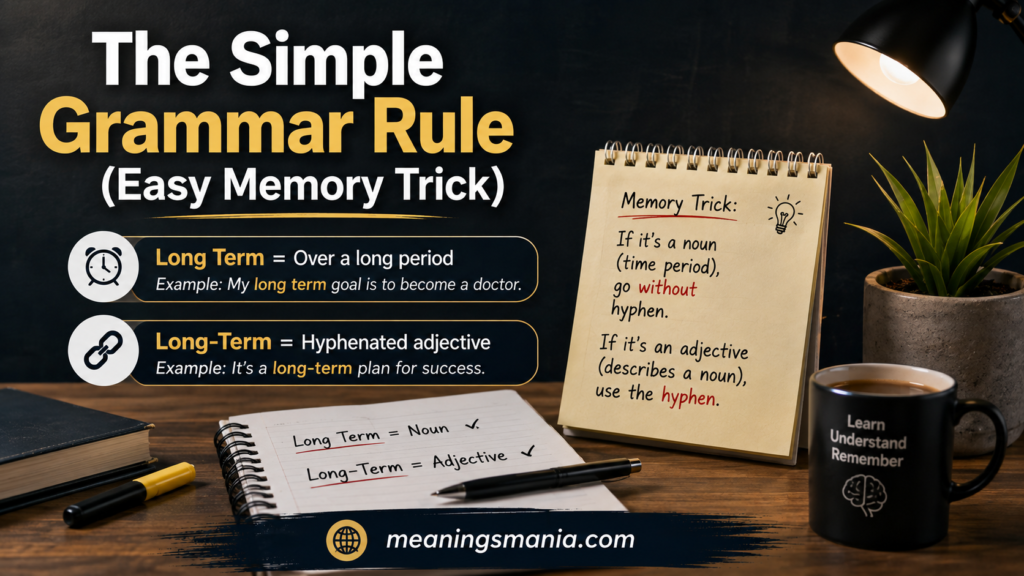
The Simple Grammar Rule (Easy Memory Trick)
Here’s an easy way to make the choice quickly: look at what comes next.
If long-term comes directly before a noun and describes it, use the hyphen.
a long-term investment
If you’re using the phrase to talk about an extended period, use long term.
In the long term, the investment may pay off.
This works because a hyphen can join words that function together as a single modifier. Without that modifying role, there’s usually no reason to connect the words.
However, don’t treat this as a rule that works without context. English has exceptions and style preferences. When you’re unsure, read the whole sentence rather than checking the phrase in isolation.
Long Term vs Long-Term (Side-by-Side Comparison)
The easiest way to see the difference is to put the two forms next to each other.
| Form | Typical role | Example |
| long-term | Compound adjective | We need a long-term strategy. |
| long term | Noun phrase referring to time | In the long term, it should help. |
| longterm | Nonstandard spelling | Avoid longterm in standard writing. |
Notice how the position changes the punctuation.
In long-term strategy, the phrase tells you what kind of strategy you’re talking about. In in the long term, it identifies the period you’re discussing.
You can often test your sentence by removing the following noun. If the phrase still refers naturally to a period of time, you’re probably dealing with long term.
Why Do People Get Confused?
The confusion is understandable because long-term and long term sound exactly alike when spoken. You can’t hear the hyphen.
Things become even less obvious when you encounter both forms repeatedly:
She has long-term goals.
Her goals will matter in the long term.
The meaning is closely connected, but the grammatical structure isn’t identical.
Another source of confusion is the mistaken spelling longterm. Because English contains many compound words written as one word, some people assume this phrase should work the same way. It doesn’t in standard usage.
Different style guides can also have their own preferences about hyphenation in particular constructions. Still, the adjective-versus-noun distinction is a reliable starting point for everyday writing.
Common Mistakes Writers Make
The biggest mistake is treating long term, long-term, and long-term as interchangeable. They aren’t.
Here are a few common problems to watch for:
- Wrong: We need a long term solution.
- Better: We need a long-term solution.
- Wrong: In the long-term, costs may fall.
- Better: In the long term, costs may fall.
- Wrong: We’re making a longterm investment.
- Better: We’re making a long-term investment.
Another common issue is adding a hyphen automatically whenever the phrase appears. That’s not necessary.
For example, in the long-term is generally unnecessary when long term functions as a noun phrase. The correct form is usually in the long term.
The goal isn’t to memorize every sentence. Learn what the phrase is doing, and the punctuation becomes much easier.
Is “Longterm” Correct?
Long term is generally not the standard spelling in conventional English writing. If you’re aiming for clear, polished English, don’t combine the two words.
Instead, choose the form that matches your sentence:
Long-term:
They created a long-term plan.
Long term:
The plan should help in the long term.
You might occasionally see longterm in usernames, branding, informal posts, or other nonstandard contexts. That doesn’t make it the preferred spelling for normal English prose.
If you’re writing for school, work, publishing, or a professional audience, stick with the standard forms.
Real-Life Usage Examples
Seeing the phrase in different situations makes the distinction much easier.
Everyday conversation
“Are you looking for something serious?”
“Yes, I’m interested in a long-term relationship.”
Here, long-term describes the noun relationship.
Another example:
“Do you think this problem will matter?”
“Maybe not in the long term.”
Long term refers to a period of time.
Work and business
The company needs a long-term strategy for growth.
In the long term, that strategy could reduce operating costs.
Both sentences discuss the same general idea, but the grammar changes.
Education
She has a long-term goal of earning a graduate degree.
Over the long term, consistent study can make a major difference.
Personal decisions
Buying a reliable car can be a long-term investment.
It may cost more now, but it could save money in the long term.
These examples show why context matters more than memorizing one spelling.
Quick Grammar Test (Interactive Section)
Try this simple test. Fill in each blank with long term or long-term.
- We need a ______ solution.
- ______, the change should save money.
- She’s making a ______ commitment.
- Think about the ______ before deciding.
- They developed a ______ strategy.
Answers:
- long-term
- In the long term
- long-term
- long term
- long-term
Here’s another trick. Look for a noun immediately after the phrase.
If you see:
long-term + noun
the hyphen is usually appropriate.
If you see:
in/over/for + the long term
keep the phrase open.
Long Term or Long-Term in a Sentence?
Both forms can appear in the same sentence, which is why this topic sometimes feels confusing.
Consider this example:
A long-term strategy can produce better results in the long term.
The first phrase describes strategy, so it needs the hyphen. The second refers to a period of time, so it doesn’t.
That pattern is perfectly normal. You don’t have to use the same form throughout a paragraph.
How to use “long-term” before a noun
Use long-term when it directly modifies a noun.
Examples include:
- long-term goals
- long-term planning
- long-term effects
- long-term relationship
- long-term commitment
- long-term success
For example:
We need a long-term solution rather than another temporary fix.
Here, long-term tells the reader what kind of solution you mean.
How to use “long term” after a verb or preposition
Use long term when the phrase functions as a noun phrase referring to time.
Common patterns include:
- think about the long term
- plan for the long term
- work over the long term
- benefit in the long term
- succeed in the long term
For example:
We don’t know what will happen in the long term.
The phrase isn’t describing a noun that follows it. It’s pointing to a future period.
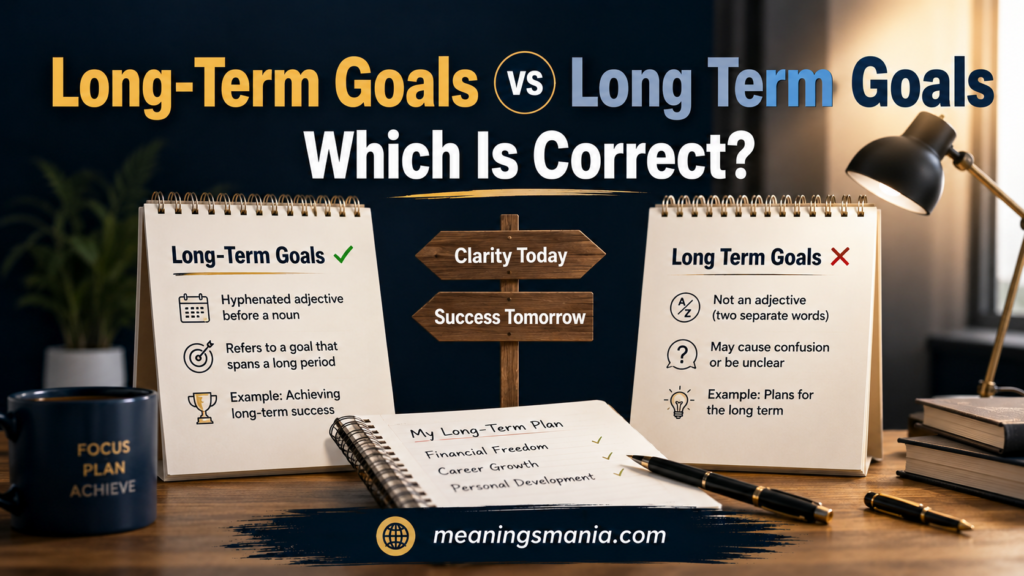
Long-Term Goals vs Long Term Goals: Which Is Correct?
When Long Term or Long-Term comes directly before goals, the hyphenated version is the standard choice:
She wrote down her long-term goals.
The hyphen connects long and term into a single modifier for goals.
Writing long term goals may still be understood easily, but the hyphenated version is clearer and generally preferred in polished writing.
You can also rewrite the sentence so the phrase doesn’t directly modify the noun:
She wants to achieve her goals in the long term.
Now the phrase refers to time, so the hyphen disappears.
This is a useful example because it shows that the words themselves haven’t changed meaning dramatically. Their grammatical function has.
Long-Term vs Long Term in Business and Professional Writing
Professional writing uses both forms frequently. You’ll see long-term in business plans, financial discussions, project documents, and strategy statements.
Examples include:
- long-term growth
- long-term investment
- long-term planning
- long-term objectives
- long-term commitment
Meanwhile, long term commonly appears when discussing outcomes or time horizons:
The policy may be expensive now but beneficial in the long term.
The distinction helps professional writing stay precise. It also prevents distracting punctuation mistakes in reports, presentations, and business communication.
Choosing the correct form in emails, reports, and formal documents
Before sending a professional document, check whether long term is modifying a noun.
If it is, the hyphenated form will usually be appropriate:
We’re developing a long-term partnership.
If you’re referring to an extended period, leave it open:
This decision should benefit the company in the long term.
Also avoid longterm in standard professional writing. A quick proofreading pass can catch this easily.
Long-Term Meaning in Different Contexts
The phrase can describe many things, but its basic idea stays consistent: something extends across a considerable period.
For example:
- A long-term relationship suggests an ongoing relationship.
- A long-term investment is intended to be held over an extended period.
- Long-term effects continue or emerge over time.
- Long-term planning focuses on future outcomes rather than immediate results.
- A long-term commitment suggests sustained involvement.
The exact length isn’t fixed. What counts as “long-term” depends on the subject.
A business may consider several years long-term. A short project might consider several months significant. The phrase describes duration relative to the situation rather than specifying an exact number.
How “Long Term” Works in Everyday English
You don’t need formal writing to use long term correctly. It appears naturally in everyday speech.
Someone might say:
“I’m not worried about the price in the long term.”
Or:
“Let’s think about the long term before we decide.”
You might also hear:
“Will this work over the long term?”
These expressions all focus on what happens across an extended period.
That makes long term especially useful when you’re discussing consequences, plans, costs, relationships, or decisions without directly describing a noun.
What About “Longterm” in Texting and Social Media?
In casual texting, people sometimes drop punctuation or combine words. You may therefore encounter longterm online.
However, informal usage doesn’t change the standard spelling. If you’re writing a resume, school assignment, article, email, or business message, use long-term or long term according to the sentence.
For example, a casual post might say:
“I need a longterm solution, lol.”
For polished writing, use:
“We need a long-term solution.”
The context may be casual, but the standard grammar rule remains useful.
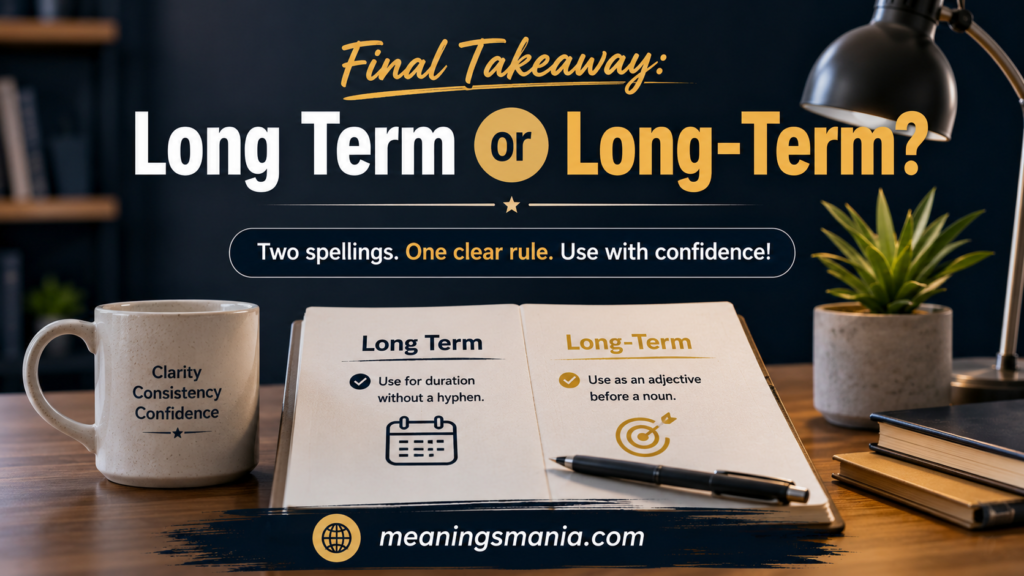
Final Takeaway: Long Term or Long-Term?
The choice is easier once you stop treating the two forms as competing spellings.
Long-term is usually a compound adjective that comes before a noun:
long-term goals
Long term is generally a noun phrase referring to an extended period:
in the long term
And longterm should generally be avoided in standard English.
When you’re unsure, look at the sentence around the phrase. Ask yourself one simple question: Am I describing a noun, or am I talking about a period of time? That answer will usually tell you which form to use.
FAQ’s
Is “long term” or “long-term” grammatically correct?
Both are correct; long-term modifies nouns, while long term usually refers to an extended period.
Is “longterm” one word?
No, longterm isn’t the standard spelling in conventional English writing; use long-term or long term.
Should I write “in the long term” or “in the long-term”?
Use in the long term because the phrase refers to time rather than directly modifying another noun.
Should “long-term” always have a hyphen?
Not always; the hyphen typically appears when Long Term or Long-Term functions as a compound adjective before a noun.
What is a long-term adjective?
Long Term or Long-Term is a compound adjective that describes something lasting or relevant across an extended period.
Is “long term goals” correct?
Use long-term goals in polished writing because the compound adjective directly modifies the noun goals.
How can I remember long term versus long-term?
Think “modifier before noun equals hyphen,” while references to time generally use the open form long term.
Conclusion
Choosing between Long Term or Long-Term doesn’t have to be confusing. The key is to notice how the phrase works in your sentence. Use long-term when it describes a noun, such as “long-term goals.” Use Long Term or Long-Term when you’re talking about time, as in “in the long term.” Once you spot that difference, the correct form becomes much easier to choose.
English has plenty of small spelling and grammar questions that can cause hesitation. You might wonder about cancellation, of course or of course, or even how long is soon. These questions seem minor, but choosing the standard form makes your writing clearer. The same idea applies here. A small hyphen can change the grammatical role of a phrase.
So, keep one simple idea in mind: long-term usually modifies a noun, while long term refers to time. Avoid Long Term or Long-Term n standard writing. With a little practice, you’ll use each form naturally and confidently.
