


Ever paused before typing “cancellation” because you weren’t sure about the spelling? You’re not alone. Cancellation vs Cancelation can be confusing, especially when American and British English follow slightly different patterns. One small letter can make you stop and second-guess your sentence.
The good news is that the answer is easier than it looks. Once you understand why Cancellation vs Cancelation usually takes two Ls, you’ll know which form to choose. We’ll also clear up related wording questions, from long-term and long term to ofcourse or of course. These small details can make your writing look much cleaner.
You may also wonder how long is soon when someone gives a vague promise. That phrase has its own Cancellation vs Cancelation and context. By the end, you’ll have simple answers and practical examples you can use confidently in everyday writing, work emails, and formal content.
Quick Answer
If you’re asking which is correct: cancellation or cancelation, use cancellation in most situations.
Cancellation is the established spelling used in standard American and British English. It appears frequently in professional documents, websites, news writing, academic material, travel information, and everyday communication.
Cancelation, with one “l,” is also found in some dictionaries as a variant. However, it’s much less common. Many readers may even assume it’s a typo because cancellation is so familiar.
For example:
- Correct and widely preferred: Your flight cancellation has been confirmed.
- Less common variant: Your flight cancelation has been confirmed.
If you’re writing for a broad audience, choosing cancellation is the safest approach.
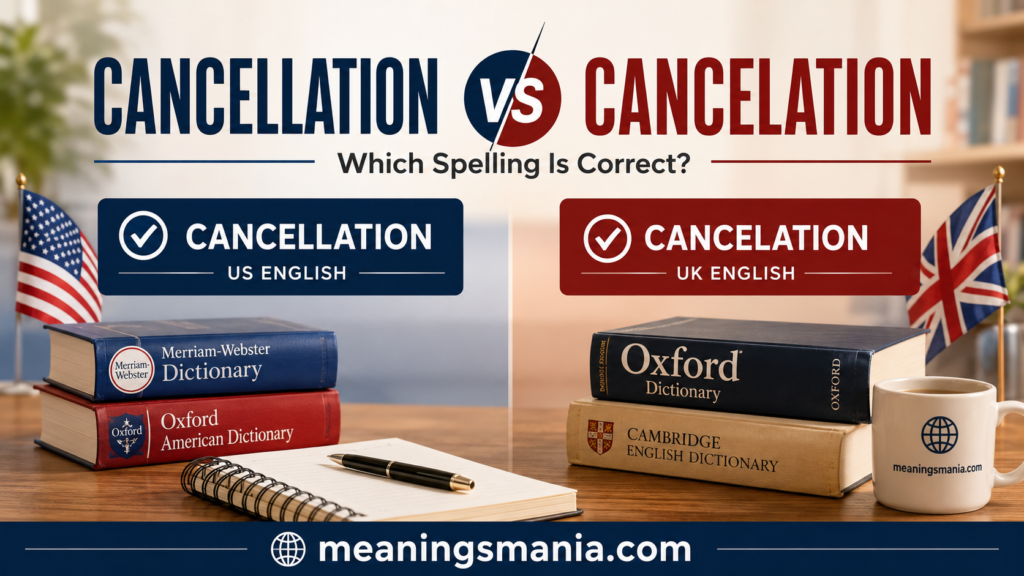
Cancellation vs Cancelation – Key Differences at a Glance
Both spellings come from the verb cancel, and both refer to the act of canceling something. The main difference is how commonly each spelling is accepted and used.
Cancellation is the dominant form. You’ll encounter it in phrases such as “cancellation policy,” “cancellation fee,” and “event cancellation.”
Cancelation isn’t meaningless or automatically incomprehensible. It’s simply a much less frequent spelling. That distinction matters when you’re writing something intended to look polished and familiar.
| Feature | Cancellation | Cancelation |
| Number of Ls | Two | One |
| Meaning | Act of canceling something | Act of canceling something |
| American English | Standard and strongly preferred | Rare variant |
| British English | Standard | Very uncommon |
| Professional writing | Recommended | Usually avoid |
| Everyday recognition | Very high | Much lower |
| Best choice for general readers | Yes | No |
So, when you’re choosing between Cancellation vs Cancelation , the practical answer is straightforward: go with cancellation.
American vs British English: The Real Difference
American and British English often spell certain words differently. You may already know examples such as color/colour, center/centre, and traveling/travelling.
However, you shouldn’t assume that every American spelling removes a double consonant. English spelling has many individual conventions, and cancellation is one example where the familiar double-L noun remains standard.
The important distinction is that the related verb forms can vary:
- US English: canceled, canceling
- UK English: cancelled, cancelling
- Both: cancellation
That can feel inconsistent at first. However, the noun Cancellation vs Cancelation has its own established spelling pattern.
Webster’s Spelling Reforms
American spelling developed several conventions that differ from traditional British usage. Noah Webster played an important role in promoting some of those differences in American dictionaries.
His influence helped popularize forms such as:
- color instead of colour
- center instead of centre
- traveled instead of travelled
Those changes don’t mean American English removes every doubled letter. Spelling developed word by word, so some forms remained unchanged.
That’s why it’s risky to use a simple rule such as “American English always uses fewer letters.” It doesn’t.
US Spelling Trends
American English commonly uses canceled and canceling, with one “l.” British English generally prefers cancelled and cancelling, with two.
Yet the noun is normally written cancellation in both varieties.
For example:
The airline canceled the flight because of severe weather.
The airline announced the flight cancellation shortly afterward.
Notice the difference. The verb canceled has one “l” in this American English example, while the noun cancellation keeps two.
Global Publishing Standards
If your content is intended for readers from different countries, familiar spelling matters.
A customer visiting a website may see terms such as:
- cancellation policy
- cancellation request
- cancellation notice
- cancellation fee
- cancellation date
Using cancellation helps your writing match the spelling most readers already recognize.
This is especially useful for websites, customer-service pages, contracts, booking systems, and other public-facing content.
What Major Dictionaries Say
Major English dictionaries generally recognize cancellation as the main or preferred spelling. Some also record cancelation as a variant.
That distinction is important. A dictionary listing doesn’t necessarily mean two spellings are equally common or equally suitable for every situation.
When a spelling is marked as a variant, less common, or secondary, you should consider your audience and writing style before choosing it. For general professional writing, Cancellation vs Cancelation remains the better choice.
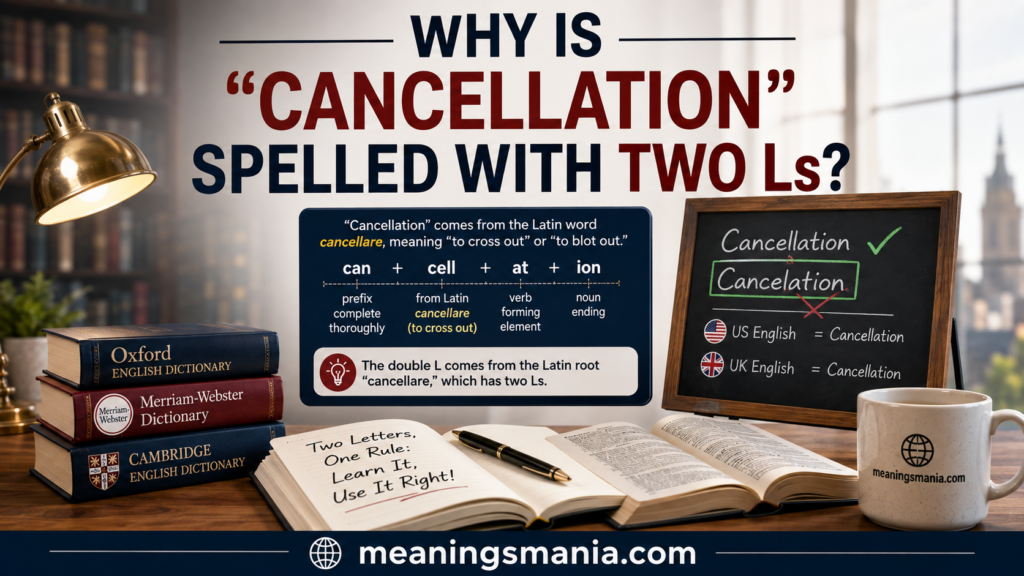
Why Is “Cancellation” Spelled with Two Ls?
The spelling becomes easier to understand when you look at the word’s formation.
Cancellation is built from cancel and the suffix -ation. But it’s not accurate to say that English has one universal rule requiring a double consonant whenever you add -ation.
Instead, spelling patterns developed through the history and structure of individual words. Cancellation preserves the double-L form associated with the word’s established noun spelling.
That’s why memorizing the exact form is more useful than relying on an oversimplified “double consonant rule.”
A helpful way to remember it is:
cancel → cancellation
The noun has two Ls.
You can also connect it with common phrases:
- cancellation policy
- cancellation fee
- cancellation notice
- cancellation request
- cancellation process
Seeing the word repeatedly in these combinations makes the spelling much easier to remember.
Is “Cancelation” Ever Correct?
Yes, cancelation can be found as a spelling variant. It isn’t simply a random misspelling created by someone who forgot an “l.”
However, that doesn’t mean it’s the best choice.
The problem is frequency and familiarity. Cancellation is overwhelmingly more recognizable to most readers. If you use cancelation, readers may pause because the word looks unusual.
For example, compare these:
Please review our cancellation policy before booking.
Please review our cancelation policy before booking.
Both communicate the intended meaning, but the first looks much more natural to most English readers.
So, if your goal is clear and professional writing, cancellation is the better option.
Real Examples of “Cancellation” in Sentences
Seeing the word in context can make the difference much clearer. Here are some natural examples:
- The airline sent a cancellation notice before the scheduled departure.
- I requested the cancellation of my monthly subscription.
- The concert was postponed after an unexpected event cancellation.
- Check the hotel’s cancellation policy before making a reservation.
- The company waived the cancellation fee for affected customers.
- We received confirmation of the order cancellation this morning.
- A doctor’s appointment cancellation opened a slot for another patient.
The word can describe many different situations. Its basic meaning stays the same: something that was planned, arranged, or expected will no longer happen.
Is “Cancelation” Ever Acceptable?
It can be acceptable when a particular dictionary, publication, or organization recognizes it as a variant. However, acceptance and preference aren’t always the same thing.
Think of it this way: cancelation exists, but cancellation is the form most readers expect.
If you’re writing an essay, website, business email, policy, or article, there’s little reason to choose the less familiar version. Using the standard spelling keeps your writing consistent and reduces distractions.
Rare Acceptance Cases
You may encounter cancelation in some American English sources, older material, specialized databases, or documents that follow a particular spelling convention.
If you’re quoting an original document, preserving its spelling may make sense. Similarly, a company might have an established name or internal terminology that uses a particular form.
Outside those situations, however, cancellation is the practical choice.
Why It Looks Wrong to Most Readers
Familiarity plays a major role in how people perceive spelling.
Most readers regularly encounter phrases such as:
- flight cancellation
- subscription cancellation
- cancellation policy
- cancellation fee
- appointment cancellation
Because the double-L spelling appears so often, cancelation can look like a typing mistake even when it’s being used as a recognized variant.
That doesn’t necessarily make the variant meaningless. It simply makes it less useful when your priority is immediate readability.
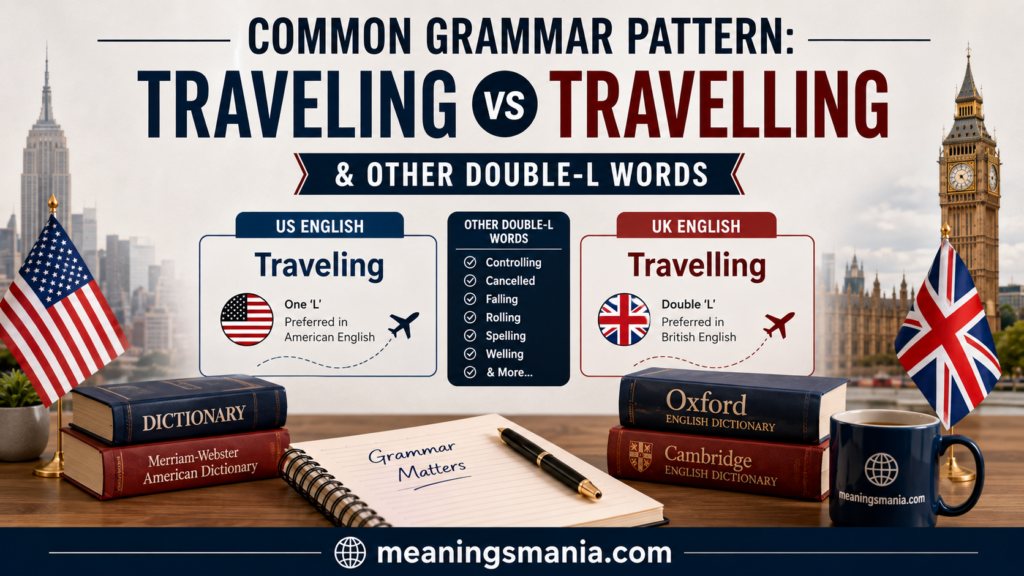
Common Grammar Pattern: Traveling vs Travelling & Other Double-L Words
The cancellation vs cancelation question often gets mixed up with another issue: American and British differences involving doubled consonants.
Consider these common forms:
| US English | UK English |
| canceled | cancelled |
| canceling | cancelling |
| traveled | travelled |
| traveling | travelling |
| labeled | labelled |
| modeling | modelling |
These examples show why the subject can be confusing. American English often drops one “l” before certain endings, while British English commonly retains it.
But Cancellation vs Cancelation is different. The standard noun spelling uses two Ls in both major varieties of English.
So don’t assume that because Americans write canceled, they should also write cancelation. The noun follows its established spelling.
Why This Pattern Matters
Understanding related forms helps you avoid several common mistakes at once.
For example, you might write:
The flight was canceled, but the cancellation was announced late.
That sentence is perfectly natural in American English.
In British English, you could write:
The flight was cancelled, but the cancellation was announced late.
The verb changes, but the noun stays cancellation.
Cancellation vs Cancelation in American English: Which Spelling Is Standard?
In American English, Cancellation vs Cancelation is the standard and much more common spelling.
You may still find cancelation listed as a variant. However, it’s not the spelling most Americans expect to see in polished writing.
This distinction becomes especially important when you’re writing for customers, clients, students, or a large online audience. A familiar spelling creates less friction.
For example, a business would normally write:
Our cancellation policy requires 24 hours’ notice.
That wording looks natural on a website or booking page. Using cancelation instead would likely draw unnecessary attention to the spelling.
When to Use “Cancellation” in Formal Writing
Use cancellation when you’re writing:
- Academic papers
- Business emails
- Website content
- Legal or policy documents
- Customer-service messages
- Travel information
- News or editorial content
- Professional reports
Consistency also matters. If you choose American English for a document, keep your other spelling choices consistent throughout.
For example, don’t switch randomly between canceled and cancelled unless your audience or quotation requires it.
Cancellation Spelling in Business, Travel, and Everyday Writing
You’ll see cancellation in almost every area of modern communication.
In travel, you might receive a flight cancellation or ask about a hotel cancellation policy. In business, a customer may submit a cancellation request for an order or service.
The word also appears in ordinary conversations:
“Did you hear about the cancellation?”
“Yes. The event won’t happen tonight.”
The meaning is usually obvious from the surrounding context. Something that was scheduled or arranged has been called off.
Common Phrases That Use “Cancellation”
Some combinations are particularly common:
- cancellation policy — rules explaining when and how something can be canceled
- cancellation fee — a charge associated with canceling
- cancellation notice — information that something has been canceled
- cancellation request — a request to end or withdraw something
- cancellation date — the date when the cancellation takes effect
- cancellation process — the steps required to cancel something
- subscription cancellation — ending a recurring service
- order cancellation — stopping an order before completion
Knowing these phrases also makes the correct spelling easier to recognize.
Common Mistakes & How to Avoid Them
The biggest mistake is assuming that every word related to cancel follows the same spelling pattern.
For example, an American writer may correctly use canceled but incorrectly assume the noun should be cancelation. That isn’t the standard form.
Other common mistakes include:
- Writing cancelation when cancellation is expected.
- Mixing American and British spelling within the same document.
- Assuming every American spelling removes a double consonant.
- Treating a dictionary variant as equally common.
- Changing the spelling inside a company’s established terminology.
How to Avoid Mistakes
The easiest approach is simple: remember cancellation as the standard noun.
If you’re writing for a specific publication, employer, or academic institution, follow its style guide. Some organizations have their own editorial preferences.
You can also proofread related forms separately:
Verb: canceled/cancelled
Present participle: canceling/cancelling
Noun: cancellation
That small distinction prevents a lot of unnecessary confusion.
Quick Comparison Table
Here’s a more practical comparison of the two spellings:
| Question | Cancellation | Cancelation |
| Is it a real English form? | Yes | Yes, as a variant |
| Is it widely used? | Very widely | Much less often |
| Preferred for general writing? | Yes | Usually no |
| Used in US English? | Yes | Rarely as a variant |
| Used in UK English? | Yes | Very uncommon |
| Suitable for professional content? | Yes | Usually avoid |
| Likely to look familiar? | Yes | Not to most readers |
The key takeaway is that the two forms aren’t equal in everyday usage. Cancellation is the form you’ll want in almost every normal writing situation.
Final Verdict: Which Should You Use in 2026?
If you’re deciding between cancellation vs cancelation, choose cancellation.
It’s the familiar, standard spelling used across American and British English. It works naturally in professional, academic, business, travel, and everyday writing.
Cancellation vs Cancelation does exist as a less common variant, so calling it completely nonexistent would be inaccurate. Still, there’s rarely a practical advantage to using it when the standard spelling is so well established.
Cancellation
Remember the spelling this way:
Cancellation = cancel + lation
More importantly, remember the finished word rather than trying to force it through a complicated spelling rule.
When you need to write about a canceled appointment, a canceled flight, or a canceled subscription, the noun is:
cancellation
That spelling will look familiar to your readers and fit naturally into professional writing.
Cancellation vs Cancelation – Which Should You Use?
Still wondering which is correct, cancellation or cancelation? For almost every ordinary writing situation, cancellation is the answer.
The one-L form, cancelation, is recognized in some sources as a variant, but it remains uncommon. That makes it a poor choice when you want your writing to look natural and polished.
So, whether you’re writing a cancellation policy, sending a cancellation notice, or discussing an event cancellation, stick with the double-L spelling.
Cancellation is the clear, familiar choice.
FAQ’s
Is cancelation a correct spelling?
Yes, cancelation is recognized as a rare variant, but cancellation is the standard spelling most readers expect.
Why does cancellation have two Ls?
Cancellation vs Cancelation has two Ls because that established noun spelling has been retained in standard English usage.
Is cancellation spelled differently in American English?
No. American English generally uses cancellation, although the related verb forms often use one L.
Which is more common, cancellation or cancelation?
Cancellation is considerably more common and is the preferred form for general, professional, and formal writing.
Should I write cancellation or cancelation in business content?
Use Cancellation vs Cancelation because it’s familiar, professional, widely accepted, and unlikely to distract readers with an unusual spelling.
Is cancelation used in British English?
It can occasionally appear, but cancellation is the normal British English spelling and should be your default choice.
Does canceled follow the same spelling as cancellation?
No. American English commonly spells the verb canceled, while the noun remains cancellation with two Ls.
Conclusion
When you compare Cancellation vs Cancelation , the choice is simple for most writing. Cancellation is the standard spelling and the one readers expect. Cancellation vs Cancelation can appear as a rare variant, but it may look unusual. The same attention to detail helps with other common questions, such as long-term versus long term. Knowing when to use each form makes your writing cleaner and more confident.
Small language questions can cause surprising confusion. You might wonder about ofcourse or of course, for example, or ask how long is soon when someone gives an unclear time estimate. These Cancellation vs Cancelation have straightforward answers once you understand their normal usage. You don’t need complicated grammar rules to write naturally. A few simple patterns can make a big difference.
In the end, choose words that are clear, familiar, and easy to understand. Use cancellation when you need the noun form of cancel. Keep long-term for its adjective use and long term when it functions as a noun phrase. Write of course as two words. With these basics in mind, your everyday and professional writing will feel much more polished.
