


Choosing the right word can be harder than it looks. Some English terms seem interchangeable, yet their meanings change with context. That’s especially true when comparing “inactivate vs deactivate.” Knowing the small difference can help you sound clearer and avoid awkward mistakes.
English also has plenty of confusing spellings and phrases. You might wonder whether “wether” is correct, search for the “well said meaning,” or ask about “sleave vs sleeve.” These questions look simple, but each has a useful answer. Learning them through examples makes the rules easier to remember.
You may also come across questions like “what does myf mean” or “cacoon or cocoon” while texting, reading, or writing online. Don’t worry if these Inactivate vs deactivate leave you unsure. In this guide, you’ll learn how to use each expression naturally, understand common mistakes, and choose the right word with confidence.
Origins and Evolution of Deactivate and Inactivate
Both words are built around the idea of changing something from an active state to an inactive one. However, they developed slightly different patterns of use in modern English.
Deactivate combines de- with activate and generally suggests reversing or stopping an active function. It became especially common with machines, electronic systems, security equipment, accounts, and other things people can control.
Inactivate uses in- with activate. English speakers often use it when something is rendered inactive through a process or condition rather than simply switched off.
Today, you’ll see the distinction most clearly by looking at the context:
- Deactivate → accounts, devices, systems, alarms, features
- Inactivate → viruses, enzymes, genes, proteins, biological processes
- Both → some technical situations can reasonably use either term
So, the difference isn’t just about the words themselves. It’s also about established usage in a particular field.
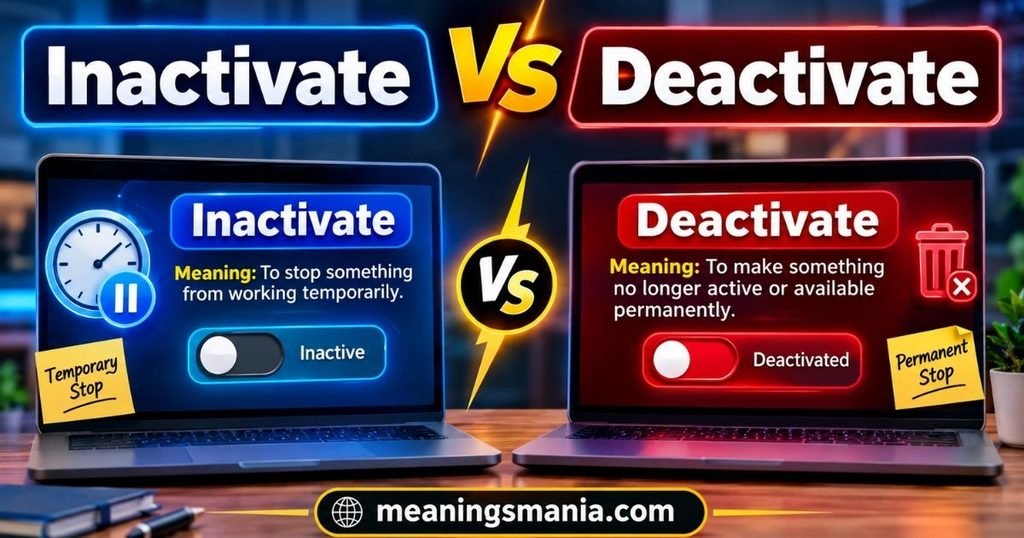
Deactivate vs Inactivate: Core Meaning and Differences
The easiest way to understand inactivate vs deactivate is to focus on what happens to the thing being changed.
Deactivate
Deactivate means to stop something from operating, functioning, or being active. It often describes an intentional action.
For example:
- You deactivate an account when you want to stop using it temporarily.
- You deactivate a security alarm before entering a protected area.
- You deactivate a feature that you don’t want enabled.
- You deactivate a device when you need to take it out of service.
The word is especially natural in everyday English and technical contexts involving controllable systems.
Inactivate
Inactivate means to make something inactive or reduce its activity. The term appears frequently in scientific, medical, biological, and laboratory writing.
For example:
- Researchers can inactivate a virus under controlled conditions.
- Heat may inactivate an enzyme.
- Scientists can inactivate a gene to study its role.
- A chemical treatment may inactivate a biological agent.
In these examples, the focus isn’t simply on pressing an off button. Instead, the subject becomes inactive because of a biological, chemical, genetic, or controlled process.
Deactivate vs Inactivate at a Glance
| Point | Deactivate | Inactivate |
| Basic idea | Stop or disable activity | Make something inactive |
| Common setting | Everyday and technical use | Scientific and formal use |
| Often used with | Accounts, devices, systems | Viruses, enzymes, genes |
| Typical action | Deliberate shutdown or disabling | Controlled reduction or removal of activity |
| Common tone | General and practical | Technical or scientific |
There’s some overlap, though. English doesn’t always create a strict boundary between these verbs.
Everyday and Technical Uses of Deactivate
Deactivate is the more familiar choice in everyday conversation. If you’re talking about something you can switch off, disable, or suspend, this word will often sound natural.
You’ll commonly encounter it in technology, online services, security, and equipment instructions.
For example, a website might tell you to deactivate an account before permanently deleting it. A phone might let you deactivate a particular setting. Likewise, a security professional might deactivate an alarm system after receiving authorization.
Deactivate Examples in Real-World Situations
Here are some natural examples:
- “I decided to deactivate my social media account for a few weeks.”
- “Please deactivate Bluetooth when you aren’t using it.”
- “The technician deactivated the system before beginning maintenance.”
- “You can deactivate notifications from the settings menu.”
- “The security team deactivated the alarm after checking the building.”
Notice the common Inactivate vs deactivate: someone intentionally changes the operational status of something.
That’s why deactivate a device, deactivate an account, and deactivate a feature sound completely natural.
Scientific and Formal Uses of Inactivate
Scientific writing often favors inactivate when researchers describe a substance, organism, molecule, gene, or biological function becoming inactive.
For example, scientists may discuss virus inactivation when describing a process that removes a virus’s ability to reproduce or cause its usual biological effects.
The Inactivate vs deactivate pattern appears with enzymes and genes. An enzyme can lose its activity under certain conditions, while researchers may deliberately inactivate a gene to observe what changes inside an organism or cell.
Key Scientific and Technical Areas
You’ll often find inactivate in areas such as:
- Biology: inactivating genes or biological agents
- Virology: inactivating viruses
- Biochemistry: inactivating enzymes or proteins
- Medicine: describing the loss of biological activity
- Chemistry: reducing or eliminating the activity of certain substances
- Research: deliberately removing a biological function for study
For instance, inactivate an enzyme is more natural in a laboratory discussion than deactivate an enzyme.
That doesn’t mean the second phrase is impossible. It simply isn’t the usual technical choice.
Deactivate vs Inactivate Examples Table
| Situation | More Natural Choice | Example |
| Online account | Deactivate | “She deactivated her account.” |
| Phone feature | Deactivate | “Deactivate location sharing.” |
| Security alarm | Deactivate | “The technician deactivated the alarm.” |
| Virus | Inactivate | “The treatment inactivated the virus.” |
| Enzyme | Inactivate | “Heat inactivated the enzyme.” |
| Gene | Inactivate | “The researchers inactivated the gene.” |
| Biological activity | Inactivate | “The process inactivated the biological agent.” |
This table isn’t a rigid grammar law. Context matters, but these choices match common usage.
Common Mistakes When Using Deactivate and Inactivate
One common mistake is assuming that the two words are perfect synonyms. Inactivate vs deactivate share a basic concept, but their usual contexts differ.
For example, saying “I inactivated my Instagram account” may be understandable, but “I deactivated my Instagram account” sounds much more natural in everyday English.
Likewise, “the virus was deactivated” may communicate the general idea, but scientific writing would typically use “the virus was inactivated.”
Another mistake involves assuming that deactivate always means permanent removal. It doesn’t. An account or feature can be deactivated temporarily and later restored.
Keep these points in mind:
- Don’t choose a word based only on its literal prefix.
- Consider the noun that follows the verb.
- Follow the terminology normally used in that field.
- Remember that everyday English and scientific English may prefer different terms.
Why Using the Wrong Word Can Cause Confusion
In casual conversation, choosing the less common word usually won’t create a serious problem. Most people will understand what you mean.
However, precision matters more in professional or technical writing. A scientific paper, laboratory procedure, software manual, or medical document needs terminology that readers recognize immediately.
Imagine reading an experiment that repeatedly refers to an enzyme being “deactivated.” You may understand the general meaning, but “inactivated” better signals the scientific process being discussed.
The Inactivate vs deactivate principle works in reverse. If an app asks you to deactivate your account, replacing that wording with inactivate would sound unusual to most users.
The goal isn’t to memorize a complicated rule. It’s to use the word that naturally belongs with the subject.

How to Choose Between Deactivate and Inactivate
When you’re unsure, ask yourself one simple question:
Am I talking about switching off or disabling something, or am I describing something becoming inactive through a process?
Choose deactivate when you’re discussing:
- Accounts
- Devices
- Apps
- Features
- Alarms
- Security systems
- General services
Choose inactivate when you’re discussing:
- Viruses
- Enzymes
- Genes
- Proteins
- Biological agents
- Biological activity
- Scientific processes
For example, you’d say:
“I need to deactivate my account.”
But you’d usually write:
“The treatment was used to inactivate the virus.”
This simple distinction will handle most everyday situations.
Real-World Examples of Deactivate vs Inactivate
Seeing the words in realistic situations makes their difference easier to remember.
Technology: Deactivating Social Media Accounts
Social media platforms commonly use deactivate when users temporarily stop an account or disable a service.
You might say:
“I’m taking a break from social media, so I deactivated my account.”
Here, the account isn’t being described as a biological or chemical object. It’s a user-controlled service being disabled or suspended.
You can also deactivate certain settings, notifications, or features depending on the platform.
Science: Inactivating Viruses for Vaccines
In scientific contexts, inactivate has a more specialized role. Researchers can describe a virus as inactivated when a process removes its ability to carry out its normal infectious activity.
The important point is that inactivated describes a change in biological activity. It isn’t simply the same as switching off an electronic device.
This is why scientific writing commonly uses terms such as virus inactivation and inactivated virus.
Military: Deactivating Devices and Equipment
In security and military-related contexts, deactivate can describe taking equipment or systems out of active operation.
For example, a technical team might deactivate a system before maintenance or storage.
In safety-sensitive situations, however, the exact terminology depends on the equipment, procedure, and professional standards involved. Don’t treat general English usage as a substitute for official safety instructions.
Deactivate vs Inactivate in Different Fields
The preferred word can shift when you move from one field to another. That’s one reason dictionary-style definitions alone don’t always settle the question.
In technology, deactivate dominates because users regularly disable accounts, features, connections, and devices.
In biology and medicine, inactivate appears frequently because researchers describe changes in biological activity. Formal technical writing also tends to preserve field-specific terminology.
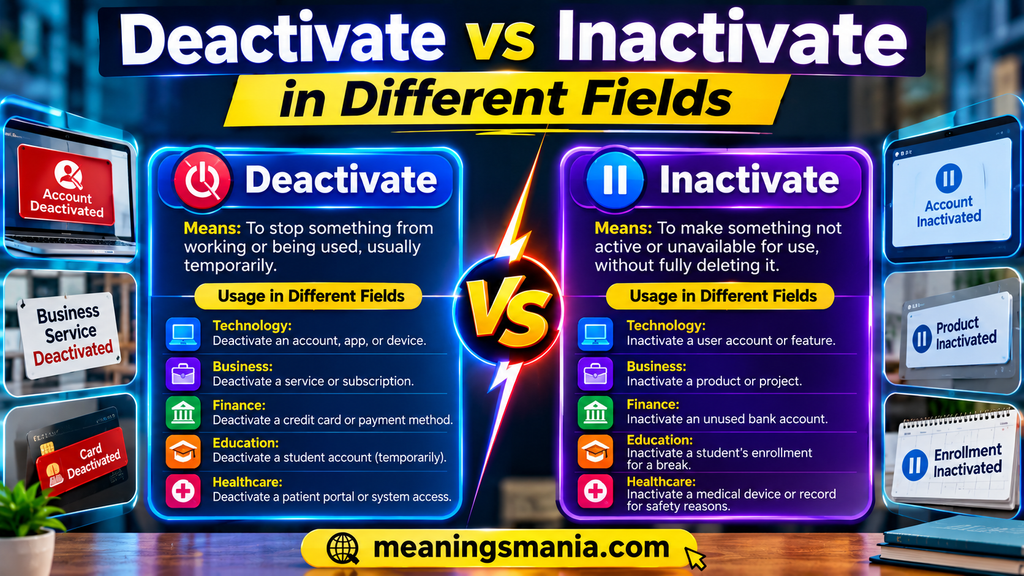
Which Word Fits Technology, Science, and Everyday English?
Here’s a quick way to think about it:
Technology:
“Deactivate the account.”
Everyday English:
“Deactivate the notification.”
Security:
“Deactivate the alarm.”
Biology:
“Inactivate the enzyme.”
Virology:
“Inactivate the virus.”
Genetics:
“Inactivate the gene.”
If you’re writing for a specialized audience, use the terminology that professionals in that field normally expect.
Is Deactivate or Inactivate More Common in English?
Deactivate is generally more familiar in everyday English. People regularly encounter it in apps, websites, electronics, security systems, and instructions.
Inactivate is less common in casual conversation but remains important in scientific and technical writing. You’ll see it much more often when the subject involves biological or chemical activity.
That doesn’t make inactivate a weaker version of deactivate. The words simply have different usage patterns.
For general writing, think deactivate first when you’re talking about something being switched off or disabled. Think inactivate when scientific terminology calls for it.
How to Remember the Difference Between Deactivate and Inactivate
A quick memory trick can help:
D = Disable or Device
I = Inactive or In Science
This isn’t a formal grammar rule. It’s simply an easy reminder.
If you can picture someone clicking a button, deactivate will often fit.
If you can picture a researcher studying biological activity, inactivate is usually the better choice.
For example:
- Deactivate an account.
- Deactivate a device.
- Deactivate an alarm.
- Inactivate a virus.
- Inactivate an enzyme.
- Inactivate a gene.
Once you see these combinations a few times, the distinction becomes much easier.
Simple Rule for Choosing the Correct Term
Use this shortcut:
Deactivate = switch off, disable, or suspend.
Inactivate = make inactive, especially in a scientific or biological process.
There are exceptions and areas of overlap, so don’t force the rule when established terminology says otherwise.
When you’re editing a sentence, look at the noun first. The noun often tells you which verb sounds natural.
Practical Exercises to Test Your Understanding
Try choosing the better word before checking the answers.
- “I want to ___ my online account for a month.”
- “The researchers ___ the gene before studying the cells.”
- “Please ___ the alarm before maintenance begins.”
- “The treatment ___ the virus.”
- “She ___ notifications on her phone.”
Answers:
- Deactivate
- Inactivate
- Deactivate
- Inactivate
- Deactivate
These examples show why context matters more than simply memorizing two dictionary definitions.

Mini Comparison Table: Deactivate vs Inactivate
| Word | Best General Use | Example |
| Deactivate | Disable or stop something | “Deactivate the account.” |
| Inactivate | Make something biologically or functionally inactive | “Inactivate the enzyme.” |
| Deactivate | Turn off a feature or system | “Deactivate the alarm.” |
| Inactivate | Remove biological activity | “Inactivate the virus.” |
FAQ’s
What is the difference between inactivate and deactivate?
Deactivate usually means disable or turn something off, while inactivate commonly describes making something inactive through a scientific process.
Is inactivate a real English word?
Yes, inactivate is a standard English verb, especially common in scientific, medical, biological, and technical writing.
Is it correct to say deactivate an account?
Yes, “deactivate an account” is natural and widely understood when describing temporary suspension or disabling of online access.
Should I say inactivate a virus or deactivate a virus?
Inactivate a virus is the standard scientific expression because it describes removing or reducing the virus’s biological activity.
Can deactivate and inactivate be used interchangeably?
Sometimes, but context matters; established terminology often makes one choice sound much more natural than the other.
Is deactivate more common than inactivate?
Inactivate vs deactivate is generally more common in everyday English, while inactivate appears more frequently in specialized scientific contexts.
What is the easiest way to remember inactivate vs deactivate?
Think “deactivate” for devices and accounts, and “inactivate” for biological or scientific activity when choosing between them.
Conclusion
Choosing between inactivate vs deactivate is easier when you understand how each word works. They can look similar, but context often decides the better choice. Simple explanations can help you write with confidence and avoid mistakes.
Language questions can feel small, yet they matter in everyday writing. You may wonder about wether, well said meaning, or sleave vs sleeve. You might also ask what does myf mean when reading texts or social posts. Each Inactivate vs deactivate has its own use, spelling, or meaning. Checking context usually makes the answer clearer.
The inactivate vs deactivate goes for confusing spellings such as cacoon or cocoon. Small details can change how polished your writing feels. Keep a reference nearby, but don’t overthink every word. When you understand the difference and use each term naturally, your writing becomes clearer. That confidence makes grammar questions easier to handle.
