


If you’re unsure whether to write inquire or enquire, you’re dealing with a common English spelling question. Both words are correct, and both relate to asking for information. The main difference comes from regional English and, in some contexts, the level of formality or the specific sense intended.
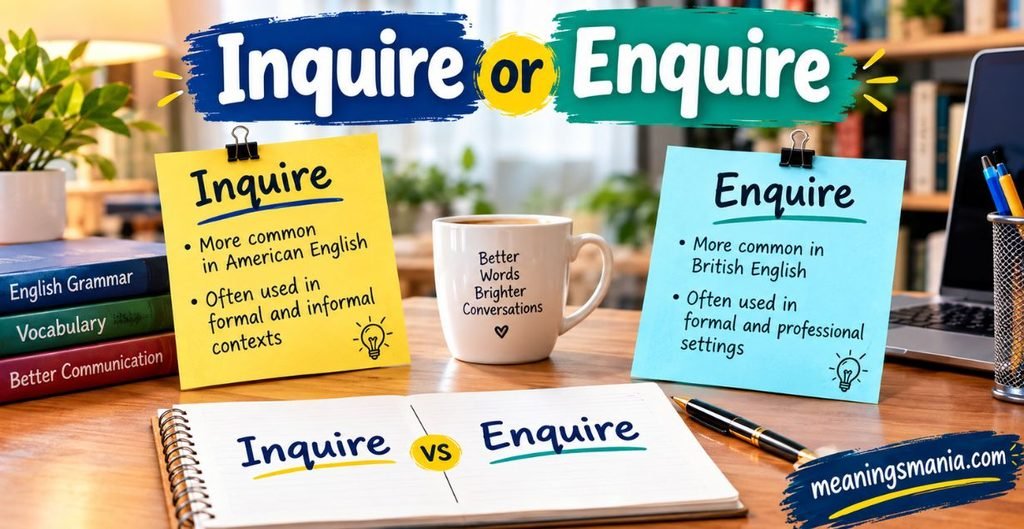
In American English, inquire is the usual choice. In British English, enquire is common, especially when someone simply wants to ask a question. You may also see inquiry and enquiry, which follow the same spelling pattern. Once you understand the basic distinction, choosing the right form becomes much easier.
Quick Answer: Inquire vs Enquire
The short answer is simple: inquire and enquire can both mean “to ask for information.” Neither spelling is automatically wrong.
For most everyday writing, your choice depends on the variety of English you’re using:
- Inquire — strongly associated with American English.
- Enquire — commonly used in British English.
- Inquiry — the noun commonly used in American English.
- Enquiry — the corresponding British spelling.
For example, an American writer might say, “I’d like to inquire about the course.” A British writer may write, “I’d like to enquire about the course.”
A Simple Background of “Inquire” and “Enquire”
The words inquire and enquire have a shared history. Both developed from older forms of English and ultimately trace back to Latin inquirere, meaning to seek information or investigate. Over time, English developed different spelling preferences in different regions.
That history explains why the two forms look so similar. They’re not completely unrelated words that happened to develop the same meaning.
Today, regional usage is the easiest way to understand them. American English generally favors inquire, while British English commonly uses enquire. However, British English also uses inquire, particularly in more formal or investigative contexts.
Clear Difference Between Inquire and Enquire
The difference between inquire and enquire isn’t always as large as people expect. In many situations, both words simply mean to ask about something.
The bigger distinction is often regional. American English tends to use inquire broadly, while British English commonly uses enquire for ordinary questions.
“Inquire” Meaning and Usage
Inquire means to ask for information about something. It can appear in everyday conversation, professional communication, customer service, and formal writing.
For example:
- “I called to inquire about the appointment.”
- “She inquired about the application process.”
- “We need to inquire about the delivery date.”
In American English, this spelling is the natural choice in most contexts. It can also describe a more formal investigation, depending on the sentence.
“Enquire” Meaning and Usage
Enquire also means to ask for information. It’s especially familiar in British English.
For example:
- “I’d like to enquire about your services.”
- “She enquired about the available rooms.”
- “He called to enquire about the schedule.”
So, if you’re writing for a British audience, enquire may sound more natural for an ordinary question.
The Important Difference to Remember
Here’s the part that causes the most confusion: inquire and enquire can overlap in meaning.
In British English, there’s also a traditional distinction between enquire for asking a question and inquire for conducting a formal investigation. That distinction isn’t universal, though, and modern usage varies.
So don’t treat the distinction as an absolute grammar rule. Your audience and the context of the sentence matter more.
Inquire vs Enquire Comparison Table
| Feature | Inquire | Enquire |
| Basic meaning | Ask for information | Ask for information |
| Common regional use | American English | British English |
| Formal writing | Very common | Also acceptable |
| Everyday questions | Common | Common, especially in British English |
| Related noun | Inquiry | Enquiry |
| Example | Inquire about fees | Enquire about fees |
The table shows why the correct spelling of inquire or enquire depends largely on your English variety. Both forms are understood by English speakers.
Which One Should You Use and When?
Choosing between the two doesn’t need to be complicated. First, think about who will read your writing. Then consider whether you’re following American or British English conventions.
If you’re writing for an international audience, either form can work. The important thing is to avoid switching randomly between regional styles.
Use “Inquire” When You Need Information
Choose inquire when you’re using American English or following an American style guide.
It’s particularly natural in professional communication:
- “I’d like to inquire about your pricing.”
- “Please inquire at the information desk.”
- “She inquired about the position.”
If your website, business documents, or other content already uses American spelling, inquire is usually the safer choice.

Use “Enquire” for General Questions
Use enquire when writing in British English, particularly when you’re simply asking for information.
For example:
- “I’d like to enquire about the course.”
- “She enquired about the price.”
- “Could you enquire about availability?”
This is why you’ll often see enquire in British websites, correspondence, and customer-service language.
The Best Choice for Everyday Writing
The best choice isn’t necessarily the one you personally prefer. Match the spelling to the audience you’re addressing.
For example, if you’re writing an American business email, inquire will usually fit better. If you’re writing for a British audience, enquire may feel more natural.
The same principle applies to related spellings. Try to keep inquiry or enquiry consistent with your chosen English variety.
Common Mistakes With Inquire and Enquire
People often make the same few mistakes when learning these words. Most are easy to avoid once you understand regional usage.
Mistake 1: Assuming One Spelling Is Wrong
Neither inquire nor enquire is simply “incorrect.” Both have legitimate uses in English.
The mistake is assuming that a different regional spelling must be a typo. English has many regional variations, including differences in words such as color/colour and center/centre.
Mistake 2: Mixing American and British English
Mixing regional spelling conventions can make your writing feel inconsistent.
For instance, using inquire throughout an otherwise British-English document isn’t necessarily grammatically wrong, but it may clash with the style you’re following.
If consistency matters, choose one variety and stick with it.
Mistake 3: Overthinking the Difference
You don’t need to stop every time you write a question and wonder which spelling is “more correct.”
Ask yourself two simple questions:
- Who is going to read this?
- Which English style am I following?
That usually gives you the answer immediately.
Real-Life Examples of Inquire and Enquire
Seeing these words in realistic situations makes their usage much easier to understand.

In Professional Emails
Both forms work naturally in professional communication.
American English:
“I’m writing to inquire about the status of my application.”
British English:
“I’m writing to enquire about the status of my application.”
The meaning stays essentially the same. The spelling reflects the English variety.
In Job and Business Situations
You might use these words when asking about a position, service, meeting, or business opportunity.
For example:
- “I’d like to inquire about the marketing position.”
- “She enquired about the interview process.”
- “We contacted the company to inquire about pricing.”
- “He called to enquire about the contract.”
These examples show how naturally both forms can appear in professional writing.
In Customer Service
Customer-service conversations frequently involve asking for information.
You might write:
- “I’d like to inquire about my order.”
- “Could you enquire about the missing package?”
- “I called to inquire about your return policy.”
The surrounding context tells the reader what you’re asking about.
In Everyday Conversations
These words can also appear in ordinary situations, although ask is often more casual.
For example:
- “I want to inquire about the opening hours.”
- “She enquired about the nearest station.”
- “Can you inquire about the price?”
In casual conversation, saying “Can you ask about the price?” often sounds more relaxed. Inquire and enquire can sound slightly more formal depending on the sentence.
Inquire vs Enquire in American and British English
Regional usage is one of the biggest reasons people search for inquire vs enquire in American English and inquire vs enquire in British English.
American English generally prefers inquire and inquiry. British English commonly uses enquire and enquiry, particularly for ordinary requests for information.
However, British English isn’t limited to enquire. You’ll still encounter inquire, especially when the word has a more investigative or formal sense.
Which Spelling Is More Common in American English?
Inquire is the standard spelling in American English.
You may see it in business emails, websites, customer-service messages, school writing, and formal documents.
For example:
“Please inquire about registration requirements.”
The noun is usually inquiry:
“We received an inquiry about the program.”
Which Spelling Is Preferred in British English?
Enquire is widely used in British English for ordinary requests for information.
For example:
“Please enquire at the reception desk.”
The related noun is commonly enquiry:
“We received an enquiry about the service.”
British English can also use inquire and inquiry, especially when referring to formal investigation or established terminology.
Does the Meaning Change by Country?
Usually, no major meaning change occurs simply because you cross the Atlantic.
The words still relate to seeking information. What changes most noticeably is spelling preference and, in some British usage, the distinction between ordinary questions and formal investigations.
That’s why context matters more than memorizing a rigid rule.
How to Remember the Difference Between Inquire and Enquire
A simple memory trick can make this much easier.
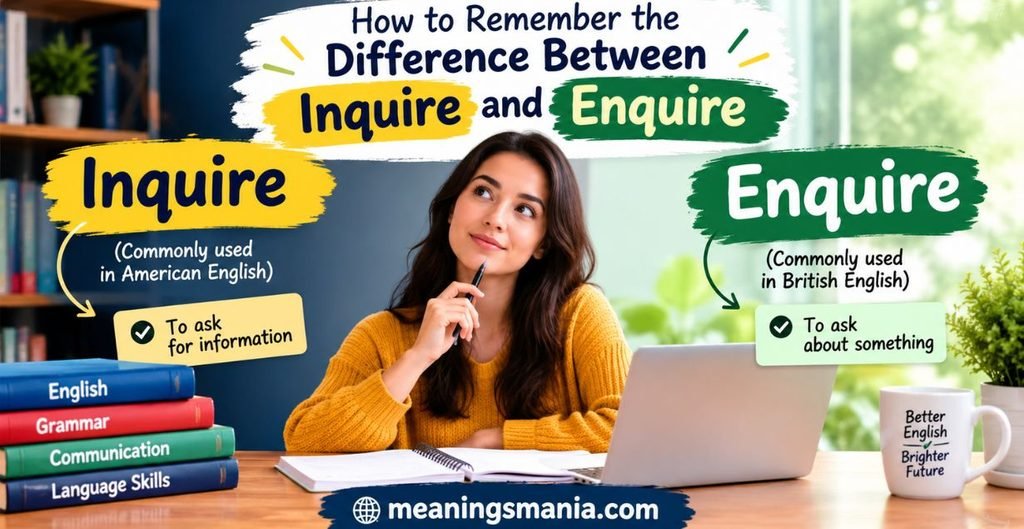
Think of the I in inquire as a reminder of American English. Think of the E in enquire as the form you’ll commonly encounter in British English.
Step 1: Think About Your Writing Style
First, identify your English variety.
- American English → inquire
- British English → enquire for many ordinary questions
This quick check will solve most situations.
Step 2: Check the Context
Ask what you’re trying to say. Are you simply requesting information, or are you referring to a formal investigation?
For a basic question, either regional form may work. In British usage, inquire can carry a more investigative sense in some contexts.
Step 3: Stay Consistent
Once you’ve chosen a style, apply it throughout the same piece of writing.
For example, if you’re using American English spelling, use:
- inquire
- inquiry
If you’re following British conventions, you may use:
- enquire
- enquiry
Practice With Simple Examples
Try completing these sentences with inquire or enquire:
- “I’d like to ______ about the course.”
- “She called to ______ about the price.”
- “Please ______ at the front desk.”
All three can take either spelling. Your choice should match the English style you’re using.
Is Inquire or Enquire More Correct?
Neither word is universally more correct. Inquire is the standard choice in American English, while enquire is widely used in British English.
There is also a useful British-English distinction worth knowing. Enquire can refer to asking for information, while inquire may be used for a formal investigation. Still, real-world usage isn’t perfectly rigid.
So, if someone asks, “Inquire or enquire which is correct?” the best answer is: both can be correct, depending on regional and contextual usage.
Can “Inquire” and “Enquire” Be Used Interchangeably?
In many sentences, yes. Both can describe the act of requesting information.
For example, these sentences communicate essentially the same idea:
- “I called to inquire about the appointment.”
- “I called to enquire about the appointment.”
The main difference is the spelling convention and, sometimes, the intended sense.
Inquire vs Enquire in Emails, Letters, and Formal Writing
Both words appear in professional correspondence. Your choice should follow the style of English used by your organization, publication, or audience.
If you’re writing a US-based business email, inquire is generally the natural option. In UK-based correspondence, enquire is often preferred for a straightforward request.
Which Word Should You Use in a Formal Email?
For American business writing, you can safely write:
“I’m writing to inquire about the available positions.”
For British business writing, you could write:
“I’m writing to enquire about the available positions.”
Neither sentence sounds strange within its respective variety of English.
Inquire vs Enquire: Quick Examples to Avoid Confusion
The easiest way to remember the difference is to see both words side by side.
Easy Sentences Using “Inquire” and “Enquire”
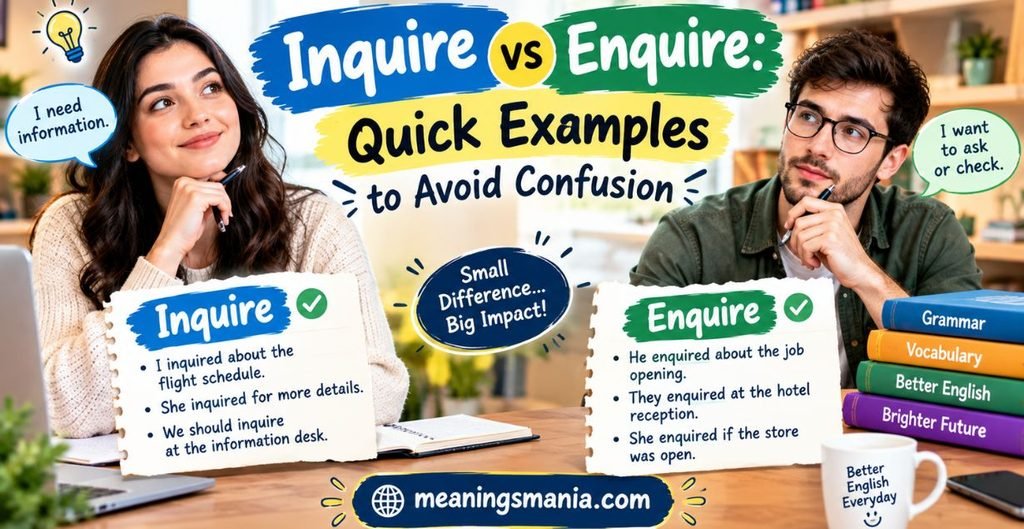
American English examples:
- “I’d like to inquire about the payment options.”
- “She inquired about the meeting time.”
- “Please inquire with the admissions office.”
British English examples:
- “I’d like to enquire about the payment options.”
- “She enquired about the meeting time.”
- “Please enquire at the reception desk.”
Notice that the sentence structure doesn’t need to change. Usually, only the preferred spelling changes.
FAQs About Inquire or Enquire
Is “inquire” correct in English?
Yes, inquire is correct English and is especially common in American English for asking about information or details.
Is “enquire” correct in British English?
Yes, enquire is widely accepted in British English, particularly when someone asks for general information.
What is the main difference between inquire and enquire?
The main difference is regional spelling, although British English sometimes distinguishes ordinary enquiries from formal investigations.
Should Americans use inquire or enquire?
Americans generally use inquire, especially in professional writing, customer communication, formal requests, and standard American English.
Should British writers use inquire or enquire?
British writers commonly use enquire for general questions, while inquire may appear in formal investigative contexts.
Is inquiry the same as enquiry?
Both nouns refer to requests for information, but inquiry is standard in American English and enquiry is common in British English.
Can I use inquire and enquire in the same document?
You can, but consistency is usually better. Choose the spelling that matches your audience, style guide, and overall English variety.
Conclusion
The choice between Inquire or Enquire is easier once you focus on audience and context. Both words relate to asking for information, and neither spelling is simply wrong.
For American English, inquire is generally the preferred form. For British English, enquire is common for ordinary questions, while inquire can appear in more formal investigative contexts. The related nouns follow the same pattern: inquiry and enquiry.
When you’re unsure, don’t overthink it. Check which English style you’re using, choose the appropriate form, and stay consistent. That’s the simplest way to handle enquire vs inquire in everyday and professional writing.
